

Nonprofit Branding Strategy: What Your Brand System Needs to Connect
By Olú Alawonde
Published
Updated 15-minute read
For nonprofit and social-impact leaders with disconnected messages, proof, stories or public materials, this guide explains what a nonprofit branding strategy should connect and helps the team choose the first break to repair.
Resume reading
Your nonprofit can be doing important work and still describe itself differently from one page, proposal or conversation to another.
The signs are usually ordinary. Two team members describe the organization differently. A proposal cites results that the website never shows. The latest campaign introduces a new tagline. A partner reads the annual report, visits the website and cannot tell which next step makes sense.
None of this means the mission is weak. It means the website, proposals, reports, presentations, social posts and staff descriptions may be working from different decisions.
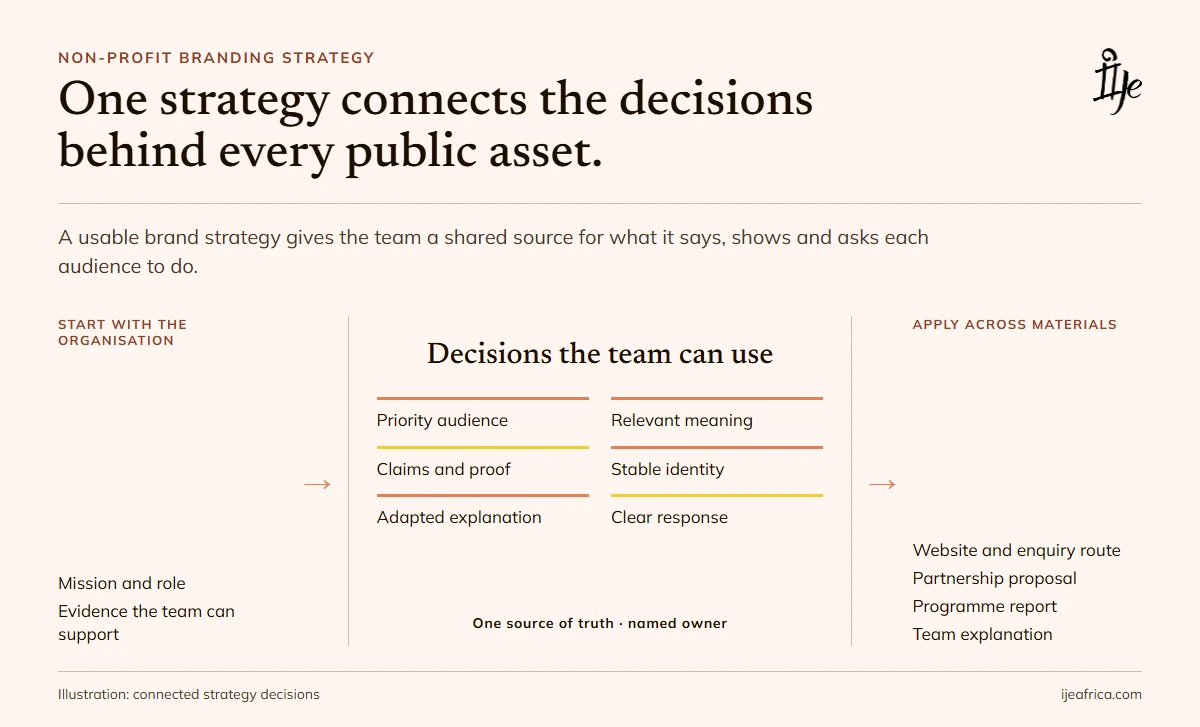
Branding strategy records the thinking those materials should share. It records what the organization stands for, who needs to understand it, what the organization can prove, how staff should explain it and where each audience should go next.
At Ije, we use the Brand-Power Gap to describe the distance between the impact an organization creates and its ability to turn that impact into visibility, trust, support and sustained advantage. The gap often appears when useful knowledge and evidence have not entered public materials, necessary assets do not exist, or existing materials contradict one another.
A branding strategy identifies those missing or contradictory decisions and helps the team decide which one to repair first. It cannot decide how every audience will respond. It records the description staff should use, identifies the evidence behind each public claim and states the next step each audience-facing asset should offer.
What should a nonprofit branding strategy help your team decide?
A logo is one answer in a much larger set of decisions.
Before a designer chooses a typeface or a communications lead plans a campaign, the team needs to settle several connected decisions.
| Decision | Required answer |
|---|---|
| Mission and role | The change the organization exists to pursue and the part it can honestly claim in that work. |
| Priority audience | The people whose understanding or action matters in the situation being addressed. |
| Meaning | What that audience needs to understand about the problem, the organization and its relevance. |
| Claims and proof | What the organization can say, the source behind it and the limits of the evidence. |
| Consistency and adaptation | What must remain the same across materials and what can change for a particular audience or use. |
| Response | What a person can reasonably do after encountering the organization. |
| Ownership | Who approves, updates and withdraws each description, figure, image, page or template. |
Scroll sideways to read the full table.
One answer affects the others. If the team has not chosen the audience, it writes a general message. If the evidence is difficult to find, it may ask one personal story to support claims about the whole organization. If the website and proposal ask people to take different next steps, attracting more attention sends more people into the same confusion.
The strategy records the team’s decisions. It states what should remain stable, what can change for a particular audience and who must update each asset. A programme lead should be able to describe the work without contradicting the website. A partnership deck should use evidence from the same verified records as the annual report. A campaign can take a fresh angle without inventing a new identity every time.
This internal use is not a side benefit. For an 18-month study published by Stanford Social Innovation Review, Nathalie Kylander and Christopher Stone interviewed 73 nonprofit executives, communications directors, consultants and donors across 41 organizations. The leaders described brand as more than a fundraising device. They were also using it to clarify identity, strengthen cohesion, protect mission focus and support choices about programmes and partnerships. That research does not settle what every Nigerian nonprofit should do, but it gives us a better question than “Do people like the logo?” Can staff use the brand to make the same organization recognisable through different kinds of work?
Imagine a programme manager preparing for a partner meeting. She should not need to invent a new organizational description because the existing one was written for donors. The strategy should tell her which part of the mission is relevant, which role the organization can claim, which programme evidence is current and what the partner can reasonably do next. She may change the order and detail for the meeting. She should not have to change the organization’s identity.
This is why brand belongs in organizational decision-making. Visual work matters, but a designer cannot resolve an audience, message or proof decision that the organization has left open.
Audit your nonprofit brand before commissioning new work
When an organization feels invisible, the first instinct may be to commission a new website, campaign, content plan, video or identity.
Sometimes a new asset is needed. First, find out whether the real problem is an absent asset, a useful one that has never been made public, or several existing assets that contradict one another.
This is also how experienced charity-brand practitioners approach the work. CharityComms’ Brand 360 Guide begins with discovery: the organization’s strategy, existing audience research, current materials, peers and stakeholder input. It also makes the relationship between organizational and brand strategy explicit. The audit below turns that broad professional practice into a first check a small team can run before it writes a design brief or approves a new campaign.
Ije describes these conditions as latent, missing and disconnected.
| Condition | What it looks like in practice | What to do next |
|---|---|---|
| Latent | Programme staff can explain the work clearly and point to delivery records, research or feedback, but approved messages and public materials do not use that knowledge. | Recover it, verify it and turn it into an asset the team can use. |
| Missing | The organization has never chosen a priority audience, agreed on a core description, defined acceptable proof or built a useful response path. | Make the decision or create the necessary asset before increasing activity. |
| Disconnected | The website, proposal, report and team descriptions use different claims or lead people towards unrelated next steps. | Choose the controlling source and repair one route from first encounter to response. |
Scroll sideways to read the full table.
Take one recent piece of work and test it. If it is a partnership proposal, ask where its description of the organization came from. Check whether the evidence has a source and date. Compare its language with the website. Follow every link or requested action. Note where the explanation changes, where proof disappears and where the pathway stops.
This audit may show that branding is not the main problem. Programme quality, governance, finance, safeguarding and delivery capacity need their own work. Use branding to improve how people understand the organization and how they can respond. Take programme, governance, finance, safeguarding or delivery failures to the people responsible for those areas.
The point is to commission the right work. A new template will not choose the audience. More social posts will not supply evidence for an unsupported claim. Find the unresolved decision first so the team does not repeat the same problem in a new format.
How mission, audience, proof, story and identity work together
A useful nonprofit brand system records the team’s decisions about the organization. Staff then apply those decisions to the questions and choices of a particular audience.
Mission and role state what the organization is trying to change and the part it plays. Staff can then explain the work without taking credit for change created with participants, partners, communities and wider systems.
Audience and position determine which part of the work to explain. “The public” is too broad to guide most decisions. A participant, institutional partner, individual donor, customer, policymaker or peer organization may approach the same work with a different question. The team must decide which value and distinction matter in that situation and support both with what the organization can show.
That does not mean manufacturing a different identity for each audience. It means keeping the organization’s role stable while changing the detail, evidence and next step to suit the decision in front of the reader.
A prospective participant may need to know who qualifies, what taking part involves and whether the service is safe and accessible. A foundation may need to understand the programme logic, governance, evidence and fit with its funding priorities. An employer considering a partnership may care about the people being prepared, the organization’s role in that preparation and what the employer would have to contribute. Giving all three audiences the same paragraph makes the writing look consistent while leaving their actual questions unanswered. CharityComms’ guidance on adapting a charity brand for different audiences makes the same practical case for using audience insight and flexible applications without rebuilding the identity for every group.
Proof shows why a claim should be believed. Delivery records, research, partner testimony, participant feedback, outcomes, outputs, corrections and learning can all be useful. They support different kinds of claims. A statistic needs a source, date and scope. A testimonial records one person’s account. A case study should identify what the organization contributed without erasing other people or forces.
The practical decision is not simply to add more proof. It is to show the evidence that a particular claim needs, in a place where the audience can examine it. A controlled experiment with 407 participants helps explain the distinction. People who received no accountability information evaluated the nonprofit less favourably than people who received the legal minimum. An external certificate improved some ratings, but it did not increase donations. An impressive badge, by itself, did not do the job. The study is not a forecast for a Nigerian nonprofit; it is a useful warning against treating proof as decoration.
Story and language explain the relationship between the parts. An organizational narrative should tell a reader what is happening, how the organization understands it, what role it plays, what it has learned, what evidence it has and what it plans to do next. The team may shorten or reorder that explanation for different audiences, but it should not change the organization’s role or invent evidence. The guide to nonprofit brand storytelling goes deeper into narrative, evidence, consent and dignity.
Visual and verbal expression apply those decisions to public materials. Identity, imagery, typography, layout, tone and interface copy establish the information order, identify the organization, present the evidence and mark the next step. The social impact design guide applies this work to one public artifact.
Public presence is where an audience meets these decisions. On a website, in a proposal or report, during a meeting or event, and through social or media contributions, the team explains the work, shows relevant evidence and offers a next step. Choose the channel according to the audience you need to reach and the action that person can reasonably take. The brand visibility guide for nonprofits shows how to organise this work across one public pathway.
Response and listening tell the team what to review next. Give people a truthful next step. Depending on the material and the audience, that may be to read, ask, refer, register, partner, donate, buy, apply or use a resource. Then record the questions people ask, the points they misunderstand, the enquiries they make and the referrals they send. If prospective participants repeatedly ask whether the service costs money, the problem may be missing information on the programme page. If potential partners reach the contact form but send enquiries for a different kind of service, the description or route may be attracting the wrong expectation. These signals do not tell the team what people “really think” in general. They identify a specific point worth checking.
Consider a hypothetical nonprofit that prepares young women in Kaduna for entry-level technical roles and helps employers offer supported apprenticeships. Its mission does not change when it speaks to a participant, a parent, an employer or a funder. The explanation does.
On the participant page, the organization should explain who the programme is for, what training involves, where it takes place, what it costs and how to apply. On the employer page, it should explain what participants have been prepared to do, how the apprenticeship arrangement works, what support the organization provides and what the employer must provide. A funder brief may need the programme logic, safeguarding process, delivery figures and learning from previous cohorts.
The proof must change with the claim as well. If the organization says that 60 participants completed training in 2025, the source record should define “completed,” identify the cohort and show where the figure came from. A photograph from one workshop can show that the workshop happened; it cannot prove that every participant secured work. A participant’s account can explain her experience; it cannot stand in for the whole cohort. An employer testimonial can support a claim about that employer’s experience, not employer opinion across Kaduna.
The visual identity helps a reader recognise that all three materials come from the same organization. The shared description keeps the organization’s role stable. The different evidence and next steps make each material useful to its intended audience. That is what connection looks like in practice.
A small team does not need to wait for a large brand manual. It can record the core decisions, name the current source for each one and apply them to one audience pathway.
Six common nonprofit branding mistakes
Starting with appearance
The redesign begins before the team has settled the audience, role, proof or message. The new identity looks more polished, but every writer and presenter still has to improvise the substance. Ask: which decisions must the design express?
Giving every audience the same explanation
One broad paragraph is used for participants, partners, funders, customers and policymakers. It says a little to everyone and rarely answers the question in front of a particular reader. Ask: who is this material for, and what do they need to understand here?
Keeping proof away from the story
The evidence appears in the annual report but not on the website or in campaign materials, where the team uses general claims instead. Elsewhere, one person’s story is asked to prove something about the whole organization. Ask: what does this claim need, and which source can honestly support it?
Increasing activity before the message is stable
The team posts more often, but the description, evidence and next step change from one channel to another. Every new item extends the inconsistency. Ask: which one audience pathway should be repaired before the team adds volume?
Letting several versions circulate
Old logos, descriptions, impact figures and presentations remain in use because no one knows which file controls them. Ask: who owns this asset, where does the current version live and what must happen before it changes?
Promising the audience response
The brand plan is expected to deliver trust, funding, media attention or public support as though the organization controls those decisions. Ask: what work can the team complete, and what response will it observe without claiming sole credit?
These mistakes are common because teams are working with limited time, scattered records and urgent requests. The answer is not to blame the person making the latest presentation. Find the decision or connection that leaves them having to improvise, then repair it at the source.
Test your nonprofit brand strategy with one audience
Start with a real situation.
Imagine that a prospective institutional partner hears about your organization through a referral and visits the website. This is a hypothetical example, but you can replace it with a pathway that already matters to your team.
Gather the materials that support the encounter: the relevant webpage, organization description, programme summary, evidence, partnership deck, contact form and follow-up message. Then work through seven questions:
- Who is the audience in this situation?
- What are they trying to understand or decide?
- What is the organization’s relevant role?
- Which claims matter, and what supports each one?
- Does the language stay recognizably consistent from referral to follow-up?
- Is the next step clear and appropriate?
- Who owns each asset and the learning that comes back?
Mark what is usable, latent, missing or disconnected. Choose the break that prevents the person from understanding the organization or taking the next step. If the webpage uses an old description, revise the controlling description and the page. If a partnership claim has no evidence, revise the claim or find the source before repeating it elsewhere. If the contact route goes to an unmonitored inbox, assign the inbox and response process to someone.
After repairing one pathway, the team can use it and observe where people still become confused or stop. If the same problem appears across several materials, the Brand-Power Diagnostic Lab can help you examine the wider gap and choose an appropriate next route.
How to measure nonprofit brand consistency and audience response
Begin with the work the team completed. Check whether:
- staff can find and use the current organization description;
- every claim on the website and in the proposal has an identifiable source;
- the website and proposal use the same core explanation;
- the intended audience can examine the relevant evidence and use the next step; and
- every affected asset has a named owner.
Then record what people do after encountering the revised materials. They may ask more specific questions, repeat the organization’s language, open the evidence, send a qualified enquiry, make a referral or still leave at the same point. None of these observations proves that the brand work caused the response. Compare them with the change you made, note other possible explanations and decide whether to revise the message, evidence, route or audience choice.
The comparison needs to be specific enough to guide a decision. Suppose 11 of the last 15 partnership enquiries asked whether the organization gives grants, even though it does not. The team rewrites the page to state its role in the first paragraph and changes the form options. Over the next month, two of 14 enquiries ask about grants and nine concern the partnership the page was built to explain. That change does not prove the wording alone caused the difference: the referral source, campaign, season or mix of visitors may also have changed. It does show that one repeated misunderstanding became less common while the intended enquiry became easier to make. The next step is to keep the clearer explanation and inspect the remaining questions, not declare that “the rebrand worked.”
Record that decision in the strategy and in the source that controls the affected material. The evidence may show that the explanation is still unclear, the proof is insufficient, the chosen audience does not fit the pathway or the next step asks too much. The team may also confirm an internal improvement—for example, staff now use one current description—even when no external response has changed yet.
A nonprofit branding strategy is useful when staff can use it to make and update real materials. Record the decisions the team needs, identify the evidence and assets already available, and repair one pathway. Use what the team observes after that change to decide what to revise next.
If the audit points to a larger system problem, the Brand-Power System explains how Ije approaches the work.
What to do next
Choose the route that matches the problem
Related articleIf visibility is the immediate problemSee how audience, message, proof, channel and response should work together before the team adds more publishing activity.→Ije’s approachSee the wider Brand-Power SystemUnderstand how Ije connects identity, proof, story, expression, activation and learning.→Ije LabCheck where the break beginsUse a short diagnostic when the next repair decision is not yet clear.→