

Nonprofit Brand Storytelling: Build a Narrative Without Exploiting People or Replacing Evidence
For nonprofit teams shaping a public narrative, this guide separates organizational story from evidence and personal accounts, then helps the team make decisions about consent, context, dignity and truthful adaptation.
Resume reading
Ask several people in the same nonprofit to describe the organization, explain why its work matters and name the evidence behind the explanation. The answers may sound as though they came from different organizations.
One person begins with the founder’s experience. Another lists programmes. A third tells a participant story. Someone else describes the long-term vision. Each answer may contain part of the truth, but an outside audience has to assemble the organization’s meaning for itself.
This is not solved by finding one dramatic anecdote. A useful nonprofit brand story is an organized narrative built from identity, context, worldview, role, proof, learning and future direction. It helps people explain the organization consistently while adapting the expression to different audiences.
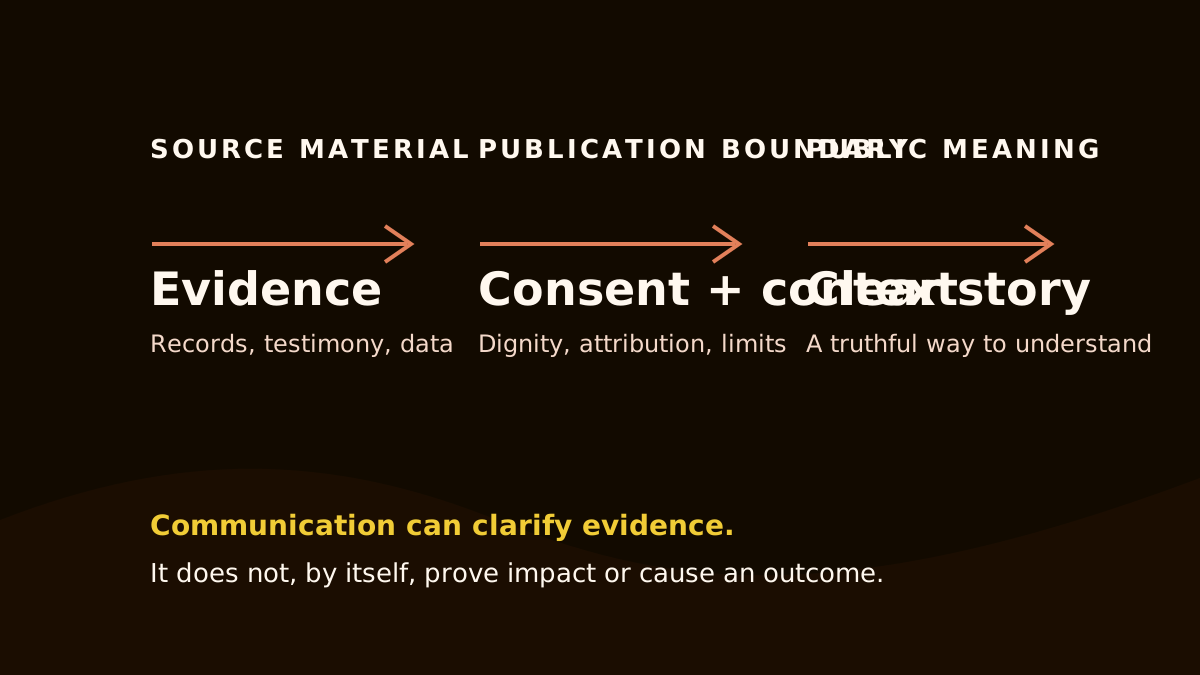
Story can make meaning easier to understand. It cannot manufacture care, replace evidence, guarantee support or control how an audience responds.
What nonprofit brand storytelling should explain
Several kinds of story and evidence appear in nonprofit communication. They perform different jobs.
| Type | Primary job | What it should contain | What it should not be asked to prove |
|---|---|---|---|
| Organizational narrative | Explain who the organization is, why it exists, what role it plays and where it is going | Origin, worldview, context, role, evidence, learning and direction | Every programme outcome or an audience’s future response |
| Impact story | Show a documented change or experience in context | Evidence, timeframe, contribution, limits and relevant human meaning | Universal impact or sole causation without supporting evidence |
| Personal testimony | Present a person’s account in their own context | Consent, attribution preferences, dignity and accurate representation | The experience of every participant |
| Organizational history | Record how the organization developed | Dates, decisions, milestones, changes and sources | Present effectiveness merely because the organization has existed for a long time |
| Case evidence | Examine a bounded piece of work | Situation, intervention, delivery evidence, outcomes, contribution and learning | Claims beyond the case or evidence available |
Scroll sideways to read the full table.
An emotional story may be memorable, but it should not be used as the organization's full identity or proof. A programme statistic may be important, but it does not explain the organization’s worldview or future direction. A founder’s origin may clarify motivation, but it should not eclipse the people, systems and evidence that now constitute the work.
Within a wider nonprofit branding strategy, narrative is one governed asset. It connects other assets; it does not replace them. The pillar defines the wider asset system; this guide stays with narrative construction, evidence, consent, context, dignity, and adaptation.
How to build the core nonprofit narrative
A core narrative is not necessarily a paragraph that must be copied everywhere. It is a source structure from which accurate versions can be created.
Begin with why the organization exists
Record the situation, experience, question or decision that led to the organization's formation. Then state the worldview behind the work: what the organization believes about the problem, the people affected by it and the kind of change it wants to support.
Origin and worldview are related, but they are not the same. “Our founder experienced this problem” explains a beginning. It does not yet explain how the organization understands the problem today, whose knowledge has shaped that understanding or what role the organization should play. Use verifiable history. If a personal experience is central, confirm the person's wording and the parts that may be made public.
Explain the context and the organization's role
Give the audience enough context to understand why the work exists. Name the condition, the people and institutions involved and the part of the situation the organization addresses. Do not turn a complex problem into a dramatic slogan or use an unsupported number because it makes the opening feel urgent.
Then state what the organization actually does. Direct delivery, convening, advocacy, funding, research and capacity building are different contributions. A nonprofit that trains teachers and supplies learning materials should not describe itself as transforming an education system unless its evidence and actual role support that claim.
Connect proof with learning
Name the evidence behind the account. Outputs, outcomes, testimonies, observations and independent findings answer different questions. Give dates and scope where they matter. If participants, partners, government agencies or wider conditions contributed to a result, the narrative should not remove them so that the organization can occupy the whole story.
Learning belongs here as well. State what the organization discovered, changed or corrected and identify the record behind that decision. “We learned to listen” says almost nothing. “After participants reported that weekday sessions conflicted with paid work, the team moved the next cohort to Saturdays” names the source, decision and practical change. Use a real example only when the organization can verify and publish it; otherwise keep the sentence as a clearly hypothetical illustration.
State the direction and the audience's place in it
Describe the future the organization is working toward and the role it intends to keep playing. A vision can be ambitious without being written as a guaranteed outcome.
Then decide why this account is relevant to the person receiving it. A participant, partner, funder, customer, volunteer or policymaker may enter the story at a different point. The underlying identity, role and evidence stay stable. The emphasis, level of detail and next step can change.
When these parts are disconnected, proof may feel like a report appendix, stories may feel extractive, and public language may shift with each campaign. When they are organized, the narrative becomes a reusable asset within the Brand-Power System.
How to use evidence and personal stories responsibly
Responsible storytelling is not a final ethics check performed after the copy has been written. Its controls belong inside collection, selection, drafting, approval and publication.
The Dóchas Guide to Ethical Communications gives this work a clear centre: respect people's dignity, privacy, security and agency; represent the wider context truthfully; account for power in the collection process; and show communities and local organizations as participants in change rather than scenery around the NGO. These principles fit Ije's own boundary that story must remain connected to proof, context and the people whose lives are represented.
Evidence
For each factual claim, record the source and what it actually supports. Separate the organization’s direct contribution from outcomes it influenced. Do not turn a participant’s experience into proof of a programme-wide result.
Consent
Consent should be informed, specific and appropriate to the intended use. Permission to collect a story is not automatically permission to publish a name, image, health detail, location or quotation indefinitely across every channel.
Bond's account of Child.org's consent process shows what this means in practice. Contributors are told what they are taking part in and where their words or images may appear; they receive time to decide; declining does not affect programme benefits; and a named route remains available if they later withdraw consent. The value of the example is not that every organization must copy one form. It shows that consent is a relationship and operating process, not a signature gathered to protect the publisher.
Where consent cannot be verified, do not disguise a real person as a composite and present the account as observed fact. Use a clearly labelled hypothetical example when teaching a pattern, or remove the example.
Stories involving children need a stronger safety decision. UNICEF's guidelines for reporting on children place the child's dignity, privacy, participation and protection from harm ahead of the publicity value of the story. Consent from a child and guardian does not remove the duty to assess risk. If publication could expose a child, sibling or peer to harm or retaliation, the story or image should not be published even if the identity has been obscured.
Context
Explain enough of the situation to keep the account accurate. Avoid removing the decisions, constraints, institutions and other contributors that shaped what happened. Context also includes time: an old result should not be written as if it describes the organization today.
Dignity
People are not raw material for organizational visibility. Do not make a person’s hardship more dramatic to strengthen a campaign. Avoid framing communities only through deficit, helplessness or gratitude. Respect attribution preferences and the right not to participate.
Review and correction
Check names, quotations, dates, numbers, causal language, image rights and the participant’s requested form of attribution. Establish how a person or source can request a correction or withdrawal where appropriate.
These controls protect both the people represented and the quality of the organizational narrative.
Build a one-page narrative evidence map
Before drafting a public story, create a simple source map.
| Narrative element | Working statement | Source or owner | Evidence type | Permission or boundary | Audience relevance |
|---|---|---|---|---|---|
| Origin | What led to formation | Founding record or confirmed source | Organizational history | Confirm public details | Explains motivation |
| Context | What condition matters | Research or documented programme context | External or internal evidence | Keep scope and date visible | Orients the reader |
| Role | What the organization contributes | Strategy and delivery records | Controlled activity | Do not overstate causation | Clarifies value |
| Proof | What can be shown | Measurement record, evaluation or attributed account | Output, outcome, testimony or finding | Claim must match evidence | Supports credibility |
| Learning | What changed | Decision or learning log | Internal record | Remove confidential details | Demonstrates adaptation |
| Direction | What the organization seeks | Approved strategy | Strategic intent | Do not promise outcome | Shows future role |
| Response | What the audience can do | Approved pathway | Operational instruction | Must be serviceable | Makes the story useful |
Scroll sideways to read the full table.
Mark a statement as unresolved if its source, permission or scope is unclear. Do not use eloquent writing to hide an evidence gap.
This map also helps teams discover latent assets: a useful insight held by programme staff, a result stored in a report, a decision in meeting notes or a frequently repeated explanation that has never been formally approved.
How to adapt your nonprofit story for different channels
One core narrative can support several formats.
Website introduction
Lead with the familiar problem, the organization’s role and a clear route to fuller proof. The reader should not need the founding history before understanding present relevance.
Partner conversation or proposal
Emphasize shared context, the organization’s role, relevant evidence, limitations and the specific basis for collaboration.
Programme or participant communication
Prioritize what the audience needs to know, what the organization will do, what it expects, what choices people have and how to raise concerns.
Social post
Use one bounded idea or piece of evidence. Link to the canonical explanation when more context is required. A short format is not permission to remove essential limitations.
When the problem is the pathway around the story—audience, channel, proof placement or response—the brand-visibility guide for nonprofits provides the wider coherence test.
Impact report
Connect organizational direction to delivery evidence, outcomes, learning and future decisions. Keep human accounts attributed and proportionate to what they demonstrate.
Take one hypothetical core narrative. A nonprofit prepares young women aged 18 to 24 in Kano for entry-level solar-installation work and convenes employers that can offer supervised placements. It records training completion, placement and participant feedback, while keeping employer demand, participant choices and wider labour conditions visible. It does not claim to secure a job for every participant or to have caused an employment outcome by itself.
On the website, the organization leads with the problem, its preparation-and-convening role and a route to programme evidence. In a partner proposal, it keeps that role but adds the employer-network method, the relevant cohort evidence and the decision it wants the partner to consider. In participant communication, it states what the programme offers, what participation requires, what choices participants retain and how to raise a concern. A social post uses one verified learning about programme delivery and links to the fuller account. The impact report connects the same role to dated outputs, bounded outcomes, limitations and the changes planned for the next cycle.
None of the shorter versions may turn “convenes employers” into “secures jobs,” or use one participant's experience as the programme result. If a format requires a stronger claim to make sense, the team must either supply the appropriate evidence and approval or keep the narrower wording.
The adaptation test is simple: has the emphasis changed, or has the claim changed? A claim change needs new evidence and approval. A format change still needs the same truth and boundaries.
How to review a nonprofit brand story before publishing
A narrative is usable when other people can apply it accurately—not only when its author likes the wording.
Review it with three tests.
Clarity
Can a reader explain the problem, the organization’s role and the next step without importing claims the narrative did not make? Note recurring questions and ambiguous terms.
Proof
Every material factual claim should trace to an appropriate source. Outputs, outcomes, contribution and aspiration should remain distinct. Consent, attribution, image rights, dates and claim limits should be recorded with the material rather than reconstructed at publication time.
Repeatability
Different team members should be able to produce a short, medium and detailed explanation that remains recognizably the same organization. They need access to the current narrative and evidence sources, plus a clear process for changing them when strategy, evidence or permission changes. If each adaptation begins from memory, the organization does not yet have a reusable narrative.
The Brand Coherence Lab can help reveal where identity, language and expression no longer connect. The Proof and Trust Lab is the more relevant route when the central difficulty is what a claim can responsibly say or show.
The aim is not to make people care on command. It is to give audiences a clear, truthful and respectful account of the organization’s identity, contribution, evidence and direction—then provide a suitable way to respond.
What to do next
Choose the route that matches the problem
Related articlePlace the narrative inside the wider brand systemSee how the story connects to mission, audience, proof, identity and public expression.→Ije’s approachSee where narrative decisions fitUnderstand the wider system that organizes proof, story, expression and activation.→Ije LabCheck the evidence and permission boundaryChoose a Proof and Trust Lab tool when the unresolved question concerns claims, evidence, consent or responsible public use.→