

Brand Visibility for Nonprofits: Why More Posting Will Not Fix a Coherence Problem
For nonprofit teams that publish regularly but remain difficult to understand, this guide connects one audience, message, proof set, channel, response path and learning signal in a visibility plan the team can maintain.
Resume reading
Imagine a nonprofit team that posts regularly, attends events and produces reports. New contacts still ask the team to explain what the organization does, who its programmes serve, what evidence it has and where an interested person should go next.
The team is visible in the narrow sense that its name and activities appear in public. Yet its public presence does not consistently help people understand, recognize or respond to the organization.
Publishing more may increase activity without resolving that problem. The more useful starting question is: what is preventing the organization’s identity, value and evidence from becoming clear across the pathway an audience actually uses?
At Ije, low visibility can be examined as a possible symptom of a Brand-Power Gap. The assets needed to turn impact into visibility, trust, support and sustained advantage may be latent, missing or disconnected. This does not mean every visibility problem is caused by branding. It means volume should not be prescribed before the underlying system is understood.
What brand visibility means for a nonprofit
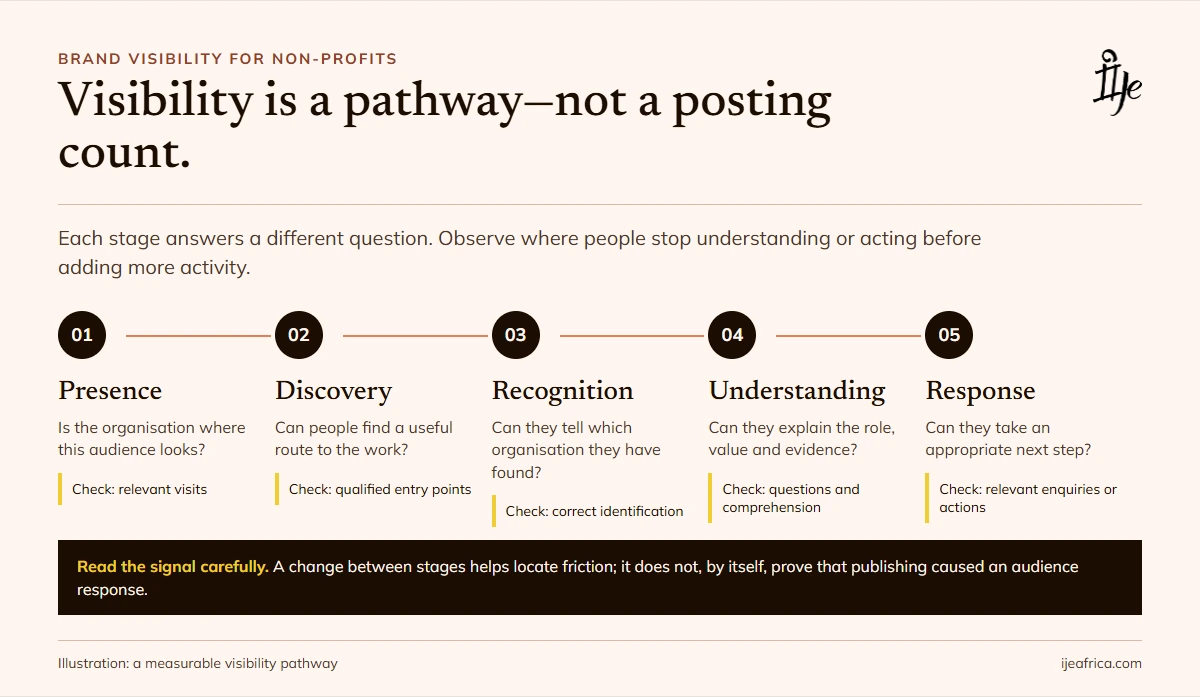
For planning purposes, it helps to separate five signals that teams often group under visibility.
| Signal | What it tells the team | What it does not establish |
|---|---|---|
| Presence | The organization or its work appeared in a place an audience could encounter. | That the intended people noticed it. |
| Discovery | Someone found a page, profile, event, document or referral route. | That the person understood the organization. |
| Recognition | A person could identify the organization again from its name, language or visual cues. | That the person remembers its role accurately. |
| Understanding | A person can explain the relevant problem, the organization's role and why the work matters. | That the person agrees, trusts or will act. |
| Response | A person takes the next step offered by the material. | That visibility alone caused the action. |
Scroll sideways to read the full table.
A team can increase presence without improving understanding. A campaign can attract attention without making the organization itself more recognizable. A person can remember a name without knowing what response is expected. These distinctions are operational definitions for this guide, not a universal measurement standard. Their job is to stop one large reach number from answering five different questions.
Visibility also differs from impact. Programme outcomes exist whether or not they are communicated well, and communications cannot manufacture evidence that the work has not produced. The role of visibility work is to make relevant identity, proof and meaning easier to encounter—not to stand in for delivery.
This is why a useful visibility strategy treats public attention as an influenced outcome. A team can directly improve its message, evidence, channel choice, accessibility, cadence and response path. It cannot control an algorithm, guarantee media interest, secure donor action or command public trust.
What makes a nonprofit easier to find and understand
This article does not rebuild the whole nonprofit brand system. The nonprofit branding strategy guide owns that architecture. Here, the question is narrower: do the selected assets work together along one public pathway, from an audience’s first encounter to a truthful response and a useful learning signal?
Clear identity and audience
The organization needs a stable answer to what it is, what role it plays and who a particular pathway serves. “Everyone” is not a usable audience decision. A participant, institutional partner, individual supporter, buyer, policymaker or peer may need a different entry point.
CharityComms' guide to audience insight in charities starts with the organization's aims: which people can help the organization make progress, and which people does the organization need to reach or serve? That order matters. A platform's popularity does not make every user on it relevant to the same organizational goal.
Consistent message
Consistency does not mean copying one paragraph into every channel. It means that different expressions share the same underlying truth: the organization’s role, worldview, value, evidence and direction do not change opportunistically from one encounter to another.
Accessible proof
Evidence should be available where a claim is made and labelled according to what it supports. A project count, participant quotation, partner statement and outcome finding are different kinds of evidence. The public pathway should not hide them in an unrelated PDF or use one piece of evidence to support every claim.
Usable stories
Stories help people connect context, choices and meaning. They should preserve consent, dignity and accuracy. They should also be connected to organizational evidence rather than used as an emotional substitute for it.
Recognizable expression
Language, imagery, typography, layout and recurring visual cues can help people identify the organization across encounters. Recognition is useful when the underlying message remains clear and the materials remain accessible.
A relevant channel
The right channel is the one the intended audience can realistically use for the intended job. A search-led article, partner deck, WhatsApp message, community meeting, email, media briefing and LinkedIn post do not perform the same function. A current CharityComms guide for reviewing social-platform choices recommends judging a platform by the audience and objective it serves, the time and format it requires, and the risk of maintaining or leaving it. That is a more useful channel decision than joining a platform because another organization appears active there.
A truthful response path
After an audience encounters the organization, what should happen? The next step may be to read evidence, make an enquiry, use a tool, refer someone, register, partner, donate or purchase. The response should fit the person’s intent and the organization’s capacity to follow through.
Consider a hypothetical nonprofit that helps public secondary schools in Ogun State run weekly science clubs by training teachers and supplying activity kits. It wants to reach corporate foundations that may support the next group of schools.
The partnership page is the primary home. It explains the problem the clubs address, the nonprofit's exact role, the schools and period covered by its current records, what it has learned, what kind of partnership it can manage and whom to contact. A partnership deck uses the same description and evidence, then adds the delivery plan and responsibilities needed for a serious conversation. At an education event, the team uses a short introduction and directs interested partners to the page. A LinkedIn post explains one verified lesson from the programme and links to the full context rather than turning the lesson into a broad impact claim.
Each format does a different amount of work. The page supports discovery and examination. The deck supports a decision already in progress. The event introduction makes the next route easy to remember. The post gives one relevant reason to enter the route. The organization's role and the limits of its evidence remain the same across all four.
If the event introduction describes the organization as a national STEM network while the page documents work in one state, or the post implies employment outcomes that the programme has not measured, the team should correct the message or claim before adding another channel. Distribution cannot repair a contradiction created at the source.
The Brand-Power System organizes these elements as connected assets, not isolated communications tasks.
Five reasons more posting does not improve brand visibility
1. The audience is unclear
When one piece of content tries to address funders, participants, customers, partners and the general public at once, it can become vague. More distribution then multiplies the vagueness.
Choose one primary audience for the pathway. Ask what that person needs to understand, what evidence is relevant and what response makes sense.
2. The language keeps shifting
If the website, proposal, team members and social profiles describe the organization differently, each encounter forces the audience to reconstruct the meaning.
Create a shared core description and a small set of message priorities. Adapt them by context without changing the underlying claim.
If the instability is in the organization’s underlying narrative rather than only its short description, use the responsible nonprofit storytelling guide to rebuild the identity, context, role, evidence and direction that the channel language should express.
3. The proof is buried or unsupported
A feed may contain many activity photographs while the evidence that explains reach, quality, learning or outcomes is difficult to find. The reverse can also happen: a technical report contains useful findings but offers no accessible public explanation.
Organize proof by claim and audience. Make the source, date, context and limits clear. Remove claims that the evidence cannot support.
4. The channel does not fit the job
A platform may be familiar or fashionable but still be a poor fit for a specific audience, message or response. A short social post cannot include every methodological detail. A long report is a poor first encounter for someone seeking a basic explanation.
Define the job first, then choose the channel and format. Use links and connected assets so that each format gives the audience the information needed at that point in the pathway.
5. There is no clear response path
Attention ends at the post, page or event. Contact details may be generic, the requested action may be too large, or the team may not be able to respond consistently.
Design one proportionate next step and assign a way to receive and learn from the response. A smaller, reliable pathway is more useful than a broad call to action the organization cannot service.
How to build a nonprofit visibility plan your team can maintain
Sustainable visibility is not a fixed publishing quota. It is a repeatable system that matches the organization's priorities and capacity. A small team can build that system around a campaign or audience need rather than promising daily output on several platforms.
Return to the school-science example. The team can plan one partnership cycle around five connected decisions.
| Part of the flow | Decision for this campaign | Hold the next step when |
|---|---|---|
| Primary home | Update the partnership page with the current description, programme record, partnership scope and named contact. | The claims have no verified source, the offer is unclear or nobody owns the enquiries. |
| Introduction | Send a short email to a defined group of relevant contacts and use the same short explanation at planned events. | The contact list has no relationship to the partnership goal or the introduction promises more than the page explains. |
| Public reinforcement | Publish one or two LinkedIn posts that explain a verified programme lesson or partnership need and link to the page. | The post requires a stronger claim, different role or unrelated call to action to attract attention. |
| Response | Route partnership enquiries to a form or inbox with an owner, response expectation and qualification question. | The team cannot respond, the form asks for information nobody will use or the next step exceeds delivery capacity. |
| Review | Compare the contacts reached, page visits, questions and suitable enquiries with the campaign's original audience and message. | There is too little or poor-quality information to support a decision. |
Scroll sideways to read the full table.
The flow can run over two weeks or six. Cadence follows the actual opportunity, the useful life of the material and the team's ability to respond. The point is not to publish as little as possible. It is to know why each item exists, which source controls it and what the team will do when someone responds.
If the canonical page and response process are not ready, hold the adaptations. If the same qualified audience question appears in several encounters, revise the controlling explanation once and update the dependent materials. Add another channel only when the existing pathway works and the team can maintain the response.
This is not an instruction to remain on one channel forever. It is a way to build a functioning pathway before adding more surfaces. Expansion should follow evidence of usefulness and available capacity.
How to measure nonprofit brand visibility
Measures should follow the job of the pathway. A visibility system needs more than a single reach number.
What the team delivered
Track what the organization directly controlled: whether the asset was published, whether its links worked, whether proof was correctly labelled, whether the page was accessible, whether the response mechanism functioned and whether follow-up happened.
Whether people encountered it
Relevant signals may include search impressions, clicks, visits, referrals, distribution, event attendance or document use. These show exposure, not necessarily understanding or trust.
For website search performance, Google distinguishes the sources. Its documentation identifies Search Console as the source for Google Search performance, including the queries and pages associated with impressions and clicks. Google Analytics describes what visitors do on the site after they arrive, subject to the site's measurement and consent setup. Clicks and sessions should not be forced to match because the products count different things. Use each tool for the question it can answer.
Whether meaning became clearer
Look for the questions people ask, language they repeat, pages they continue to, resources they use and whether qualified enquiries contain a more accurate understanding of the organization. These are learning signals, not automatic proof that communications caused an outcome.
Whether a suitable response followed
Track responses appropriate to the pathway. This may be a completed diagnostic or a relevant enquiry. In another pathway, it may be a referral, registration or partner conversation. Record quality and context, not only volume.
What should change
Keep a decision log. Note what the team learned, what it changed and what happened after the change. This prevents every fluctuation from being treated as a strategic conclusion.
Suppose the partnership page begins receiving more search impressions but almost no clicks. The team should inspect the queries, title and description before concluding that the subject lacks interest. If clicks increase but most enquiries still ask for grants the organization does not provide, the page may be easier to find while its role remains unclear. If the right enquiries arrive but nobody answers them for ten days, the visibility work has exposed a response failure. The metric becomes useful when it points to the part of the pathway that needs a decision.
Start with one audience, one message and one next step
Write the pathway on a single page before adding another item to the calendar.
| Record | What to write |
|---|---|
| Audience | The specific person or institution this pathway serves. |
| Problem | What that audience is trying to understand or do. |
| Message | The one relevant idea the organization needs to make clear. |
| Proof | The evidence that can responsibly support the message. |
| Channel | Where the first useful encounter should happen and why. |
| Response | The next action the organization can support. |
| Learning signal | The question, behaviour or qualified response that would reveal clarity or confusion. |
Scroll sideways to read the full table.
Then inspect every asset between the first encounter and the response. The description should remain coherent, the proof should be reachable, the design should support access, the next step should be unambiguous and the team should be able to respond. Any failed condition identifies the break to repair first.
Fix the biggest break before increasing the cadence. The Visibility Lab can help a team examine a bounded visibility problem and identify a useful next action without offering false closure.
A visible organization is not simply one that appears often. It is one whose relevant audiences have a fair chance to encounter, understand and respond to a coherent expression of its real work.
What to do next
Choose the route that matches the problem
Related articleIf the problem reaches beyond visibilityReview the mission, audience, proof, story and identity decisions the wider brand system needs to connect.→Ije’s approachUnderstand the Brand-Power GapExamine whether useful brand-power assets are latent, missing or disconnected before prescribing more activity.→Ije LabWork on a specific visibility problemChoose a Visibility Lab tool that matches the problem the article helped you identify.→