

NGO Branding Agencies in Nigeria: 9 Providers to Explore (2026)
Resume reading
If you are searching for the best NGO branding agency in Nigeria, the right fit depends on the assignment. A new visual identity, a positioning and messaging project, a public campaign and a nonprofit website can overlap—but they are not interchangeable briefs.
This comparison looks at nine Nigeria-connected providers whose public pages show relevant work or services. It includes agencies, studios and one independent specialist. The profiles are alphabetical, not ranked. For each, the useful question is what the published example actually covers—and what your organisation would still need to confirm.
How to read the profiles
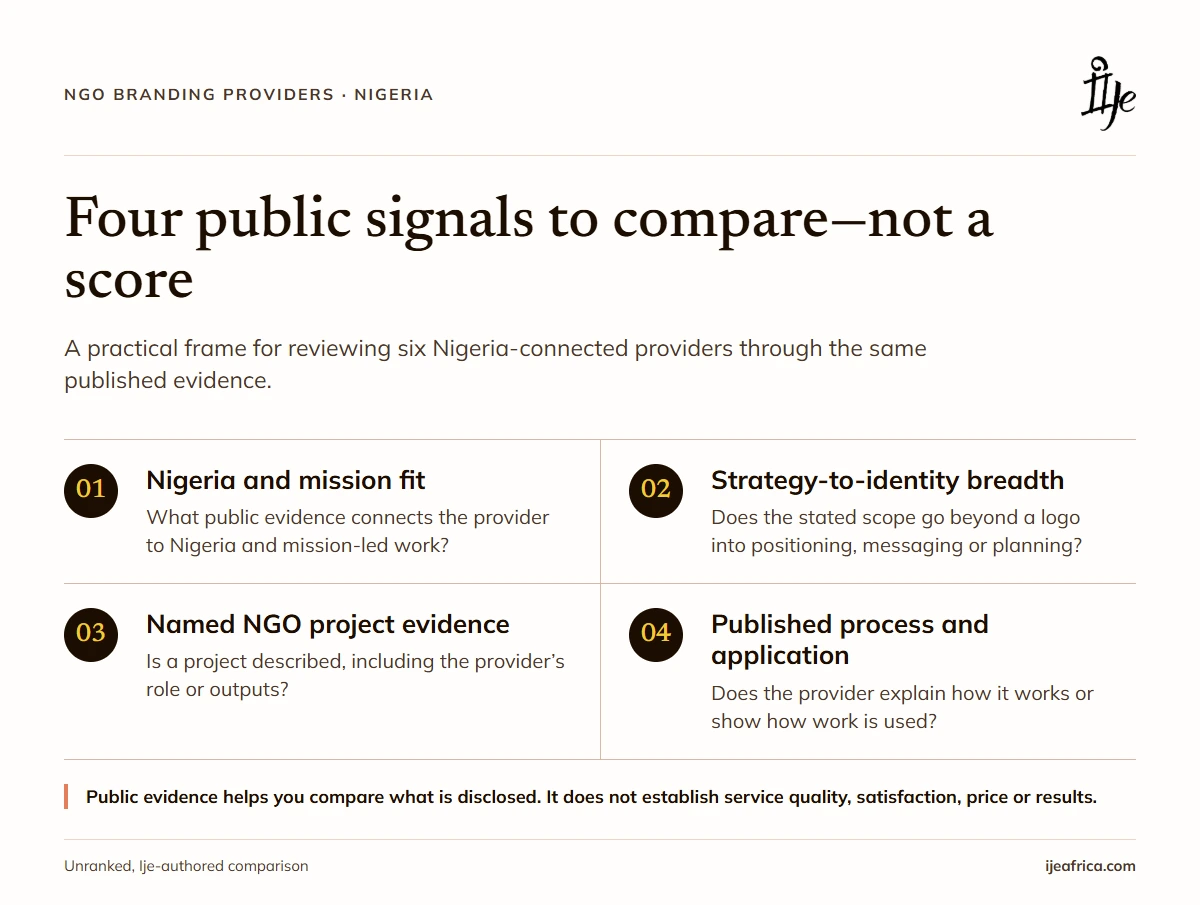
Look for four things: a credible connection to Nigeria and mission-driven work; the actual scope (from a bounded identity job to connected strategy and activation); a named project or clear service description; and enough process detail to understand how the work may be applied. These are comparison prompts, not a quality scorecard. Provider case pages are first-party accounts: they can show what a provider says it did, but they cannot independently prove quality, client satisfaction or results. Where a detailed NGO case did not surface in the pages reviewed, that is a limit of this review—not proof the provider lacks the experience.

Awora Studio
Awora’s public connection to nonprofit work is a specific one: its portfolio features The Orchid Mission Nigeria, an organisation supporting children with neurodevelopmental disabilities. The provider’s 2022 project page describes a visual identity engagement, including a logo and decisions about visual language, colour and typography. Awora also describes discovery and planning as part of its design process.
That makes the project a useful reference if your assignment is to give an organisation a coherent visual identity. The page does not, by itself, establish that the engagement included a complete communications strategy, a multi-channel rollout or measured organisational outcomes. For a current brief, ask to see how the identity was applied after handover, what research shaped the design, and which editable files and usage guidance were included.
Baselinks Business Consult
Baselinks’ public portfolio includes work for Dipo Dayo Foundation. Its case page describes a visual identity and stationery scope: logo, colour palette, typography, guidelines and stationery. Those items make the visible production scope concrete. The public case offers less detail about stakeholder research, positioning decisions or how the identity was carried into ongoing communications.
If your organisation already knows what it stands for and needs those decisions translated into a usable identity, this is the kind of distinction to discuss. Ask what strategic inputs informed the design, whether the guidelines include digital and print use, which source files are handed over, and who helps your team apply them consistently. The listed deliverables are evidence of the provider’s stated scope—not evidence of downstream donor or audience response.
Brandor Creative Media Agency
Brandor’s current public description identifies it with Kano and says it serves NGOs and development partners. Its stated services range across branding and identity, strategic storytelling, event documentation, media production, communications and training. That breadth may be relevant where an NGO’s need includes both a brand-related assignment and practical communications or documentation work.
The pages reviewed for this comparison did not surface a detailed, named NGO case explaining a full strategy-to-identity engagement. That is a public-evidence gap, not a conclusion about Brandor’s capability. If you are considering work beyond event or programme documentation, ask the team to separate discovery and positioning from identity design and campaign production in its proposal. Request a directly relevant example, the named people who would do the work, and the decision points at which your organisation would approve the direction.
CKDigital
CKDigital has two distinct nonprofit examples that are worth keeping separate. Its Hopegate Foundation project describes logo, stationery and brand-identity design. A separate Helpmeet A Need Global Foundation project describes a WordPress website with a blog, photo gallery, social integration, newsletter and email-marketing features, among other items. The latter is evidence of a website scope; it should not be read as proof that the two assignments were one integrated brand strategy.
CKDigital’s branding-process page describes work involving messaging, identity, collateral and guidelines. For a combined assignment, ask how the brand decisions would inform the website structure and copy, who would maintain the site, and whether the proposal treats strategy and implementation as separate stages. The important comparison is whether the deliverables connect to the audience decisions your NGO needs to make, not simply how many features are listed.
Goldrush Multimedia
Goldrush identifies Abuja as its headquarters. Its published disciplines span brand strategy and identity, communications and public relations, digital and content marketing, and creative production. This is a wider service mix than a standalone logo or identity brief, and it may suit an organisation exploring how brand work and communications activity relate.
The public pages reviewed here did not surface a detailed, named NGO branding case. That should be treated as a question to resolve, not as evidence that no such work exists. Goldrush’s public materials describe a Discover–Strategise–Create–Deliver approach; for your brief, ask what each stage would produce, who would lead strategy, and which elements are optional. Request a comparable NGO assignment and clarify whether campaign or media work follows from the brand decisions or is being proposed as a separate service. No outcomes are inferred from the service list.
Ije Africa
Disclosure: Ije Africa publishes this comparison and is describing its own services here. This profile is first-party information, not an independent assessment.
Ije focuses on Nigeria’s mission-driven organisations and businesses, including nonprofits and social-impact organisations. Its stated five-part method—Reveal, Name, Organise, Activate and Shape—connects diagnosis, identity, proof, story and public presence. Ije’s Brand-Power System describes how it brings those connected parts into an offer rather than treating a visual refresh as the whole job.
Ije’s public portfolio identifies work for organisations including CHEVS and IGE-SRH, with examples such as reports, websites and communications strategy. These are selected, Ije-published examples; the portfolio is not a full independently verified case record. A buyer considering Ije should ask for the closest project example, the specific assets and decisions included, the evidence and permissions behind any public claims, and the owners of implementation after delivery. If the need is already settled and limited to one production task, ask whether the connected-system scope is warranted.
Sites by Amaka — independent provider
Sites by Amaka is an independent provider, not an agency. Its Slovers Foundation case describes work combining brand foundations and a nonprofit website: colours, voice, messaging and positioning alongside a WordPress site, programme information, donation details, and routes for volunteers and partners. The case also names the tools used for the site, including Kadence and GiveWP.
This is relevant when an organisation wants brand decisions and its web presence considered together, but it is still one provider-authored case. It does not independently establish improvements in legitimacy, donor trust or growth. Because this is an individual practice, clarify who handles each part of a larger assignment and what capacity is available for future changes. Ask who owns the copy and site accounts, what training and documentation are included, and who will provide maintenance when programmes or fundraising routes change.
Studio X Creative Hub
Studio X lists a broad strategy-to-implementation scope on its services page: naming and brand story; mission, vision and values; positioning and audience work; visual identity; voice and messaging; guidelines; and web and marketing services. Its Genesys Foundation case describes work spanning brand story, identity, messaging and content, social activity, and a website with donation and volunteer pathways.
The case page contains a date discrepancy: its overview labels the project 2023 while the narrative says the foundation engaged Studio X in 2024. The article therefore does not choose one date. Ask the studio to clarify the timeline and which deliverables were completed in each phase. For an NGO brief that combines identity with digital and campaign work, also ask how the audience and message decisions carry through each asset, who approves claims and stories, and what evidence supports any outcome statements. The case remains the provider’s account.
Talku Talku
Talku Talku’s current homepage positions the company around revenue and growth systems, including a Brand-to-Market pathway. Its TGAS Foundation case gives a more specific nonprofit example: the provider describes discovery and audience work, visual identity and brand voice, an awareness playbook, website and social assets, and early campaign activity. The case connects strategic and activation work more explicitly than a page that shows only a finished logo.
That account is provider-published, and its results have not been independently verified here. The current homepage’s wider growth-systems positioning may also have evolved since the case. If the case resembles your needs, ask which parts match the present offer, who would lead the work, what would be built before activation, and how success would be measured against a baseline. Separate the planned activities from any results the proposal forecasts.
Turn your assignment into a comparable brief
Before approaching providers, write down the decision your organisation needs to make and the change it needs the work to support. Then ask each provider to respond to the same scope. A brief for a visual identity after positioning has already been agreed is different from one that must first resolve audiences, message, evidence and supporter pathways.
- Starting point: Which audience, organisational decision or communication problem is in scope—and what has already been decided?
- Work and outputs: Which research, strategy, identity, copy, website or activation deliverables are required? What is explicitly outside scope?
- People and approvals: Who will do the work, what will your team need to supply, and who approves positioning, identity and public claims?
- Handover: Which editable files, usage guidance, account access, training and maintenance arrangements are included?
- Evidence and evaluation: What baseline and observable signal will indicate that the agreed work was completed or is being used? Who is responsible for measuring it?
For example, “design a logo and stationery using our approved positioning” should not be compared as though it were the same assignment as “help us resolve our audience and message, then connect identity, proof, website and supporter response.” Naming that difference before requesting proposals makes scope, price and responsibility easier to compare; it does not guarantee an outcome.
When the work crosses several connected assets
If your organisation’s identity, evidence, story, website and supporter pathways each tell a different part of the story, the brief may reach beyond a visual refresh. Ije’s Brand-Power System explains how Ije approaches those connected parts. It is one option to examine—not a requirement for every NGO hiring a branding provider.
How this comparison was assembled
We reviewed provider-published service pages and project examples on 26 September 2026. The nine profiles are alphabetical and unranked; the selection is not exhaustive. Ije Africa publishes this article and is included in it. Provider descriptions and case claims are attributed to those providers and have not been independently audited. The comparison concerns the public material reviewed, not actual service quality, client satisfaction, price or results.