

Marketing Strategy for Nonprofits: What Should Come First?
Resume reading

Which organisational priority should the next round of marketing support? A marketing strategy for nonprofits should answer that question before the team chooses a channel or deliverable. The choice becomes harder when programme staff need to recruit participants, a partner requests materials and someone else asks for more social posts. Each request may be reasonable. The team still has to decide which audience decision matters first.
Start with one organisational priority for the next planning period. The team then names the audience decision its communication can support. That choice gives it a reason to defer other requests, assign an owner and review its assumptions.
A marketing strategy for nonprofits starts with one choice
Marketing work can include public explanations, event communication, search content, partner materials, email, media and social posts. A strategy gives those activities a direction. It identifies which organisational need comes first, whose decision matters and what the team can reasonably ask that audience to do.
An annual plan may list several important organisational goals. One campaign cannot serve every goal at once: each may involve different people, decisions, evidence and follow-through. Bundling them can leave each audience unsure what the organisation wants them to understand or do.
Start by naming the organisational priority in plain language. “Raise awareness” describes a broad communication intention. “Prepare the next adult-literacy class for enrolment” names an organisational need. The team can then decide what prospective learners need to know and whether staff can respond to questions.
The organisation controls the accuracy and accessibility of its explanation, the evidence it uses, the channels it selects and the response process it provides. It can observe whether people encounter or respond to that work; the audience makes its own decision.
Separate the organisational priority from the communication task
Before choosing content or channels, translate the priority into an audience decision. Ask:
- What organisational need is the work meant to support?
- Which people can make a relevant decision, take part, or help the organisation make progress?
- What do those people need to understand before they can decide or act?
- What can the organisation show that supports this explanation?
- What response can the team receive and manage?
Keep the answers separate. “Prepare the next adult-literacy class for enrolment” is an organisational need. “Help eligible adults understand the schedule, requirements and registration process” is a communication task. “Publish a social post” is one possible activity. Choosing the activity before the task risks producing material that does not answer the audience’s decision.
The same care applies to funding or partnership priorities. “Secure a new institutional partner” is an organisational ambition, not a guaranteed result of marketing. A communication task might be to help a defined group of potential partners understand the programme model, the organisation’s role, the evidence available and the contribution being requested. Relationship-building, due diligence, programme capacity and partner decisions remain part of the outcome.
Compare the priorities competing for attention
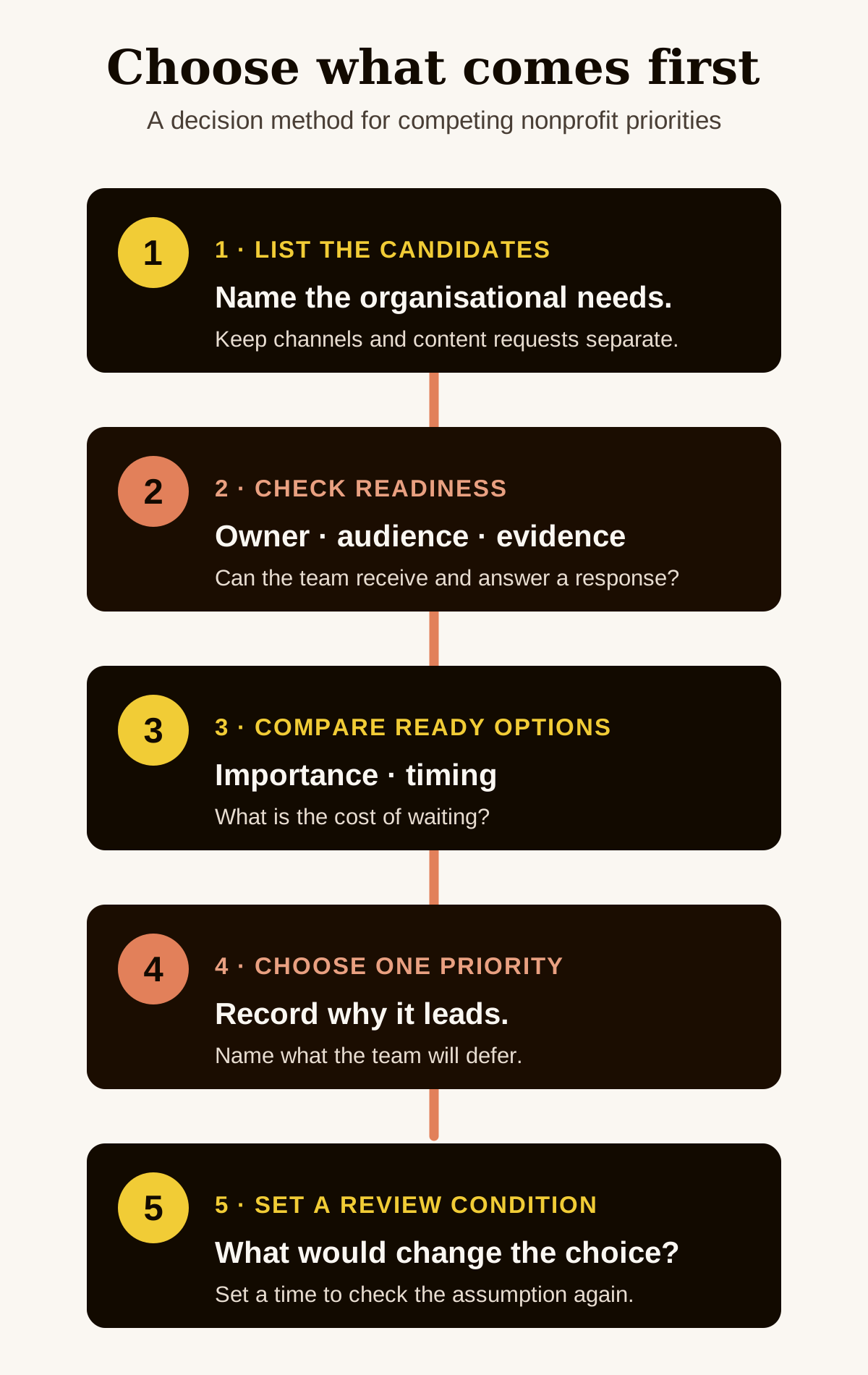
When several requests compete, use two passes. First check whether each proposed priority is ready for communication. Then compare the ready priorities by organisational importance, timing and the cost of waiting. This keeps a loud request from winning simply because it arrived last.
| Readiness check | What to confirm before this priority enters the comparison |
|---|---|
| Organisational authority | A decision-maker has named the priority and its intended contribution. |
| Audience decision | The team can name who needs to understand or decide something, and what that decision is. |
| Evidence and materials | Current information supports the explanation; the team knows what is still missing. |
| Response capacity | Someone owns questions and follow-up, and the organisation can provide what the communication invites. |
Scroll sideways to read the full table.
If a priority fails one of these checks, record the work required to make it ready. Do not treat promotion as a repair for missing approval, evidence, service capacity or response ownership.
For options that pass, compare three conditions:
- Importance: Which priority most directly supports the organisation’s current direction?
- Timing: Is there a confirmed decision window, intake period or external commitment?
- Cost of waiting: What becomes harder if the team gives this priority no attention in the current cycle?
Choose the priority with the clearest case across those conditions, state the assumption behind the choice and set a review point. This is a transparent management decision, not a score that can replace leadership judgement.
The comparison may show that an apparently urgent campaign is not ready. The message may promise a programme place that has not been confirmed. The team may not know who can approve the evidence. The named contact may be unavailable to answer enquiries. Those are useful findings: they identify what must be settled before wider communication begins.
Worked example: one NGO, two urgent priorities
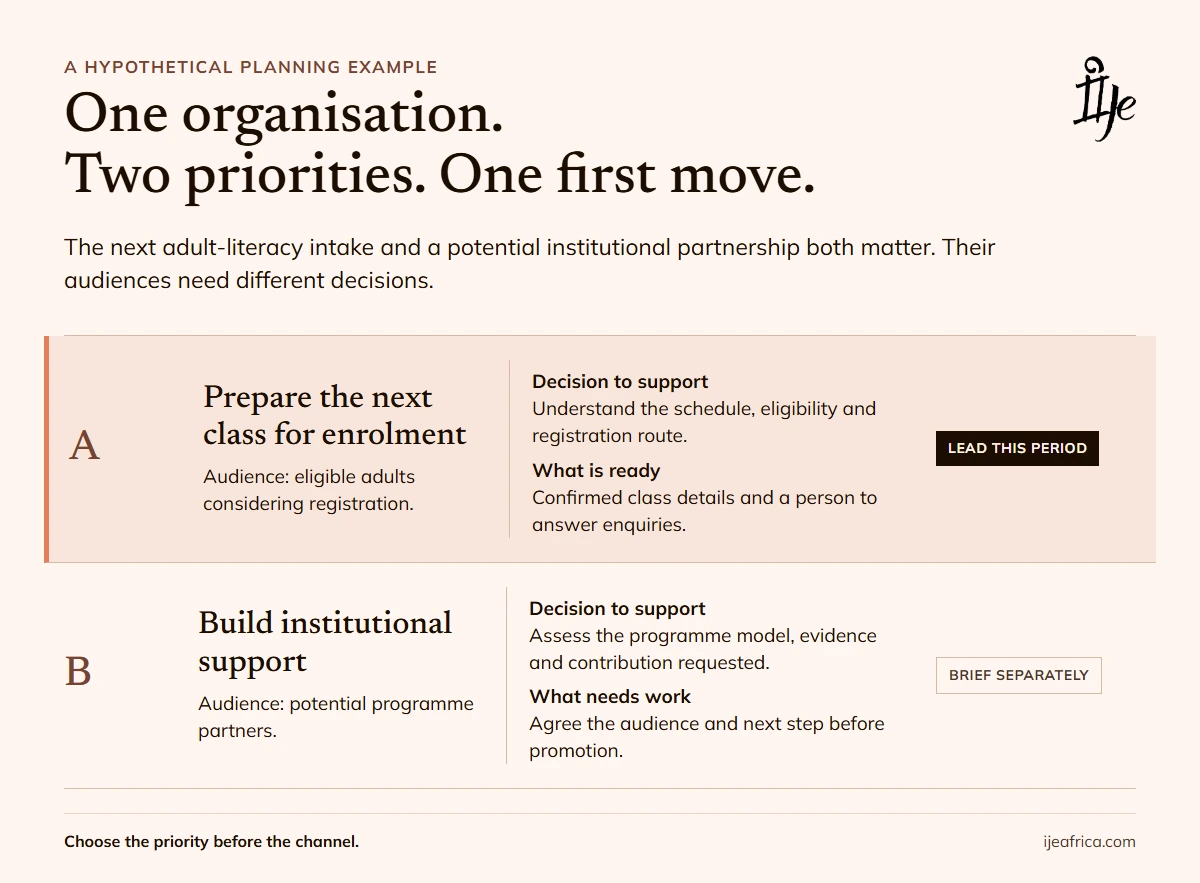
Consider a hypothetical Nigerian nonprofit that runs adult-literacy classes. It is preparing its next enrolment period. Two requests compete for attention:
- make the class details and registration route clear to prospective learners; and
- create a general awareness campaign about adult literacy for institutional supporters.
Both may support the organisation. Prospective learners need to understand who can enrol, what participation involves and how to register. Institutional supporters need a clear account of the programme, evidence of current delivery and a specific partnership question.
For this example, assume the class schedule, eligibility information and registration route are confirmed, and a staff member can answer enquiries. The supporter campaign has no agreed audience or next step yet. The enrolment communication is ready to lead because it serves a defined programme priority and the organisation can respond. The supporter campaign needs a separate brief before the team promotes it.
If registration is already full, or the organisation confirms a supporter meeting and prepares the relevant evidence, the decision may change. Record why the current priority leads and what new information would justify changing it.
The priority decision, recorded
| Field | Example decision |
|---|---|
| Priority and reason it leads | Prepare the next adult-literacy class for enrolment; the schedule and response route are ready for a defined upcoming intake. |
| Audience and decision | Eligible adults deciding whether to ask about the class or register. |
| Evidence to use | Approved class description, confirmed schedule, eligibility details, registration route and current contact information. |
| First activity and owner | Make the registration information clear, then share it through routes the intended learners can use; the assigned staff member handles questions. |
| What is deferred | A general awareness campaign for institutional supporters, until its audience, evidence and next step are agreed. |
| Review condition | Reconsider if places fill, the schedule changes, the team cannot respond or a time-bound supporter decision becomes ready. |
Scroll sideways to read the full table.
The brief gives the team a consistent explanation and a workable route for responding. Questions from prospective learners can show where the information needs clarification; registrations alone do not establish that communication caused a programme outcome.
Turn the choice into a one-page marketing brief
Use the same record for the priority you select. Keep it short enough that programme and communications colleagues can work from it together.
Priority and reason it leads: What organisational need comes first, and why now?
Audience and decision: Whose decision matters, and what must they understand or do?
Evidence to use: What current, approved information supports the communication?
First activity and owner: What is the smallest useful activity, and who will carry it out?
Response route: What can the organisation invite, receive and follow up? Who owns that response?
Review condition: When will the team reconsider the choice, and what change would trigger that review?
This record is not a substitute for the organisation’s programme plan, budget, safeguarding process or governance. It is a bridge between the priority and the communication work meant to support it.
Choose activity after the decision
After the priority is chosen, select the smallest activity that lets the named audience make its decision. A class registration page, an invitation through a trusted community contact and a social post have different jobs. The team should choose a format the audience can use and that staff can maintain.
This article stops at that channel-selection handoff. When the organisation has chosen its priority and needs to design one audience pathway, Ije’s guide to nonprofit visibility covers the next decision.
Review what the work taught you
At the agreed review point, compare what the team planned with what happened. Did the material go out with approved evidence? Did the intended audience encounter it? What questions came back? Did the response route work? Could the team handle the enquiries? Which assumptions proved wrong?
Separate activity from influence. The organisation can count the materials it completed, check whether links worked, and record whether responses were followed up. It can observe suitable enquiries or repeated questions. It cannot treat a post view as understanding, an enquiry as a partnership, or a campaign as the cause of a programme outcome without supporting evidence.
The next decision may be to continue the priority, revise the explanation, complete missing evidence, prepare a different audience path or move to another organisational need. Record the reason. That is how a marketing strategy remains connected to the organisation instead of becoming a calendar that keeps running after its purpose has changed.
When the problem needs more than a marketing plan
Sometimes the comparison exposes a problem that marketing cannot solve. The team may lack programme evidence, delivery capacity, an approved service or a decision-maker. Resolve that constraint with the people responsible before inviting an audience to act.
If the difficulty instead concerns the organisation’s role, audience, evidence and public explanation, Ije’s Brand-Power System describes the connected brand work that may be relevant. It is one possible route, not the answer to every marketing question.
Before the next planning meeting, list the competing priorities, apply the readiness checks and record which one leads, why it leads and what would change the decision. Then brief communications around that choice.