

Brand Guidelines Your Organisation Can Use
Resume reading
A logo file, colour palette and list of typefaces may give a team a starting point. They do not always answer the questions that come up when someone is preparing a programme announcement, partner presentation or report: Which message should lead? Can a partner use the logo? Which image fits? Who checks the final material?
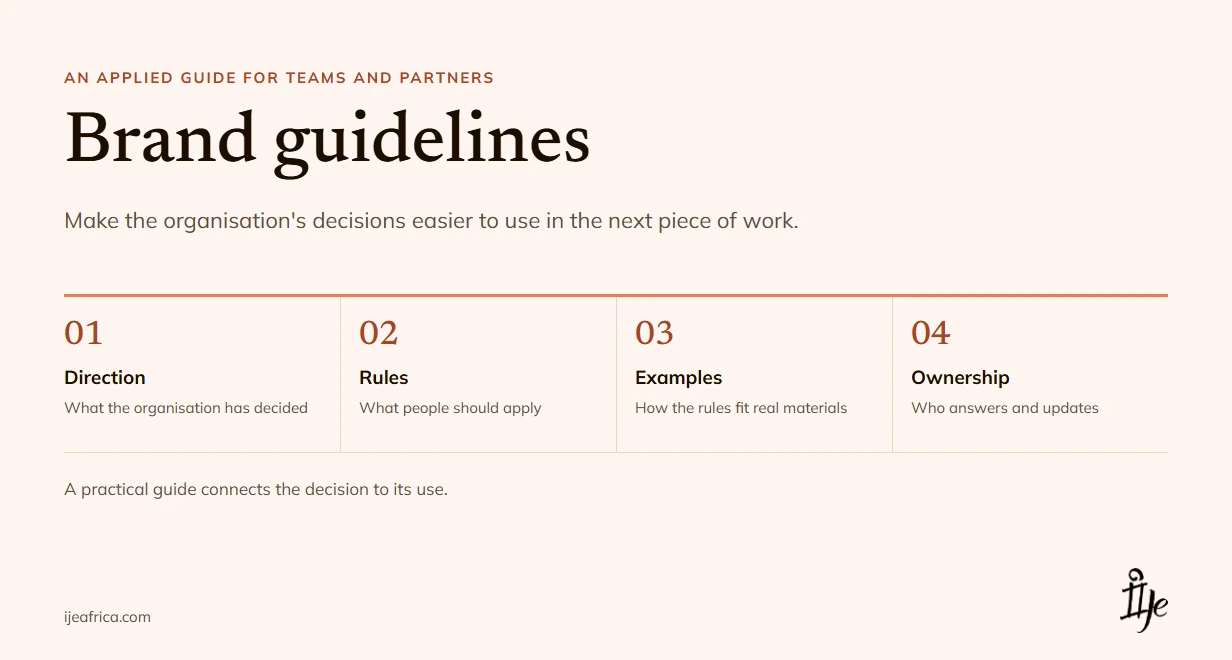
Useful brand guidelines help people answer those questions with the organisation’s existing decisions in view. They connect the identity to the work people actually produce, so staff and partners can find the right rule, see how it applies and know who to ask when an exception comes up.
What brand guidelines are meant to help people do
Organisations use terms such as brand guide, brand guidelines, identity manual and style guide in different ways. The title on the cover does not tell you whether the document will help with the decisions your team faces.
For one organisation, a guide may focus on visual identity: approved logo versions, colours, type and imagery. Another may also include its purpose, audiences, language, key messages, examples, asset files and approval process. The right scope depends on the decisions people need to make—not on the number of pages or the name of the document.
Think of a team preparing a partner-facing programme announcement. A visual rule can tell the designer which logo file to use. A message rule can help the programme lead explain what the work does. An application example can show how those choices fit together in a partner presentation or a social post. An owner can resolve a co-branding question before the material goes out.
That is the working test: can the person doing the work find the decision, apply it to this material and get help when the guide does not cover the situation?
What Nigerian organisation examples include
Public brand guides from organisations in and working across Nigeria show why the scope can extend beyond a logo. AFENET Nigeria says its guide covers logos, language, imagery, colours, typography and approval procedures. The Community Development Centre Africa’s 2021 guide includes its vision and mission, colour palette, proper and improper logo use, typography and logo variants for different countries.
The practical lesson is to start with your own materials and responsibilities. If several people create content, a file of visual specifications may not answer questions about language or approval. If partners use the organisation’s identity, staff need a clear rule for what can be shared, what needs review and which files are current.
What belongs in a guide people can use
A guide should make the most important decisions easy to locate. These five areas give a team a useful starting scope.
1. The organisation’s direction
State the organisation’s purpose, the people or issues it serves, and the position it has chosen to take. Include only the context that helps someone make a communication decision. A long history or a list of values without an application does not tell a designer which message belongs on a programme page.
This section should help staff explain the organisation consistently without replacing the strategy itself. If people disagree about the organisation’s role or priority audience, a style guide cannot settle that disagreement by itself.
2. Voice and messages
Describe how the organisation speaks, then show that voice in the messages people need to use. A useful guide might include a short introduction, a service description, a partner-facing explanation and words the organisation uses carefully. Examples make a tone instruction easier to apply than a row of adjectives alone.
For example, “clear and respectful” is a direction. A sample paragraph can show what that sounds like when the organisation explains a programme to a community partner. The sample should be current and should not promise a result the organisation has not demonstrated.
3. Visual rules and source files
Record approved logo versions, spacing and minimum-size rules, colour values, type hierarchy, image guidance and any rules for co-branding. Tell readers where the master files live and which file to use. The examples above show two ways a published guide can make approval procedures, logo-use examples or variants visible.
Avoid rules that cannot be followed with the assets the team can actually access. If a partner needs a logo or template, the guide should tell them how to request the approved file rather than encourage them to copy one from an old presentation.
4. Examples for the materials people make
Choose examples from the organisation’s real work: a report cover, a programme page, a presentation, a campaign post or a partner announcement. Show the rule in context. A guide that says “use the primary colour for emphasis” becomes easier to apply when it shows where that colour appears in a real page layout and where it should not.
Prioritise the materials that matter most to the current work. A guide does not need a mock-up of every possible channel. It should cover the situations where staff or partners repeatedly need to make the same decision.
5. Ownership, approval and updates
Name the role that maintains the guide, the role that approves exceptions and the route for proposing a change. Include a version date and a short change record so people can tell whether their saved copy is current. Distinguish routine corrections—such as adding a newly approved template—from a change to the organisation’s positioning or audience.
This makes the guide a maintained reference, not a file that quietly becomes outdated. It also lets a new staff member or partner see which version to follow and where an unresolved question belongs.
Test the guide against one piece of work
Imagine a Nigerian social enterprise is preparing a joint announcement with a delivery partner. This example is hypothetical. The communications lead has a draft, the partner has supplied a logo, and the programme team has written a description of the service.
The team can test the guide by asking:
- Can we find the approved logo files and the rule for partner use?
- Does the guide show how to describe this service in language the organisation has already approved?
- Is there an example for a joint announcement, or a person who can approve a new arrangement?
- Can the designer find the current type, colour and image rules without copying an old post?
- Who gives final approval, and where will the current announcement template be stored?

If the team can answer those questions, the guide is helping people apply existing decisions. If the answers are missing, record the exact gap. Add the rule, example or asset that resolves it; do not expand the document just to make it longer.
Does the guide need a revision or do the brand decisions need attention?
Some problems call for clearer application guidance. The organisation still agrees on its role, audience and core message, but people cannot find the approved file, adapt a message for a partner or tell who approves an exception. Update the guide, examples or ownership process.
Other problems point to a deeper decision. Staff may be using different explanations because the organisation has not agreed on whom it serves, what it wants to be known for or how its work differs from related efforts. Adding more logo rules will not resolve that uncertainty. Revisit the underlying brand decisions first, then translate the agreed direction into the guide.

The distinction matters because a guide should express decisions people can stand behind. If the work requires the organisation to connect its identity, messages, proof and public materials, Ije’s Brand-Power System explains the wider process. If the need is specifically to brief identity work, see our article on what to brief beyond the logo.
Before you commission or revise a brand guide
Bring a few current materials and questions to the conversation: who needs to use the guide, which decisions slow them down, which assets are approved, and who owns updates? Ask the team to test a draft guide against one real work item before calling it complete.
The goal is a reference people can use when the next piece of work begins. If the guide cannot answer a recurring question, identify the missing decision and assign someone to resolve it. If the question is really about the organisation’s direction, return to that decision before adding another page of rules.