

Case for Support: Make the Need, Work and Ask Clear
Resume reading
A case for support explains why a particular piece of work matters, what an organisation proposes to do, what evidence and capacity it can bring, and what support it is asking for. It gives a reader enough of the argument to understand the work and decide what question to ask next.
The document’s design can help people follow that argument. It cannot supply a missing programme plan, verified evidence or realistic budget. Start by joining those pieces; choose the format afterwards.
What a case for support needs to do
“Case for support” can mean a short public page, a presentation, or a longer source document from which an organisation prepares audience-specific material. The format varies. The central job is more stable: connect the need to a defined response, explain why this organisation has a meaningful role, show what is known, and make the requested support clear.
That connection matters because a list of activities does not, by itself, tell a prospective supporter why those activities belong together or what they are intended to change. A broad appeal may communicate commitment but leave practical questions unanswered: Who is the work for? What will the organisation do? What has it learned so far? What resources are needed? What would the next step involve?
One Nigerian example is Elohim Foundation’s public Case for Support page. The page describes services connected to programme objectives, invites technical, material and financial support, and sends readers to more information and a support action. That is a description of one organisation’s public page—not evidence about its fundraising results or a template every organisation should copy.
How it differs from a proposal, pitch deck and annual report
These materials can share facts, but they answer different questions.
| Material | Its main job | What a reader usually needs from it |
|---|---|---|
| Case for support | Explain the central argument for backing a defined area of work | Why this need, this response, this organisation, and this kind of support? |
| Project or grant proposal | Set out a specific plan for a particular opportunity or funder | What will be done, by whom, when, at what cost, with what risks and measures? |
| Pitch deck | Present a concise story for a live conversation or decision meeting | What should the audience understand and discuss in the time available? |
| Annual report | Account for work and activity over a reporting period | What did the organisation do, what evidence can it report, and what needs to be explained? |
Scroll sideways to read the full table.
There is no universal rule that every NGO needs four separate files. An organisation might use a few pages, a slide deck or a web page for its case, then adapt verified material for a proposal or conversation. The important distinction is the reader’s task. A case for support can inform those other materials; it does not replace their budgets, workplans, application questions or reporting responsibilities.
Ije’s guide to NGO annual report examples helps when the task is to inspect reporting formats. The social-enterprise pitch deck guide addresses presentation structure. Neither is a substitute for first deciding what the organisation is asking a supporter to understand.
Build the case from the work, not from the layout
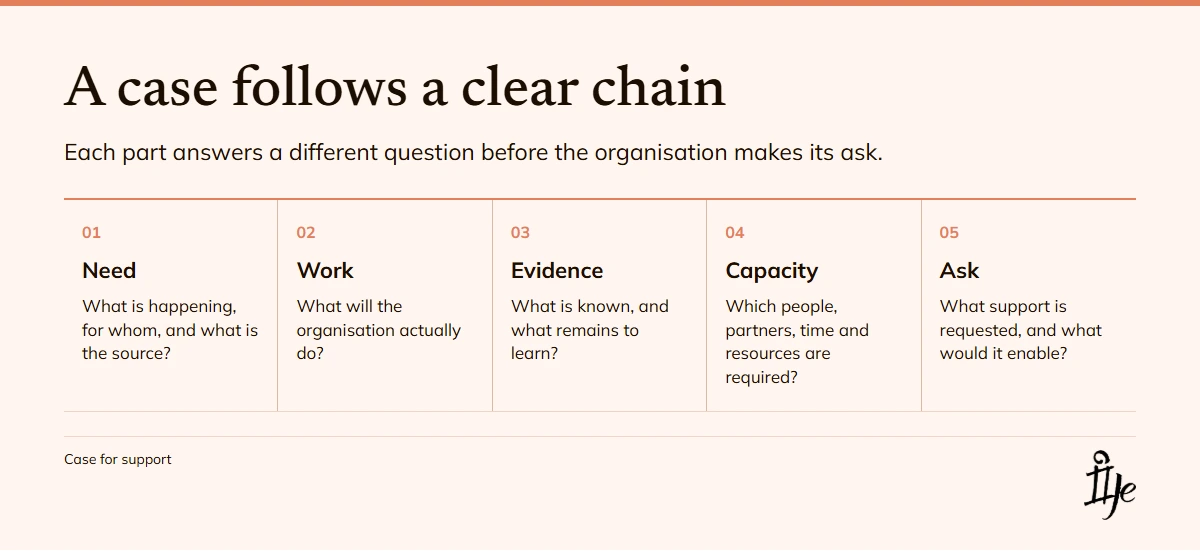
Before choosing photographs, colours or page count, connect six parts. Each should make the next one easier to understand:
- Need: What specific condition or challenge is the work addressing, and for whom? Use current, appropriately scoped evidence. Separate national context from what the organisation has observed in its own programme area.
- Response: What will the organisation actually do? Describe the activities and who will carry them out, not only the hoped-for change.
- Reason for this approach: Explain the link between the need and the proposed work. If the link depends on an assumption or partner, say so.
- Evidence and learning: What has the organisation already done, what can it show, and what remains unknown? An output such as sessions delivered is not automatically evidence of a longer-term outcome.
- Capacity and resources: What people, partnerships, time and costs are required? A case that leaves out material costs may describe an appealing idea that the organisation cannot responsibly deliver as written.
- Ask and next step: State the kind of support sought and what the reader can do next. If the plan is still being shaped, ask for the right conversation rather than implying a fully costed programme is ready.
One public project-design example from Made With Hope and CHETI places a case for support after earlier project-design work and lists need, solution, monitoring and evaluation, budget, sustainability and prior impact among its contents. That is how this particular process is documented; it is not a Nigerian rule. It illustrates a useful sequence: the case draws on decisions and evidence assembled elsewhere rather than pretending a designed document can make an unfinished project ready.
A fictional example: a community repair-skills programme
Suppose a Nigerian social enterprise wants to ask partners to support a supervised repair-skills programme. The following is fictional; it is not an Ije client or a claim about a real community.
| Case block | What the fictional team would need to say |
|---|---|
| Need | Which local repair-access or skills problem has the team actually documented? What is the source, date and area covered? |
| Response | What repair practice, supervision and equipment would the programme provide, and to whom? |
| Reason for the approach | Why do these activities fit the documented problem? Which assumptions still need testing? |
| Evidence and learning | What can the team already show? Which new measures would tell it whether participants completed practice or used the skills later? |
| Capacity and resources | Which supervisors, tools, partner sites, time and costs are required? Are those costs included in the plan? |
| Ask and next step | Is the request for equipment, a delivery partner, funding, or a planning conversation? What would each option enable the team to decide? |
Scroll sideways to read the full table.
The table does not invent a local statistic, budget or result. That is deliberate: if the team has not documented the need or costed the work, the case should identify that gap rather than fill it with a plausible-sounding figure. If the team does have those records, it can replace the prompts with sourced facts and label estimates as estimates.
Turn the argument into versions people can use
A source case may be longer than a website introduction or a conversation needs. Shortening it is safe only when the shorter version preserves the same meaning. Keep a small fact record beside the case: the need and its source, the work and its scope, the evidence and period, the cost basis, and the exact ask. Then adapt emphasis for the reader without changing those facts.
For example, a partner introduction may begin with the shared delivery role, while a public page may begin with the need and the organisation’s response. A funder proposal may require more detail about activities, timing, risks and budget. The sequence and length can change; the underlying programme, figures and evidence cannot quietly change with the audience.

One way to check is to compare three sentences across the versions: What is the need? What is the organisation doing? What support is requested? If those answers no longer agree, the team has changed the case—not merely shortened it. Resolve the difference against the programme owner and source records before publishing or sending the material.
Check the case before you share it
Read the draft as someone unfamiliar with the organisation. Can that person tell:
- who the work is for and what need it addresses;
- what the organisation proposes to do, in concrete terms;
- why that response follows from the need described;
- which statements are evidence, which are plans, and which are still assumptions;
- what the plan requires in people, partnerships, time and money; and
- what exact action or support is being requested?
If one answer is missing, the next step may be to improve the underlying programme plan, verify a source, or clarify the request—not to add more persuasive language. If the facts are sound but readers still encounter different accounts of the organisation’s work across its materials, that may point to a wider gap among identity, message, proof and audience meaning. Ije’s Brand-Power System explains how those assets can be organised together; it is not a fundraising service or a promise of funding outcomes.