

Brand Promise Examples: Make a Commitment Your Organisation Can Keep
Resume reading
A brand promise tells people what they can reasonably expect from an organisation. The words may be visible in a tagline or campaign, or the promise may be unstated and inferred from repeated experiences. Either way, people form expectations from what the organisation says and does.
That makes a promise more than a memorable line. For a nonprofit, it might concern how participants are treated or how a programme is explained. For a social enterprise, it may concern what a buyer receives and how the social purpose fits the offer. For a mission-led service business, it may concern the way work is scoped and delivered. The right promise depends on the organisation’s actual audience and work.
The examples below are constructed to show how a promise can connect to behaviour, evidence and scope. They are not descriptions of real organisations or proof of results.
What does a brand promise help people expect?
A useful working definition is simple: a brand promise describes an expectation people can carry into an interaction with an organisation. A Nigerian BusinessDay explainer describes the promise as what customers expect across a brand’s products and services. Ije applies the idea more broadly to the audiences an organisation is responsible to serve.
For mission-driven organisations, “customer” may be too narrow. The relevant audience could be a participant, community member, partner, funder, buyer or client. Each group may encounter a different part of the organisation’s work. A promise should therefore name the audience and moment it concerns rather than claim to be everything to everyone.
The difference between an aspiration and an expectation becomes clearer in practice. “We change lives” states a desired impact. It does not tell someone what the organisation will do when they contact it, apply for a programme, buy a product or begin a partnership. A promise answers a more immediate question: what can this person expect from us in this situation?
The organisation must be able to point to the behaviour behind the sentence. If it cannot name who does what, when, and what evidence would show that it happened, the line is probably still an aspiration. That does not make the aspiration unimportant; it means the team has not yet translated it into an experience it can describe and review.
Use a practical test: if your team cannot name the audience moment and the behaviour it can repeat, keep the line as an aspiration until it can. Otherwise, the next person still will not know what to expect from the organisation.
A promise is not the same as purpose, tagline or offer
These statements often sit close together in brand materials, but each has a different job.
| Statement | Question it answers | Example of its job |
|---|---|---|
| Purpose or mission | Why does the organisation exist, or what change does it seek to contribute to? | Names the organisation’s role or intended contribution. |
| Tagline | What short phrase should help people recognise or remember the brand? | Compresses an idea for public communication. |
| Offer | What service, product or programme is available, and on what terms? | Makes the actual exchange or participation clear. |
| Brand promise | What can a named audience reasonably expect from the organisation in a recurring interaction? | Sets an expectation the organisation’s behaviour should support. |
Scroll sideways to read the full table.
The distinctions matter when teams try to make one sentence do all four jobs. A purpose statement may be ambitious and still leave a prospective participant unsure what happens after they apply. A tagline can be memorable without describing a service. An offer can list deliverables without explaining the experience the organisation intends to make consistent.
The promise does not replace any of these. It connects the public expectation to the work that people actually encounter. Ije’s guide to a credible business purpose statement explores a different question: whether a purpose claim is supported by the organisation’s choices and evidence.
Choose the statement by asking what is still unclear: why the organisation exists, what phrase people should recall, what a person receives, or what they can expect in an interaction. Trying to make a tagline answer all four can leave the practical offer uncertain.
Three brand promise examples, traced to the work
The short sentences below are not finished slogans to copy. Each is a constructed example, followed by the behaviour and proof that would make it meaningful. A real organisation would need to adapt the language to its audience, service and capacity.
Nonprofit or social-impact programme
Constructed promise: “When you apply to the programme, we will explain the eligibility decision and your next step.”
This is narrower than promising that every applicant will be admitted or achieve a particular outcome. The team can support it through published criteria, an assigned response owner and a process for communicating decisions. It could review a sample of applicant communications to see whether the explanation and next step were actually provided.
The limit is part of the promise’s usefulness: it covers communication about a decision, not admission, employment or a change in a participant’s circumstances. If the team cannot reliably respond to applicants, it needs to address that service capacity before promoting the sentence.
Social enterprise
Constructed promise: “Before you buy, you can see the full price and what is included.”
The relevant behaviour is not a broad claim about changing the world. It is making the terms of the offer understandable before a purchase. A team could check product pages, invoices or point-of-sale materials to see whether the price and inclusions are visible and consistent.
This promise does not guarantee that every buyer will like the product or that each purchase will create a specific social outcome. Those claims would need their own evidence and scope. The promise stays with information the enterprise can control.
Mission-led service business
Constructed promise: “Before work begins, you will receive an agreed scope, a named contact and a review point.”
The supporting behaviour is concrete: confirm the work, identify who owns communication and set a point for checking progress. A team could inspect its engagement records to see whether those elements were shared before delivery started.
The promise does not guarantee that the work will produce a particular business result. It describes a consistent way of working. If the organisation cannot provide the named contact or review point for every engagement, it should define where the promise applies rather than imply universal coverage.
Across the examples, the sentence is only one part of the work. The promise becomes usable when the organisation can connect it to an owner, a repeatable action and evidence that can be checked.
Keep a promise only if a named owner can repeat the action and the organisation can inspect a record of it. If either is missing, improve the process or narrow the audience moment before publishing the line.
How to write a promise your team can keep
Start with one audience and one moment. “Everyone we serve, all the time” is too broad to guide behaviour. Choose a situation that matters to the organisation and the people it wants to serve: an enquiry, an application, a purchase, a project start or a partner hand-off.
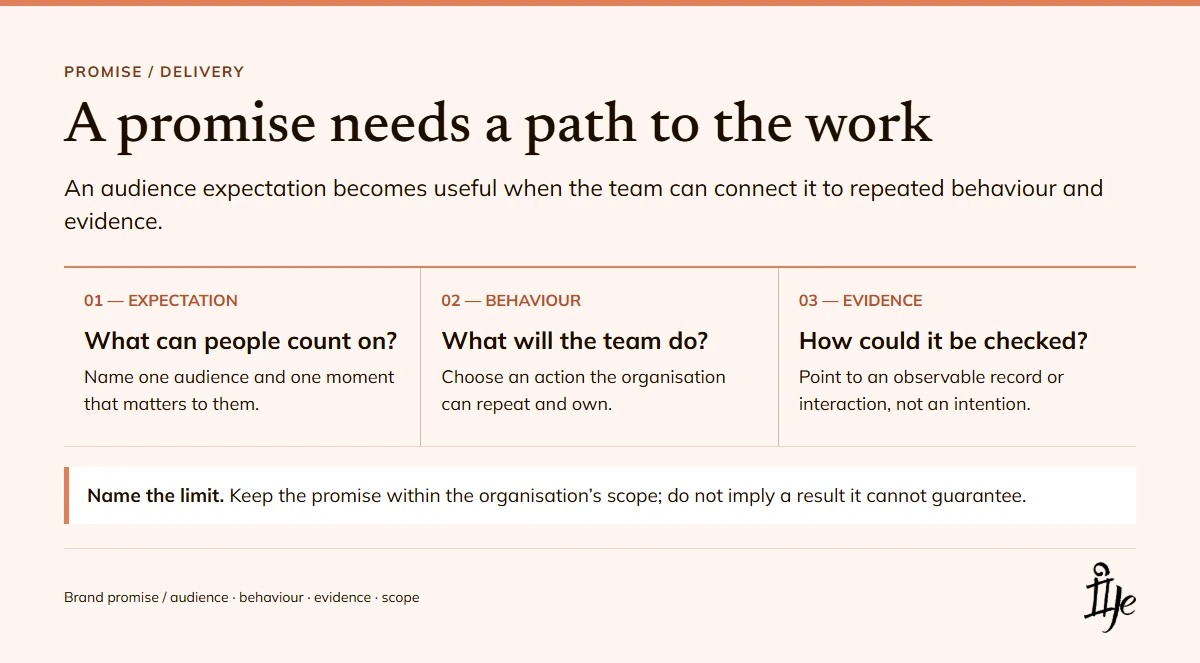
Then use this four-part trace:
- Name the expectation. What should the person be able to count on in that moment? Use words they would recognise, not an internal value such as “excellence” or “innovation.”
- Name the behaviour. What will the organisation or team do repeatedly to support that expectation? Choose an action within its control.
- Name the evidence. What existing record, artifact or observation could show whether the behaviour happened? Do not substitute an intention or a target for evidence of delivery.
- Name the limit. What does the sentence not promise? Be clear about eligibility, availability, timing, scope or outcomes that depend on other people or conditions.
Consider the aspiration “We change lives.” It may express the organisation’s purpose, but by itself it does not name an audience moment or a delivery behaviour. For a fictional programme that receives applications, the team might first describe what it can control: “Applicants receive a clear explanation of the decision and the next step.” The team could then identify an owner for sending those explanations and inspect a sample of communications. It would also state that the message does not promise admission or a particular life outcome.
In practice, the team would first check that applicants can find the eligibility criteria, assign someone to communicate each decision, and choose a record it can review. If those pieces are not in place, the organisation has a process to build before it has a promise to publish.
Notice what changed. The revised sentence is smaller than the aspiration, but more useful for the audience and the team. It points to a piece of work that can be assigned and reviewed. The purpose still matters; it simply belongs in a different part of the organisation’s message.
Write the promise in ordinary language, then ask someone unfamiliar with the internal discussion what they think it means. If they infer an outcome or entitlement the organisation did not intend, narrow the wording. If the sentence could describe any organisation, make the audience moment or behaviour more specific.

Check the promise against delivery before publishing it
Before the line goes on a website or into a presentation, check the work behind it:
- Audience: Can the intended audience recognise the situation the promise covers?
- Owner: Is a person or team responsible for the behaviour it describes?
- Evidence: Is there a record or observable action that can show whether the organisation kept it?
- Scope: Does the wording separate what the organisation controls from what depends on eligibility, partners, funding or external conditions?
- Exceptions: What happens when the normal process cannot be followed, and how will the audience be told?
For the applicant example, this means checking that the criteria are available, someone owns the response, and a sample of communications can show whether applicants received a decision and next step. The team also needs a way to explain delays or exceptions.
If the team cannot answer one of these, it may need to improve the service, process or evidence before it publishes the sentence. A change in wording can clarify a real commitment; it cannot create the staff time, information or delivery practice needed to keep it.
Ije’s Brand Promise Readiness Diagnostic can help a team review audience clarity, proof, delivery reality, message focus and the scope of a promise. It is a readiness check, not a promise-writing service or verification of audience response. If the promise is one of several disconnected identity, message and proof assets, the Brand-Power System explains how Ije organises that wider work.