

What Does a Brand Consultant Do? Scope, Deliverables and Fit
Resume reading
A team asks a brand consultant for help because the organisation is difficult to explain. Someone else says the logo is the problem. A funder-facing deck and the website describe the work differently. Those concerns may be connected, but they do not yet call for the same assignment.
The useful first question is not “Which package should we buy?” It is “What decision are we unable to make, and what work would help us make it?” The answer could be a strategy engagement, a visual identity project, a messaging brief, a campaign, or a combination. It could also be that the organisation already has clear direction and needs a designer to apply it. A consultant’s title cannot settle that for you.

The consultant label can cover different work
“Brand consultant” is a broad service label, not a standard list of deliverables. One person may advise on positioning and messaging. Another may also design the identity or manage campaigns. An agency may bring several specialists into one project. The useful distinction is between the decisions you need help with and the work someone will actually perform.
For example, “we need a new brand” may mean any of these:
- The organisation cannot explain whom it serves or what it offers.
- The team has agreed its position but needs a visual identity and usage guidance.
- Different programmes use conflicting messages and evidence.
- A campaign needs to reach a defined audience with an agreed proposition.
- Staff need existing materials adapted for a new channel.
These requests point to different work. A visual designer can create a strong identity from an approved direction; that does not automatically mean the designer was hired to decide the organisation’s audience or offer. A communications team can plan a campaign; it cannot supply a missing impact record. A consultant may identify those gaps, but the proposal should say whether resolving them is included.
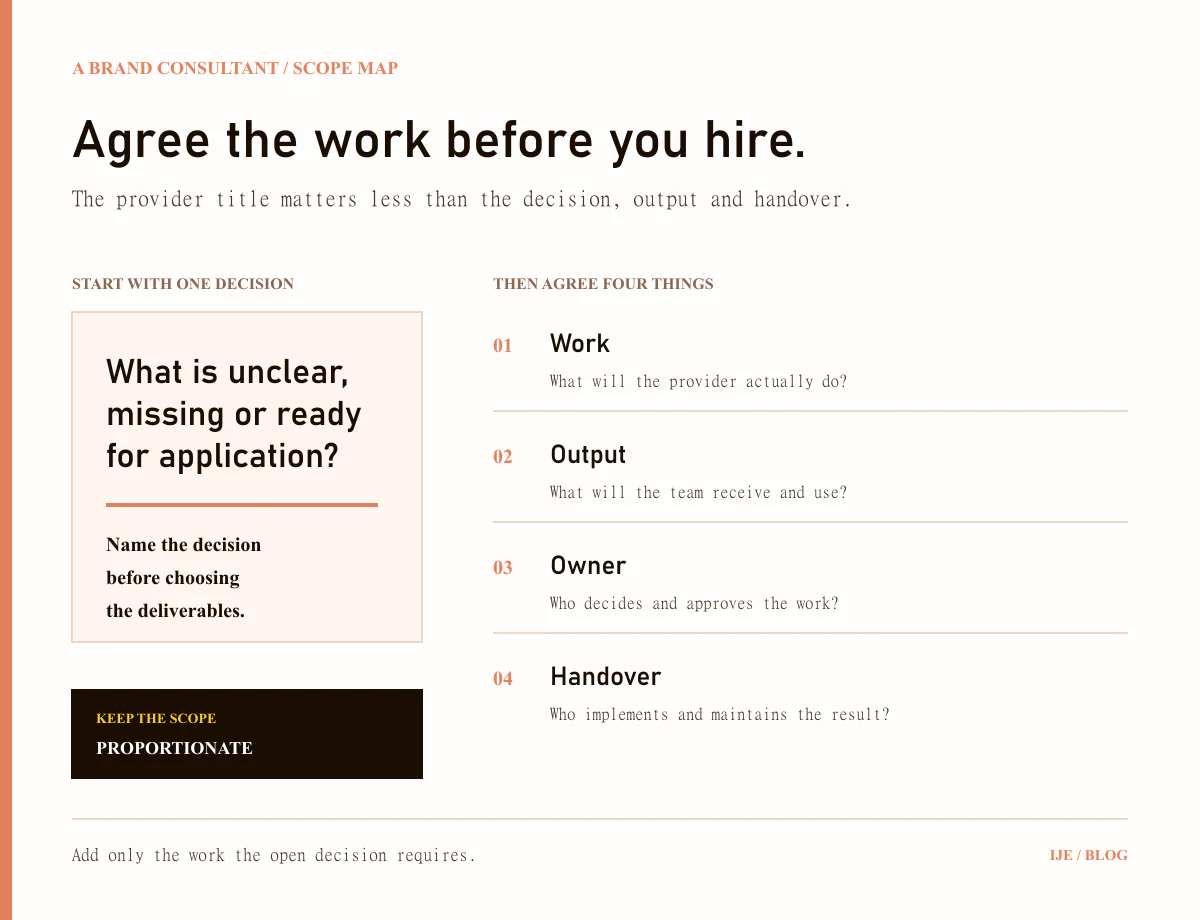
When a provider offers both advice and production, ask which part of the fee covers each. Ask who makes the decisions, what you will receive, and who will use or maintain the work after handover. Do not infer a scope from a title or from a gallery of finished designs.
Start with the decision your organisation needs to make
Imagine a Nigerian social enterprise that sells affordable solar equipment and also runs a community energy programme. Its leadership wants a new identity because partners describe the organisation in different ways. At first glance, this sounds like a design request. But the team may have two unresolved questions: which part of the offer should lead in partner conversations, and how should the organisation distinguish commercial sales from the community programme?
If those decisions are still open, starting with a logo may produce a polished expression of a position the team has not chosen. The consultant’s first task might instead be to clarify the audiences, offers, evidence and relationship between the two parts of the organisation. The visual identity can then express those decisions.
There is another possible reading. The leadership may already have agreed the audiences, offer and relationship, while the current identity is simply hard to apply across its website and partner materials. In that case, a focused identity brief may be enough. A long strategy process would add work without answering a question the team still has.
Use three questions to separate these situations:
- What do we need to decide? Name the choice, such as the priority audience, offer, position, message or visual application.
- What do we already know? Point to approved strategy, current audience evidence, proof, materials and decisions. Mark assumptions separately.
- What output would help us act? This might be a positioning decision, message architecture, identity system, campaign plan, implementation support or a combination.
The answers should change the scope. If the decision is already made, commission the missing production. If it is not, agree who will help resolve it and what evidence the work will examine. If the team cannot yet tell, a bounded diagnostic or discovery phase may be more useful than approving a complete rebrand.
Connect the scope to an output and an owner
A proposal is easier to evaluate when it connects the work to an output and a responsibility. The table below is a drafting aid. Remove any row that does not fit the assignment; add the people, materials or approval stages your organisation actually needs.
| Scope item | What to specify | Example question |
|---|---|---|
| Decision | What must be clearer or agreed by the end? | Are we resolving the offer and audience, or applying an already approved position? |
| Inputs | What evidence and materials will inform the work? | Which strategy, audience feedback, programme records, website pages or existing identity files will be reviewed? |
| Activities | What will the provider do? | Will they facilitate decisions, interview stakeholders, write messages, design assets, or manage implementation? |
| Outputs | What will the organisation receive? | Is there a decision record, message guide, identity files, campaign plan, or implementation support? |
| Roles | Who supplies information, makes decisions, approves claims and maintains the assets? | Who can confirm programme details and who gives final approval? |
| Exclusions | What is not included? | Does the scope exclude research, website development, printing, media buying or ongoing content production? |
| Review | What can be checked at handover? | Are the files complete, do the approved claims match their evidence, and can the team apply the guidance? |
Scroll sideways to read the full table.
Do not treat a long deliverables list as proof of a useful engagement. Twenty assets may all depend on a positioning decision the organisation has not made. A short decision record can be more valuable when it clarifies the audience, offer, message and evidence that the later assets must follow.
At the same time, avoid buying strategy work by default. If the organisation has current, approved direction and the team can use it consistently, the brief can begin with production. The point is to pay for the unresolved work, not to make every project larger.
Brand strategy, design and marketing answer different questions
Providers often combine these services, so the labels alone do not tell you what is included. Ask what decision or deliverable sits behind each term.
| Work | Main question | Possible output |
|---|---|---|
| Brand strategy | What should the organisation be known for, for whom, and on what basis? | Positioning decisions, audience priorities, message direction and evidence needs |
| Visual identity | How should approved direction be expressed and applied visually? | Logo system, typography and colour guidance, templates or application files |
| Marketing | How will a particular offer reach and serve its intended market? | Channel or campaign plan, content, media activity and measurement approach |
| Communications and PR | What should a defined audience understand, and through which relationships or channels? | Messages, communication plan, media work or stakeholder materials |
Scroll sideways to read the full table.

These boundaries are not fixed job descriptions. A single provider may be qualified and contracted to do more than one kind of work. The proposal still needs to distinguish the activities, outputs and people responsible. A page that says “strategy, branding and marketing” may describe a broad capability; it does not prove that each item is included in your fee.
If your organisation already has the strategic decisions in writing, send them with the brief and ask the provider to identify what remains unclear. If the provider recommends changing an approved decision, ask what evidence or new information supports that recommendation. A fresh opinion is not the same as a completed research step.
A connected scope follows the decisions still open
Some assignments cross several assets because the organisation’s public meaning depends on how they work together. A purpose statement may not explain the offer. A website may claim an outcome that the programme records cannot support. A visual identity may be clear, while teams keep using different descriptions. A campaign can then repeat the same confusion at a larger scale.
That is when the brief may need to connect direction, audience, positioning, messages, proof, identity and activation. The Brand-Power Gap is Ije’s way of naming the distance between the impact an organisation creates and its ability to turn that impact into visibility, trust, support and sustained advantage. It is a way to examine the connected problem; it is not a claim that every organisation needs every service.
Return to the hypothetical solar enterprise. If its audiences, offers and evidence are still mixed together, the work may need to clarify those decisions before producing separate sales and programme materials. If those decisions are already agreed, the assignment can stay focused on the identity applications. The scope should expand only when one unresolved decision affects several assets.
Ije’s Brand-Power System describes how Ije connects diagnosis, identity, proof, story and public presence when that broader work is warranted. Its method begins by revealing and naming the gap before organising and activating the work. If you are unsure where the problem sits, the Brand-Power Problem Finder offers a bounded starting check; its result is not a final diagnosis or a substitute for organisational evidence.
Prepare a short brief for the first conversation
Before you contact a provider, write six lines. The answers can be provisional; the purpose is to make the open questions visible.
- Our organisation and offer: What do we do, for whom, and where does the work happen?
- The audience that matters for this assignment: Who needs to understand or use the result?
- The decision or problem: What is unclear, inconsistent or missing today?
- What we have already decided: Which strategy, evidence, message or identity choices are current and approved?
- The output we need: What should the provider deliver, and who will apply it?
- What is outside the assignment: Which work, costs, approvals or outcomes should not be assumed?
For the solar enterprise, the brief might say: “We need partners to understand how our equipment offer relates to our community programme. We have not agreed which audience comes first in partnership materials. We can provide current programme records and the approved product description. We need the provider to help clarify the relationship and produce a message direction; a new visual identity and media buying are not yet in scope.”
That statement does not prove what partners think or guarantee that the new materials will secure support. It gives the consultant a concrete question, identifies available inputs and prevents two excluded activities from quietly entering the proposal. The provider can then explain what additional evidence is needed, what work they recommend and what the organisation must decide itself.
Choose the scope that matches the work
A brand consultant may advise, facilitate decisions, develop strategy, create assets or support implementation. The label tells you less than the proposal’s account of the work. Start with the decision, check what your organisation already knows, and agree the outputs and responsibilities that fit.
If you need a visual application, brief that work. If the organisation is still choosing its audience, offer or message, include the decisions that must come first. If several connected assets are at issue, compare the proposed scope with Ije’s Brand-Power System to understand one way that broader work can be organised.