

Impact Report Template: A Practical Structure for Nigerian Nonprofits
Resume reading
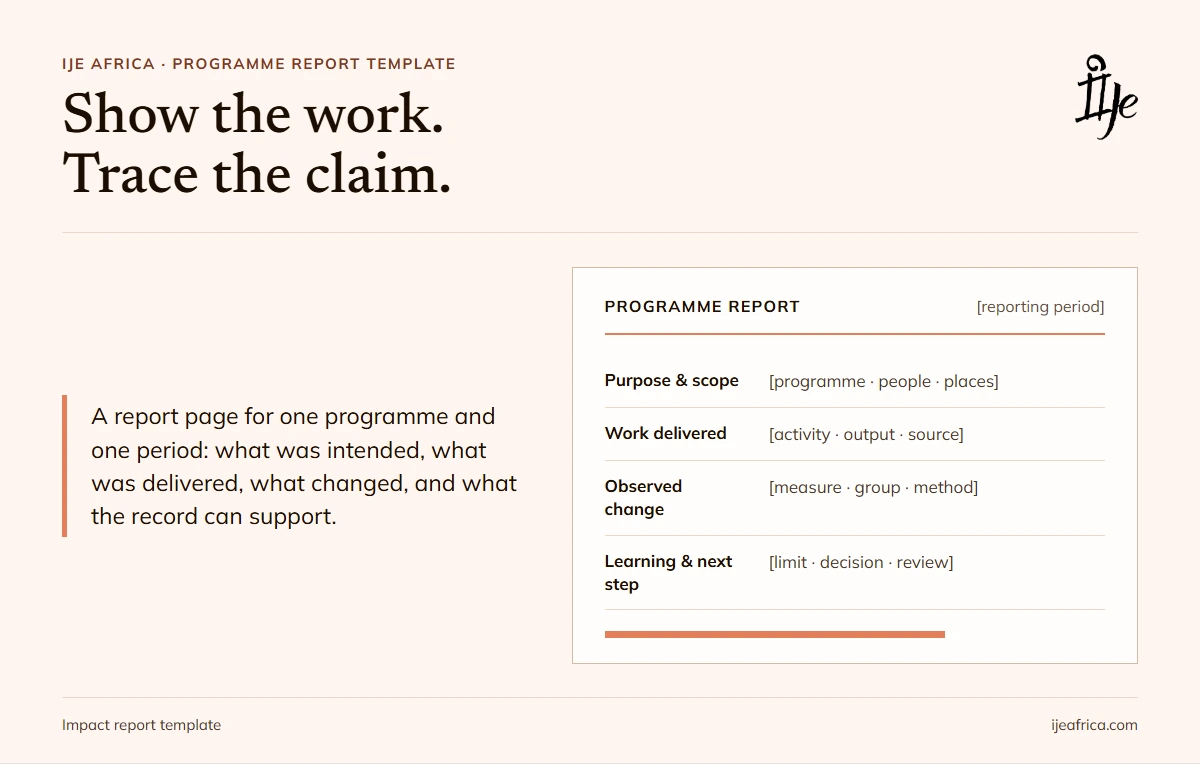
If you need an impact report template, begin with the programme and reporting period you want to explain. A report covering one intervention needs different detail from an organisation-wide annual report. The structure below is for one programme or a defined programme period. Copy it into your working document, remove sections that do not fit, and keep the source notes with each claim.
Choose the report’s unit and reader
Write down what the report covers before drafting the opening. Is it one project, a programme across several locations, or the organisation’s full year? Name the period, places and intended reader. If the account covers activities in several Nigerian states or local government areas, say which locations are included and how they were counted. A total without a defined scope can be mistaken for a complete account of work that was outside the report.
An impact report may sit beside an annual report, assessment or financial statement. The Nigeria Network of NGOs’ annual-report guide treats programmes, achievements and financial statements as parts of an annual account; those documents do different jobs. A Nigerian report page such as Supertouch Kindness Foundation’s separates yearly impact reports from assessments and board reports. The useful lesson is to name the document and its scope clearly, not to assume that every report type belongs in one file. The annual-report examples article looks at how Nigerian organisations label and present those documents.
Copy this impact report template
Use the prompts as a starting structure. Replace every bracket with information that your programme team can verify. If a field does not apply, remove it; if the information is not available, say so rather than filling the gap with an estimate presented as fact.
1. Report details
- Programme: [Name used by the organisation]
- Reporting period: [Start date–end date]
- Locations covered: [State, LGA, community or service area, as relevant]
- Prepared for: [Intended reader or group]
- Prepared by / reviewed by: [Names or roles]
- Publication date and version: [Date / version]
2. Purpose and scope
- What need or opportunity was the programme designed to address? [State the issue and whose experience or evidence informed the work.]
- Who was the programme intended to serve? [Define the group and relevant eligibility or location boundaries.]
- What does this report cover? [State programme, period, locations and work included.]
- What does it not cover? [Name any locations, activities, groups or results outside the available record.]
3. Work delivered
| Activity or service | Planned | Delivered | Period and location | Source record |
|---|---|---|---|---|
| [Activity] | [Plan or target] | [What the record shows] | [When and where] | [Register, log, report or named source] |
Scroll sideways to read the full table.
Use the count that matches the record. For example, a session register may show sessions delivered or attendances recorded; it does not automatically show the number of distinct people reached. State the measure’s definition so a reader knows which count they are seeing.
4. What changed during the period
| Intended change | What was observed | For whom / where | Evidence and method | What remains uncertain |
|---|---|---|---|---|
| [Expected change] | [Observed result, including no change or an unexpected result] | [Group and scope] | [Source, method and date] | [Limit, missing baseline or alternative explanation] |
Scroll sideways to read the full table.
Keep the wording close to the evidence. If participants described a change in interviews, identify that as reported experience. If a before-and-after measure changed, state how it was measured and for whom. Do not describe either as proof that the programme alone caused a broader change unless the research design supports that conclusion.
5. One finding, explained
- Statement for the reader: [One sentence that the source supports.]
- Measure and definition: [What was counted or assessed, and how it was defined.]
- Source and date: [Record, dataset, interview or assessment; date collected or published.]
- Period and population: [When, where and for whom the finding applies.]
- Interpretation: [What the finding may mean for the programme.]
- Limit: [What it cannot establish or what is not yet known.]
- Decision or action: [What the team did or will examine next.]
The OECD’s guidance on evaluation distinguishes results at output, outcome and impact levels, and notes that assessing higher-level effects requires suitable data and methods. For this template, use the distinction as a check on your wording: a completed activity is not itself an observed outcome, and an observed change does not by itself establish what caused it. The reporting method should fit the question and the evidence available.
6. Participant or community account
- What experience does this account help explain? [Connect the account to a specific part of the programme.]
- What words or details are cleared for publication? [Use only material permitted for this purpose.]
- How will the person or community be identified? [Use the agreed name, attribution or anonymisation.]
- What context is needed to avoid misreading the account? [Include the relevant period, service or limitation.]
A story can make a programme easier to understand, but one person’s account does not represent every participant. Keep the person in control of identifying details and do not turn a difficult experience into a dramatic device. If the report has no account that is appropriate to publish, leave the section out.
7. Resources and partnerships
- What resources supported delivery? [Use the financial or in-kind categories relevant to the report.]
- Which partners contributed, and how? [Name the role accurately and confirm the public acknowledgement is appropriate.]
- Which source supports the figures or descriptions? [Link or name the underlying record and responsible reviewer.]
If the document includes financial information, identify the statement or records used and have the responsible finance lead review the figures. A programme impact account is not a substitute for audited accounts or any separate reporting a funder or regulator requires.
8. Learning, limitations and next step
- What did the team learn from the period? [Include a finding that changed the programme’s understanding or approach.]
- What did not go as planned? [State the difference and what the team knows about it.]
- What is not yet known? [Name a question that needs further evidence or time.]
- What will the team do next? [Give the next action, owner or review point if known.]
Keep activities, outputs, outcomes and impact distinct
The terms describe different points in a results chain. An activity is work undertaken. An output is a product or service delivered. An outcome is a change observed among people, organisations or conditions. Impact refers to higher-level effects and may require a longer time horizon and more demanding evidence. The OECD’s guidance cautions that methods should follow the evaluation question and context; its criteria are guidance, not a form every nonprofit must use.
When a team writes “we delivered the training,” it has described an activity. “Participants completed the training” reports an output if the completion record supports it. A statement about changed knowledge or practice needs evidence that actually measures that change. A wider claim about improved livelihoods or community health needs evidence suited to that claim and a careful account of other influences. If the programme did not measure a result, the report can state what it delivered and what it plans to examine next.
Make each number and story traceable
Before publication, ask a colleague to select a figure and locate its source without help from the person who drafted the page. Can they identify its unit, definition, period and population? Can they see whether the total includes repeat visits, more than one location, or several programme phases? If not, add the missing context or revise the sentence.
Name the measure precisely: sessions delivered, attendances recorded and distinct people reached are different counts. A register that records attendance cannot establish the number of unique people unless the data also identifies repeat participation.
The Nigeria Network of NGOs’ annual-report guide advises nonprofits to keep information simple and verifiable. Applied here, each prominent number should have a clear label and a source the team can retrieve. If you need to build that source trail across proposals and reports, How to Organise Nonprofit Evidence for Grant Proposals and Impact Reports shows a reusable way to record a claim, definition and source.

Finish with learning and the next reporting step
The final review is not only a spelling check. Read the report as someone who did not run the programme. Can they tell what period and locations it covers? Can they distinguish what the team delivered from what changed? Does every major claim have a source and a scope? Are limitations visible where they affect interpretation? Do the photographs and personal accounts have permission for this use?
If the account is ready but its story needs clearer order, Ije’s Impact Narrative Planner can help organise the material. For a full organisation-wide annual report, use the Annual Report Narrative Planner instead. The two reports may share evidence, but their audience and scope are not automatically the same.
Common questions about impact reports
What should an impact report include?
For a programme-level account, start with purpose and scope, work delivered, observed results, supporting evidence, relevant participant or community accounts, resources, learning, limitations and next steps. Choose only sections your reader needs and your records can support.
What is the difference between an impact report and an annual report?
An impact report may focus on a programme or a defined set of results. An annual report usually covers a broader organisational period and may include governance, activities, finances and several programmes. The title alone does not tell a reader exactly what is included; state the report’s scope.
Can one template cover every programme?
The same prompts can help teams organise different reports, but the measures and evidence will vary. A health service, arts programme and social enterprise do not use identical indicators. Keep the reporting structure consistent where it helps readers, then adapt the measures to the programme’s purpose and available evidence.