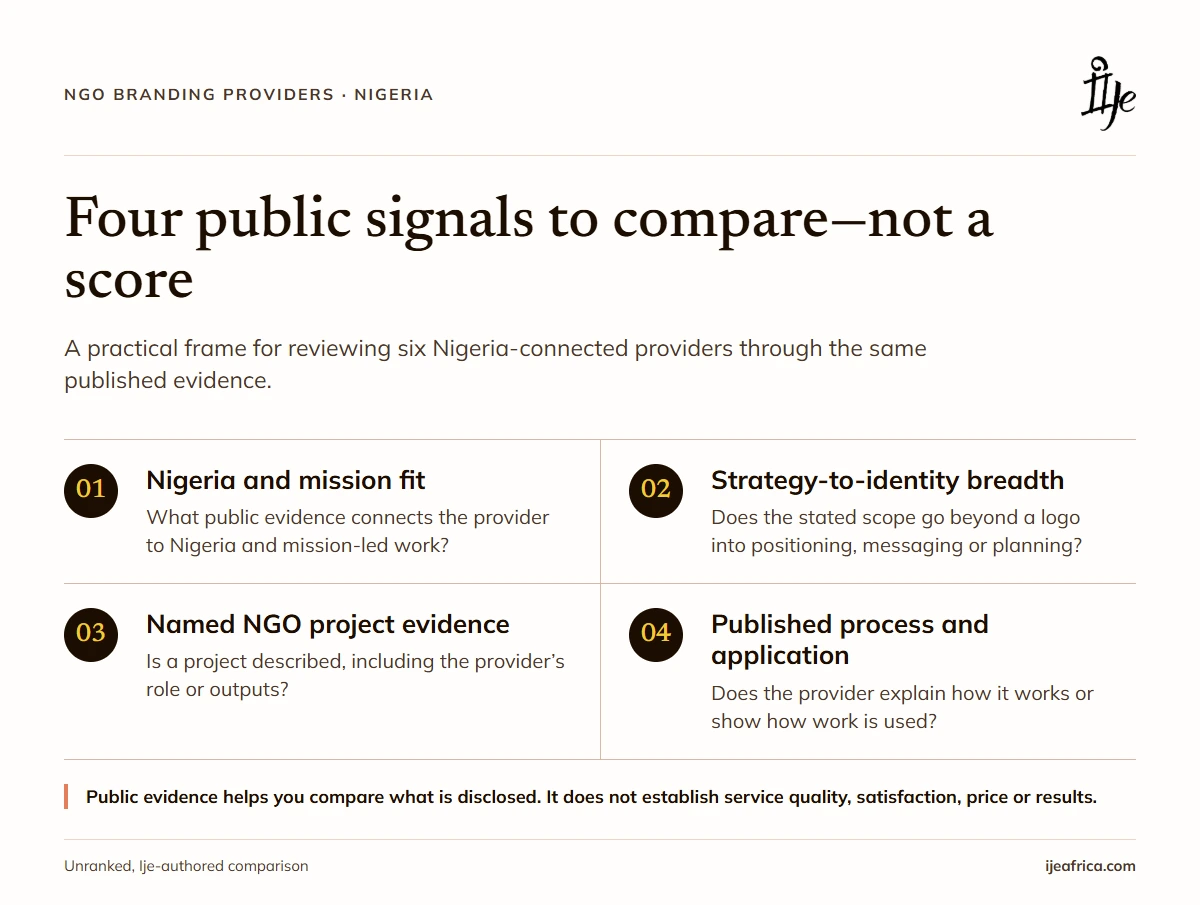
If you are searching for the best NGO branding agency in Nigeria, you may be comparing providers and looking for work that fits your organisation. This article introduces six Nigeria-connected providers and describes the same public signals for each: fit with mission-driven work, scope from strategy into identity, named NGO project evidence, and a visible working approach.
The same four questions for each provider
Nigeria and mission-driven fit: What public evidence connects the provider to Nigeria and NGO or mission-led work?
Strategy-to-identity breadth: Does the published scope extend beyond a logo into positioning, messaging, identity, or connected brand planning?
Concrete NGO project evidence: Is a named NGO project described, including the provider’s role or outputs?
Published process and application: Does the provider explain how it works or show how its work is used?
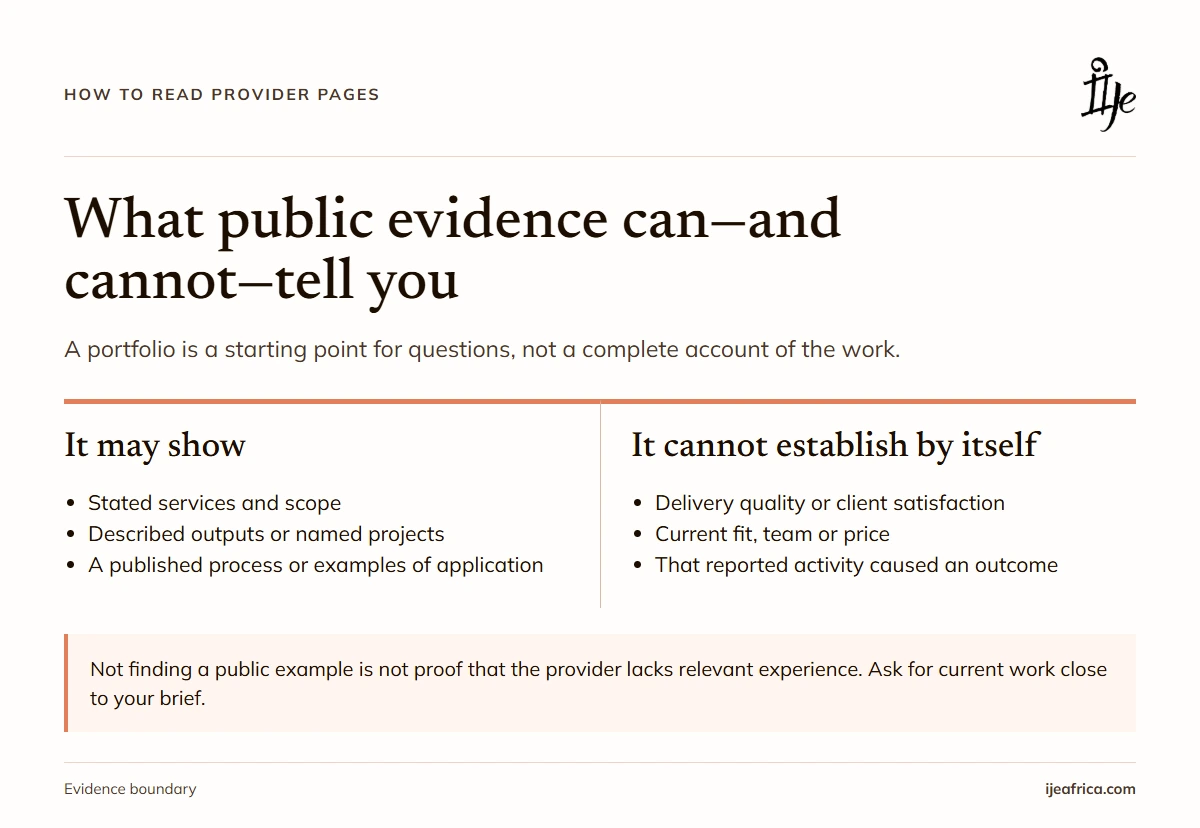
These are practical comparison questions, not a sector-standard scorecard. Applying them to every provider makes the public evidence easier to compare without turning it into a score of service quality. A missing public example means we did not find it in the pages reviewed; it does not prove the provider lacks relevant experience. Ask each firm for current evidence related to your actual brief.
Public pages are useful starting evidence, not a substitute for project-specific questions.
Awora Studio
Nigeria and mission-driven fit. Awora Studio’s portfolio includes The Orchid Mission Nigeria, a nonprofit supporting children with neurodevelopmental disabilities.
Strategy-to-identity breadth. The studio’s described process includes discovery and planning as well as design. The named NGO engagement is a focused visual identity project, not evidence of a complete organisation-wide communications system.
Concrete NGO project evidence. Awora’s 2022 Orchid Mission project describes logo, visual language, colour and typography decisions. This is the provider’s own project account.
Published process and what to ask. The Orchid Mission project page describes the design decisions behind that identity. Ask for recent related work, the proposed team and examples showing how the identity was used after handover.
Baselinks Business Consult
Nigeria and mission-driven fit. Baselinks is a Nigerian business consultancy whose public portfolio includes work for Dipo Dayo Foundation.
Strategy-to-identity breadth. The visible example focuses on visual identity and stationery. The case provides less public detail about stakeholder research, positioning or ongoing activation.
Concrete NGO project evidence. Baselinks’ Dipo Dayo Foundation case describes a logo, colour palette, typography, guidelines and stationery. This is a provider-published description of deliverables.
Published process and what to ask. The listed assets make the scope easier to discuss, but do not independently establish effects on donor trust or growth. Ask what strategic inputs informed the identity, what editable files are included and how the work will be applied beyond stationery.
Brandor Creative Media Agency
Nigeria and mission-driven fit. Brandor describes serving NGOs and development partners. Its stated work includes branding, strategic storytelling, event documentation, media production, communications and training.
Strategy-to-identity breadth. Its public scope spans brand-related and communications work, but the currently visible examples are more concrete for event and media assignments than for a full NGO brand-strategy and identity system.
Concrete NGO project evidence. The Brandor website and visible projects establish its stated NGO and development-partner focus. The pages reviewed for this comparison did not show a detailed named NGO identity-system case. That is a limit of the public material reviewed, not proof that no such work exists.
Published process and what to ask. The service descriptions identify several kinds of work. Ask who owns positioning and identity decisions, how strategy informs production, and for a directly relevant NGO example if your brief goes beyond programme documentation or media.
Goldrush Multimedia
Nigeria and mission-driven fit. Goldrush’s current homepage lists non-profit and NGO work among its sectors and identifies its headquarters as Abuja, Nigeria.
Strategy-to-identity breadth. Its published disciplines span brand strategy and identity, communications and public relations, digital and content marketing, and creative production.
Concrete NGO project evidence. The public pages reviewed list NGO and nonprofit sectors but did not surface a detailed, named NGO branding case. This does not establish that Goldrush has not done such work.
Published process and what to ask. Goldrush describes a Discover–Strategise–Create–Deliver process on its homepage. Ask for a relevant NGO example, clarify who would lead and deliver the work, and distinguish brand strategy from any ongoing media or campaign scope.
Ije Africa
Disclosure. Ije Africa publishes this comparison and is describing its own services here. This profile is first-party information, not an independent assessment.
Nigeria and mission-driven fit. Ije focuses on Nigeria’s mission-driven organisations and businesses, including nonprofits and social-impact organisations.
Strategy-to-identity breadth. Ije describes a connected Brand-Power System and a five-part method—Reveal, Name, Organise, Activate and Shape—that links identity, proof, story, public presence and response pathways. Read Ije’s method and Brand-Power System.
Concrete NGO project evidence. Ije’s public portfolio names work for organisations including CHEVS and IGE-SRH and identifies report, website and communications-strategy assets. The page shows selected work, but provides less project context and bounded outcome evidence than a buyer may want from a full case study. Treat the portfolio as Ije-published examples, not independent outcome verification.
Published process and what to ask. The method and offer pages explain Ije’s intended approach. If considering Ije, ask for the project example closest to your organisation and confirm scope, evidence, deliverables and decision ownership. If your strategy is settled and you need one discrete production task, ask whether the broader approach is warranted.
Talku Talku
Nigeria and mission-driven fit. Talku Talku’s current homepage positions the company around revenue and growth systems, including a Brand-to-Market pathway. The TGAS Foundation example is a provider-published NGO case, not proof that NGOs are its exclusive or current primary audience.
Strategy-to-identity breadth. Talku Talku’s TGAS Foundation case describes work from visual identity and brand voice to an awareness playbook, digital assets and early campaign activity.
Concrete NGO project evidence. The case names TGAS Foundation and describes its own account of the engagement. Its outcome statements have not been independently verified for this article.
Published process and what to ask. Talku Talku’s current homepage describes an approach built around diagnosing the problem, designing solutions and building workflows. Ask which parts of the TGAS case reflect the current offer, who would lead your project and what evidence supports any outcome relevant to your brief.
Before you brief a provider
Use the same questions with each firm you approach:
Which past assignment is closest to ours, and what exactly did your team deliver?
Who will lead the work, and which decisions or inputs will you need from us?
Which deliverables, formats, review rounds and editable files are included?
What is outside scope, what could add cost, and how will we approve completion?
If public claims or people’s stories are involved, how will accuracy, permission and attribution be handled?
The answers may make one provider a stronger fit for your particular project. A firm with public evidence of broad strategy work is not automatically the right choice for a settled, one-off design assignment.
When the brief reaches beyond a visual refresh
If your organisation’s message, evidence, story, website and supporter pathways each tell a different part of the story, the issue may extend beyond visual identity. Ije’s Brand-Power System explains how Ije approaches those connected parts. It is one option to examine—not a requirement for every NGO hiring a branding provider.
How this comparison was assembled
We reviewed public provider pages and named project examples available on 26 September 2026. Ije Africa publishes this article and is included in it. The six profiles are alphabetical and use the same four questions; there are no scores, ranks or claims of independent judgement. Provider-published claims have not been independently audited. This is a selected comparison, not an exhaustive directory of Nigerian branding providers.