
Brand Audit: What to Examine Before Changing Your Brand
Resume reading
Someone has asked for a new logo. A partner says the organisation's message is not clear. A programme team has produced materials that look as if they came from different organisations. These can all prompt a brand audit, but they do not yet tell you what needs to change.
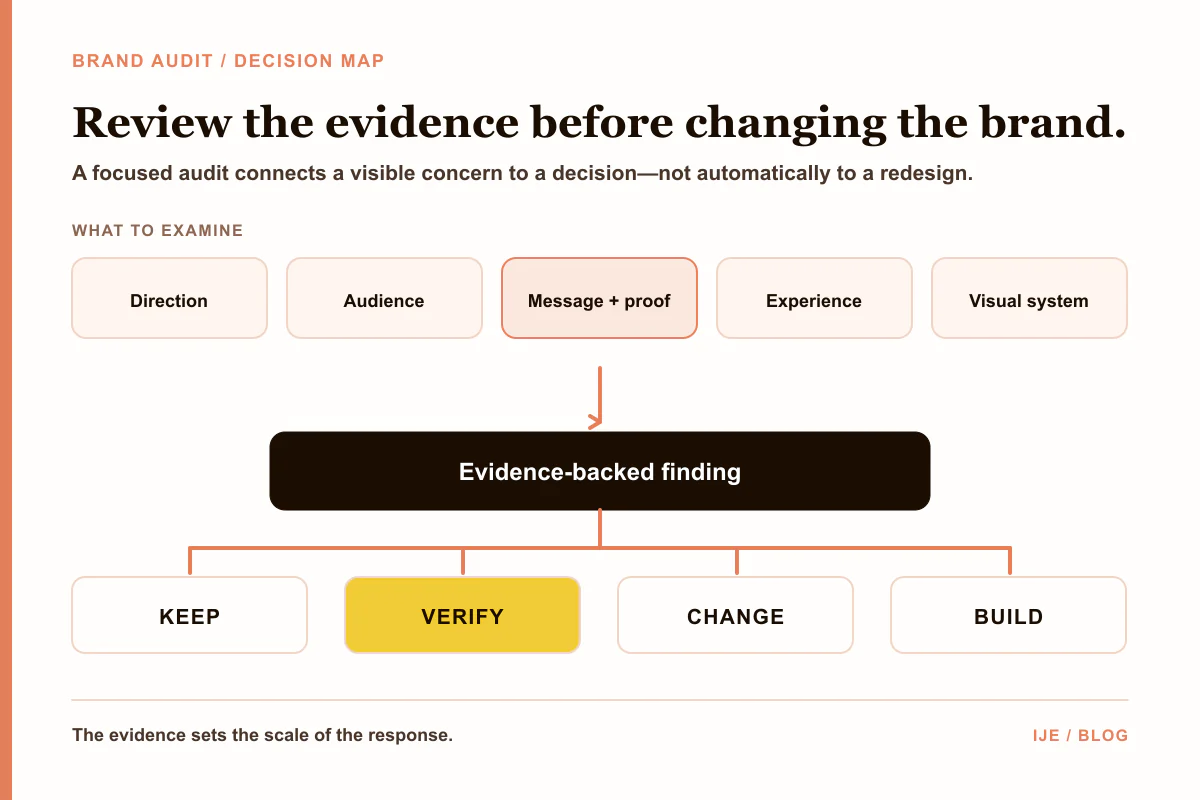
A brand audit is a structured review of what an organisation intends its brand to mean, what people encounter, and what evidence is available about the gap between the two. It can cover strategy, audience understanding, positioning, messaging, visual identity, experience and the systems that keep those things connected. The exact scope depends on the decision the organisation needs to make. AAMA's editable audit, for example, spans strategic and operational areas and advises teams not to score a question when they lack evidence. Shopify's guide also includes customer experience and internal culture alongside external materials. These are examples of audit approaches, not one universal checklist.

The audit's job is not to prove that a rebrand is needed. It is to help the team decide whether to keep what it has, verify a concern, change a specific asset or process, or build something that is missing.
Start with the decision, not the logo folder
Before collecting every presentation, social post and banner, write down the decision the review should support. “Our brand looks dated” is a concern. It is not yet a decision question. Try to make the question answerable:
- Should we change the visual identity, or is the issue limited to how current materials are applied?
- Do new audiences understand what the organisation does and whom it serves?
- Can we support the promise in our public message with a real, repeatable experience?
- Are several programmes using separate identities because their audiences need them, or because the organisation's own structure is unclear?
Choose one priority audience and one moment that matters to them. A person who first hears of a social enterprise at a market, a foundation reviewing a partnership proposal and a programme participant trying to find application criteria encounter different parts of a brand. An audit that tries to examine every audience and channel at once can become a large inventory without a useful decision at the end.
Set a practical boundary: which decision is in scope, which audience matters most for it, and which representative moments can give you evidence. Record what is outside the review too. If the team is examining inquiry clarity, it may not need to score every internal document or produce a new identity system.
What to examine in a brand audit
Collect a small set of current materials and observations across the parts of the brand that could explain the concern. Do not treat the table as a compulsory scorecard; use the rows that relate to the decision.
| Area | What to inspect | Evidence might include | What that evidence cannot establish alone |
|---|---|---|---|
| Direction and positioning | What the organisation wants to be known for, whom it serves, and what it offers | Approved strategy, offer description, audience research, decision records | Whether an audience understands or values that position |
| Audience meaning | What people think the organisation does and what they expect next | Interviews, enquiry questions, feedback, referral language, usability observations | What all audiences think, if the sample is narrow or self-selected |
| Message and proof | Whether important claims are clear, specific and supported | Website copy, proposals, programme materials, evidence records | Whether a claim is true just because it appears in several places |
| Experience | Whether the next interaction matches the expectation set by the message | Enquiry steps, response time records, application instructions, service observations | Why an interaction failed without checking capacity, process and context |
| Visual identity | Whether the approved identity is recognisable, readable and applied consistently | Website, report, social page, presentation, print or event material | Whether the organisation's strategy or service is sound |
| Ownership and use | Whether people can find current assets and know who maintains them | Source files, guidance, approval routes, staff or partner workflows | Whether a manual is useful just because it exists |
Scroll sideways to read the full table.
Use evidence that is recent enough for the question. A ten-year-old strategy may explain why a logo was chosen; it cannot tell you what current participants understand. Website analytics can show where people leave a page; they do not explain why someone left. A team member can identify an inconsistent deck; that observation does not prove that the inconsistency caused a funding or partnership decision.
For each finding, keep four things separate: what you observed, what source supports it, what you think it might mean, and what you still do not know. This is where an audit becomes useful. Without the separation, a preference such as “the orange should be brighter” can acquire the authority of a research finding.
A hypothetical finding: is the message or the process at fault?
Suppose a Nigerian social enterprise hears that prospective partners do not know what to do after reading its programme page. The immediate suggestion is to redesign the page. Before accepting that recommendation, the team examines the page, the partnership deck, recent enquiry messages and the response process.
The page names the programme and describes its purpose. The deck describes a different next step. Enquiries are routed to an inbox with no named response owner. Those observations support at least two explanations: the message may be unclear, or the process may make the next step hard to complete. They do not show whether partners understood the offer, whether the response delay changed a decision, or whether the page's visual design is the main barrier. The team would need appropriate audience feedback or interaction evidence to answer those questions.
If it changes the page alone, the organisation may make a clearer promise that the response process still cannot keep. A proportionate first action could be to agree one next step, name the person responsible for responding, align the page and deck, then review a small set of new enquiries. If those materials are already clear but people still interpret the offer differently, the next step is to speak with the intended audience rather than keep rewriting internally.
The example is hypothetical. Its point is not that every unclear page has an operations problem; it is that several explanations can fit the same visible symptom. The audit should distinguish them before prescribing work.

Turn the audit into a decision record
An audit report does not need a large numerical score. For a focused review, a short record can preserve the reasoning:
| Record | What to write down |
|---|---|
| Decision question | What choice must this review support? |
| Observation | What did the team actually see or hear? |
| Source | Which page, interview, record, material or behaviour supports it? Include date and scope. |
| Interpretation | What might the observation mean? Note a credible alternative explanation. |
| Unknown | What cannot be concluded from this evidence yet? |
| Disposition | Keep, verify, change or build. State the reason. |
| Owner and review signal | Who will act, and what evidence will show whether the change was completed or the question needs another look? |
Scroll sideways to read the full table.
Use one of four dispositions:
- Keep when the existing asset is doing its job and evidence does not support changing it. Preserve the current identity, message or process; do not redesign for the sake of activity.
- Verify when an important concern rests on a small, old or indirect evidence base. Identify the audience, question and method that would resolve it.
- Change when a specific claim, page, visual application or interaction conflicts with approved direction or current evidence. Name that item rather than prescribing a full rebrand.
- Build when an essential input or operating condition is missing, such as a clear audience definition, proof record, owner or usable guidance.
If reviewers use ratings to organise work, they should also record the evidence and confidence behind each rating. A low score is not a diagnosis by itself. A high score is not proof that an audience sees the brand the same way the organisation does.
When a visual audit is enough—and when it is not
If the strategy and message are clear but people apply the identity inconsistently, a visual identity audit may be the right scope. Check approved logo versions, colour and type use, image treatment, readability, accessibility and how files are handed to staff or partners. Ije's existing Visual Identity Audit Checklist is designed for that narrower question.
If people cannot explain what the organisation does, if claims lack evidence, or if a stated promise does not match repeated interactions, changing colours will not answer the underlying question. The review may need audience evidence, clearer positioning, connected proof or an operating change. If the cause remains unclear, the Brand-Power Problem Finder can help identify which issue to examine next; it is a starting diagnostic, not a final organisational diagnosis.
When the findings connect direction, audience understanding, message, proof and public experience, they point to a system rather than an isolated asset. Ije's Brand-Power System explains how those assets can be organised and activated together. If the audit specifically identifies a gap between a stated expectation and repeated delivery, this guide to brand promise examples examines that narrower issue.
Questions about a brand audit
What is a brand audit?
A brand audit is a review of the organisation's direction, audience understanding, messages, evidence, visual identity, experiences and operating practices, scoped to a decision. It should show which conclusions have evidence and where the team still needs to learn.
Does a brand audit mean we need a rebrand?
No. The findings may support a full change, a focused correction, additional research, stronger ownership, or keeping the current brand. The decision should follow from the evidence, not from a desire to redesign.
What should a brand audit checklist include?
It should include only areas relevant to the decision, with a way to record the observation, its source, what it supports, what remains unknown and the next action. A visual-consistency review needs different evidence from an audience-positioning question.
How often should an organisation conduct a brand audit?
There is no useful interval for every organisation. Review when a material decision, audience change, new offer, repeated confusion or change in operating context gives the team a reason to examine the brand. A narrower question can justify a focused review rather than a full audit.
The next decision matters more than the score
A good brand audit leaves the organisation with a clearer decision and a record it can revisit. It does not mistake a preference for evidence, a visible inconsistency for a strategic failure, or a checklist score for audience understanding. Start with the concern, examine the evidence that could explain it, and choose the smallest action that addresses what the review can actually support.
That may be a visual correction. It may be a conversation with the audience, a clearer message, stronger proof, a named process owner or a broader system of work. The audit is complete when the organisation can explain why it chose that next step—and what it still needs to learn.