

Brand Equity vs Brand Value: What Is the Difference?
Resume reading
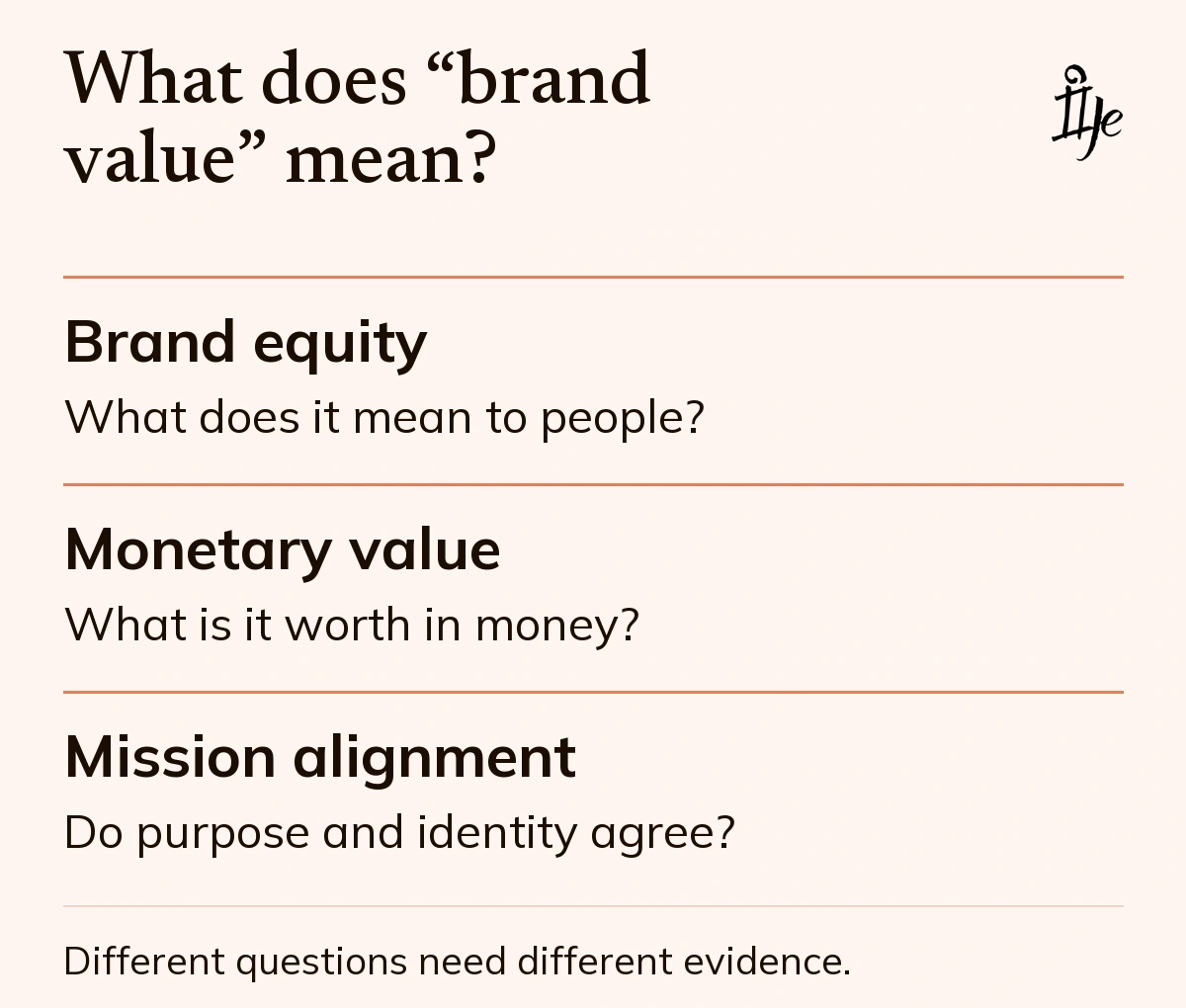
Brand equity and brand value are often used as if they mean the same thing. They can refer to related ideas, but they answer different questions. One asks what a name means to people and how that meaning affects their responses. The other may ask what the brand is worth in money. In nonprofit and mission-driven research, “brand value” can also describe the challenge of aligning a brand with the organisation’s purpose and different stakeholders.
The distinction matters when a board, communications team or funder asks whether an organisation’s brand is “strong” or “valuable”. Before choosing a score, report or valuation, the team needs to say which meaning it has in mind.
Brand equity and brand value answer different questions
In their 2007 conceptual paper, Randle Raggio and Robert Leone distinguish brand equity from brand value. They describe equity as an individual-level construct that affects how marketing activity works, while brand value is the sale or replacement value of the brand. Their framework comes from commercial brand management; it is a useful distinction, not a universal definition adopted by every field.
Put simply, brand equity concerns a relationship between a brand and a person. Depending on the model, researchers may study what people know, associate with, trust, prefer or intend to support about that brand. Brand value, in a monetary valuation, concerns an estimate expressed in money. The concepts may relate, but evidence about one does not automatically establish the other.
For example, a survey might show that a group of customers recognises a company and associates it with reliable service. That could inform a customer-based equity question. It does not calculate the price a buyer would pay for the brand. A financial valuation needs its own purpose, method, assumptions and evidence.
The International Organization for Standardization’s ISO 10668 sets requirements for monetary brand valuation, including its objective, valuation basis, approach, method, data and assumptions. The standard is specifically about monetary value. It does not provide a general measure of stakeholder trust, mission contribution or nonprofit brand equity. ISO 10668: Brand valuation
Before choosing a measure, state the decision and perspective: whose relationship are you studying, or what monetary question must the valuation answer?
Why a mission-driven organisation may hear “value” differently
Commercial brand frameworks often focus on customers and owners. A mission-driven organisation may also need to understand how its identity relates to participants, communities, staff, partners, funders and the purpose it exists to serve. The relevant groups vary by organisation, and one group’s experience cannot stand in for all the others.
Research on NGOs uses the language in more than one way. Karen Hand and colleagues’ 2021 study, “Worlds Apart? The Challenges of Aligning Brand Value for NGOs,” examined how ten decision-makers within one Oxfam context understood the challenge of aligning brand value across stakeholders. In its background discussion, the paper describes aid settings where donors fund work that recipients experience; evidence from one group therefore cannot stand in for the other’s perspective. The authors’ interviews were with internal decision-makers, not donors or recipients. They identified tensions involving competing stakeholder needs, internal culture and the organisation’s societal effectiveness. These are questions of organisational purpose and stakeholder alignment, not a sale price. One organisation’s case cannot establish how every NGO—or a Nigerian organisation—uses the term. The Oxfam case study
That difference in usage is a reason to define the question before discussing a result. If a team says “we need to measure our brand value”, it should clarify whether it means a monetary estimate, a particular stakeholder’s brand-related beliefs and responses, or whether the organisation’s identity and work make sense across the relationships it depends on. Those are related concerns, but they require different evidence.
Three questions behind brand value
| Meaning | The question it answers | Evidence that may help | What it does not establish by itself |
|---|---|---|---|
| Stakeholder-based brand equity | What does a named group know, associate with, trust, prefer or intend to do in relation to the organisation? | Interviews, carefully designed surveys, observed choices, repeat use or support records, and message-comprehension tests | A monetary price for the brand, the views of groups not studied, or that communication caused a later action |
| Monetary brand value | What is the brand worth under a stated valuation purpose and basis? | A valuation method, financial and market data, documented assumptions, and the applicable legal and economic context | Whether participants understand the mission, trust a claim or support the organisation |
| Mission and stakeholder alignment | How well does the organisation’s identity make sense across its purpose and relevant relationships? | Strategy and identity materials, stakeholder research, examples of how the work is described, and evidence of where accounts differ | A standard financial valuation or a validated universal “mission value” score |
Scroll sideways to read the full table.
The first two rows follow the commercial distinction described by Raggio and Leone and the monetary scope of ISO 10668. The third is an organisational alignment question explored in the Oxfam case study, not a standardised valuation method. Once the team names its decision and whose relationship or asset matters, that choice points to the evidence it needs.
Apply the distinction to a hypothetical Nigerian skills organisation. Asking employers whether they can explain the programme is a stakeholder question; preparing for a sale or transfer calls for a monetary valuation; checking whether the organisation’s public description, programme and purpose agree is an alignment question. Each inquiry needs its own records, and none can serve as a single summary of the organisation’s worth.
Choose the row that matches the decision; do not combine them into one score without a defined and validated model. Otherwise, the total hides which stakeholder view or asset each item describes and what conclusion its evidence can support.
What nonprofit brand-equity research tells us
Romero, Abril and Urquia-Grande’s 2024 review examined NGO donor-based brand-equity research. After screening 511 records, the authors retained 61 studies. They found the field limited and inconclusive and reported that there was no generally accepted brand-equity model suitable for NGOs. The review also notes that existing models are often adapted to particular organisations and research settings. The literature review in Nonprofit Management and Leadership
For example, the review discusses studies that treat recall and recognition separately from familiarity with an NGO’s cause and purpose. Researchers do not report the same result in every setting, and the authors argue that adapted models are difficult to generalise. Those differences show why a team should select a measure for a defined audience and decision; they do not add up to a standard scale.
That finding does not mean an NGO cannot study its relationships with people. It means the team should not present one borrowed model as a validated measure for every organisation, stakeholder group or country. The review focuses on donor-based equity; it does not validate a model for participants, communities, partners, customers of mission-led businesses or Nigerian organisations.
It also matters that the authors discuss intention and behaviour separately. A donor saying they intend to give is not the same as a recorded gift. Recognition is not the same as understanding, and positive associations do not alone prove that a programme works. Each measure answers a defined question; none should be stretched into evidence for a different outcome.
Choose the measure by the decision you need to make
Consider a hypothetical Nigerian organisation that runs a skills programme and works with employers. Its leaders want to know whether its brand is “strong”. That wording is too broad to select a measure. The organisation should first name the decision.
If leaders need to understand whether employers can explain the programme and the organisation’s role, they could ask a defined group of employers to describe both in their own words, then record what they understand and what remains unclear. If the organisation wants to know whether participants understand how to join, it needs to hear from participants and examine the actual participation route. Neither answer represents every stakeholder.
If the board is considering the brand as a financial asset in a sale or transaction, it needs a monetary valuation with a stated basis and defensible assumptions. A survey about programme understanding cannot produce that figure. If leaders are asking whether the organisation’s identity, programme descriptions and proof reflect its purpose consistently, they need to examine those materials and the relevant stakeholder perspectives. They should not turn that review into a monetary estimate.
The same organisation could therefore have evidence for several separate decisions. It might ask referral partners to explain its role, ask participants whether the enrolment page tells them what to do, and commission a financial valuation for a transaction. Combining those findings would obscure which audience or asset each one describes and which decision it informs.
Write the question in four parts before choosing a tool:
- Decision: What will the team decide or change?
- Perspective: Whose relationship or which asset is relevant?
- Evidence: What record could answer that question?
- Boundary: What conclusion would go beyond that evidence?

For the employer example, the record might say: “We need to revise the employer page; we will ask current referral partners to explain the organisation’s role after reading it; we will compare their answers with the role the organisation intends to communicate; this will not tell us whether employers will hire graduates.” The statement is specific enough to guide a small inquiry, and it avoids treating a comprehension check as proof of hiring outcomes.
If the real issue spans identity, explanation, evidence and the routes through which people encounter the organisation, the Ije Brand-Power System explains how Ije organises that work. If your question is broader nonprofit brand strategy, see our guide to nonprofit branding strategy. The immediate task is simpler: name the decision and perspective first. The right measure follows from that choice.