

Branding Cost in Nigeria: How to Compare Quotes
Resume reading
When branding quotes differ, compare the work behind each fee before comparing the totals. “Branding” can mean a visual identity, applications such as social templates or packaging, or a wider set of positioning and messaging decisions. Unless each proposal describes the same scope, the figures are not a like-for-like comparison.
Start with the decision your organisation needs to make, then ask each provider to price the same requested work. Record what is included, optional, excluded and still unclear. That gives you a better basis for deciding whether a quote fits the work you actually need.

What can change the cost of branding work?
The word “branding” does not describe a fixed list of deliverables. One project may start after the organisation has settled its audience, offer and position. Another may need time to clarify those decisions before a designer develops a visual identity. Those are different assignments, even if both proposals use the same label.
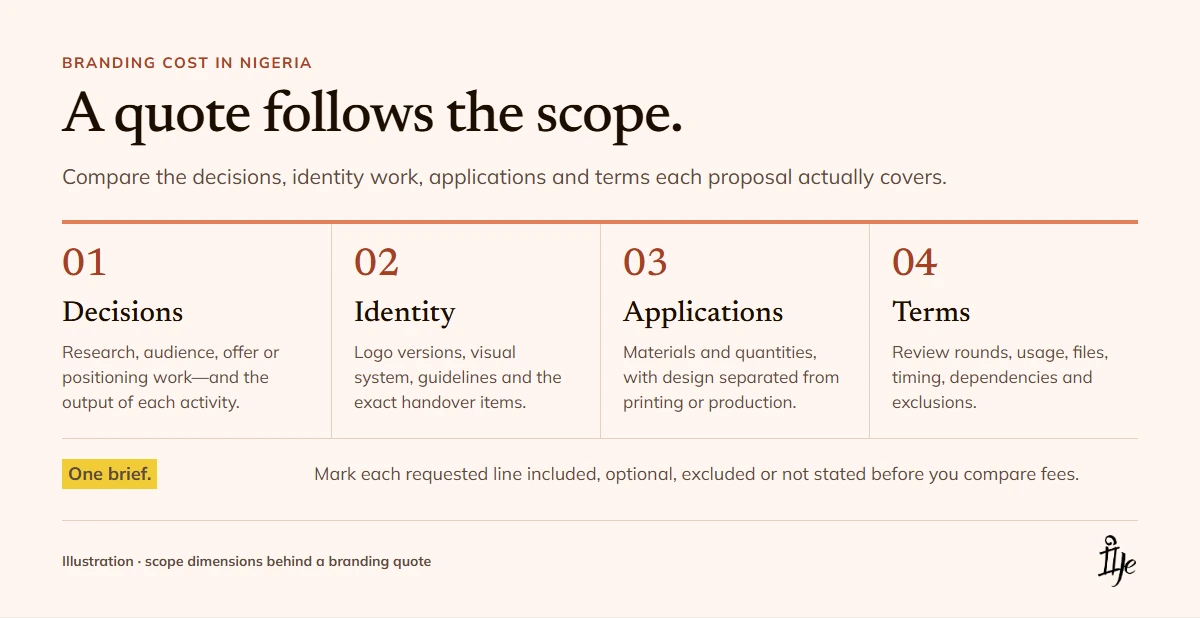
Before you compare totals, look for these scope dimensions:
- Decisions and discovery: Does the work begin from an approved brief, or does it include research and sessions to clarify audiences, offer or positioning? Ask what each activity produces.
- Identity work: Is the scope a logo, a visual identity system, or a set of rules for applying the identity? List each requested item rather than relying on a package name.
- Applications: Name the materials and quantities: for example, social templates, presentation slides, packaging or a report cover. Separate design from printing or production.
- Review and approval: Record how many concepts and review rounds are included, who consolidates feedback, and how additional changes are handled.
- Files and use: Ask which final and editable formats will be handed over and how the organisation may use them. Put the agreed terms in the proposal.
- Timing and dependencies: Note the working period, decision dates, materials your team must provide, rush terms, taxes and production costs.
These lines explain why two proposals may price different work. They do not tell you which provider will deliver better work; that requires a separate, project-specific assessment.
How do you compare two branding proposals fairly?
Use the same scope list for each proposal. Mark each line included, optional, excluded or not stated. Keep “not stated” visible until the provider answers; silence is a question, not a promise or a refusal.
Consider a constructed example. Proposal A lists a logo, colour palette and three social templates. Proposal B lists discovery, positioning, a visual identity, guidelines and five templates. Both call the work “branding,” but they cover different tasks. Comparing the totals alone would hide that difference. Ask each provider to price the same requested deliverables—or ask them to separate the fee by workstream.
| Scope line | Proposal A | Proposal B | What to clarify |
|---|---|---|---|
| Audience, offer or positioning decisions | Not stated | Included | What decision or output is covered? |
| Logo and identity items | List the exact versions | List the exact versions | What is the handover format? |
| Applications and quantities | Three social templates | Five social templates | Ask for the same quantity in both proposals. |
| Review rounds | Not stated | Two rounds | Who combines feedback, and what counts as a new direction? |
| Production and exclusions | Not stated | Printing excluded | Which taxes, production or rush costs are separate? |
Scroll sideways to read the full table.
The table does not score either provider. It helps you identify where the proposals differ and what to ask before deciding. If you do not need a listed item, remove it from the common scope. If you do need it, ask both providers to price the same specification.

What should you write before requesting a branding quote?
Give each provider the same short brief. It should answer:
- What decision needs to be clearer? State the problem the work should address, in practical terms.
- Who needs to understand the organisation? Name the audiences and the offer or work they should understand.
- What already exists? List current names, messages, identity files, guidelines and applications. Say what must remain and what may change.
- What work should be priced? Separate discovery and strategic decisions from identity design, applications and production. Mark essentials and optional items.
- What must be handed over? Specify file formats, editable files, usage terms, guidelines, review rounds and any support you need.
- What are the constraints? Name decision-makers, available materials, timing, dependencies, taxes and third-party production needs.
Then ask each provider to mark every line included, optional, excluded or not stated—and to explain any proposed change to the scope. For example, “Create a visual identity and a one-page application guide for the approved name and positioning; price printing separately” gives a clearer basis for comparison than “We need branding.”
Do you need identity design or wider brand work?
If your organisation has already settled who it serves, what it offers and what it should be known for, a bounded visual-identity project may be the right request. Ije’s guide to briefing brand identity beyond the logo helps define the identity items and applications to include.
If those underlying decisions are still open—or if positioning, messages, proof, identity and activation need to work together—make that visible in the brief instead of assuming it comes with logo design. Ije’s Brand-Power System explains the broader connected approach. A wider assignment is not automatically necessary; the scope should follow the decision your organisation needs to make.
Before accepting a proposal, check that each fee refers to work you can name, that the exclusions are visible, and that the handover fits the way your team will use the result. That is how you make a branding-cost comparison useful: same brief, clear scope, and no hidden assumptions.