

Business Branding: Choose the Work Before the Look
Resume reading
“We need branding” is a reasonable place to start a conversation. It is not yet a brief.
The phrase can mean a new logo, a clearer offer, a different position, a set of messages, a more credible way to show evidence, or a consistent way to apply existing assets. Those are not interchangeable jobs. A business can commission the wrong one beautifully.
For a mission-led business in Nigeria, the useful first question is not “Which colour should we use?” It is: what decision or change must this work make possible, and what is currently getting in its way? The answer helps you choose a scope that is useful without paying for work you do not need—or asking a logo to solve a problem it cannot reach.
Start with the business moment
Write down what has changed or what you are preparing to do. Perhaps the business is taking an established offer to a new audience, opening a new location, moving from direct sales to institutional buyers, introducing a service, or correcting a gap between what the team says and what a customer encounters. These are different situations. They can call for different work.
Then name the decision the work should support. Is the team still deciding whom to serve and what to be known for? Does it already know that, but struggle to explain the offer? Is the visual identity outdated or difficult to apply? Are useful proof points scattered across proposals, profiles and reports? Has the strategy been settled, while everyday materials still use old messages?
The distinction matters because “branding” is an area of work, not a single standard package. A project should be defined by the decision, audience and assets involved—not by a provider’s list of deliverables alone.
Match the scope to the question
The table is a starting point for a conversation with your team or a provider. It does not mean every business needs each workstream.
| If this is unclear… | Work may need to address… | A useful output could be… | It does not establish by itself… |
|---|---|---|---|
| Which audience matters, what the business should be known for, or how an offer differs | Brand strategy and positioning | A documented audience, choice, position and rationale | That customers agree, demand exists or the position will win |
| How to explain the offer consistently to different people | Verbal identity and messaging | A message architecture with usable examples | That every audience interprets the message as intended |
| How the business should look across real applications | Visual identity | Identity elements, rules and applied examples | That the business’s strategy or offer is sound |
| Which evidence supports a promise, and how to present it responsibly | Proof and trust assets | A structured set of claims, evidence and approved uses | That attention or trust will automatically follow |
| How existing assets move into proposals, profiles, digital channels or everyday use | Activation and implementation | An application plan, owners and review points | That a plan is implemented without capacity and follow-through |
Scroll sideways to read the full table.

A narrowly defined need can be a complete project. If a business has already approved its position and only needs a usable identity system for packaging, signage and digital channels, a focused identity commission may fit. If the team cannot agree what the product is for, who buys it, or what can be credibly promised, design alone may leave the central decision untouched.
Turn the request into a brief
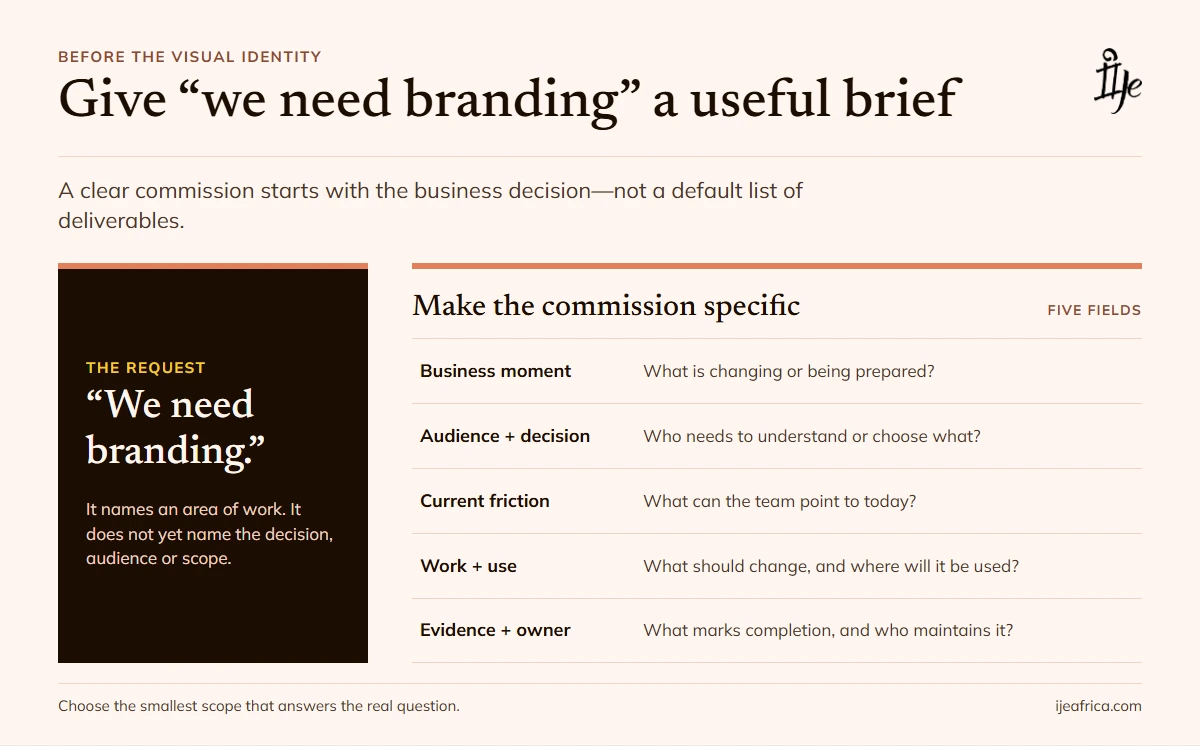
Use five fields before asking for proposals. Each one makes a different assumption visible.
- Business moment: What are you preparing for, responding to or changing?
- Audience and decision: Whose understanding or choice needs to change? What should they be able to decide or do with clearer information?
- Current friction: What can the team point to—conflicting descriptions, an unclear offer, inconsistent materials, missing proof, or a specific application that no longer fits? Separate observed facts from explanations you are still testing.
- Work and use: Which work do you think is needed, what must it produce, and where will the result be used? Include the people who need to use or maintain it.
- Evidence and ownership: What would show that the agreed deliverables are complete? Which outcomes can the business measure, and which would only be influenced? Who supplies evidence, gives approval and owns future updates?
Consider a fictional refill-and-reuse business that has sold household products directly to consumers and is exploring supply to offices. “We need a new brand” does not tell a provider whether the unresolved issue is the institutional offer, the reasons an office buyer might consider it, packaging requirements, or the materials needed to explain the service.
A better first brief might say: “We are assessing supply to offices. We need to decide whether the current offer and explanation are clear for an office buyer, and what changes—if any—are needed in the sales profile and packaging. We have product descriptions and consumer materials; we have not yet tested the proposed office offer. Please separate discovery and positioning work from any visual-identity production, and show what evidence or decisions you need from us before design begins.”
This brief does not claim that office buyers want the offer. It describes the decision the business must investigate and prevents the provider from treating an untested assumption as an approved positioning direction.
Compare proposals on the work, not only the deliverables
When proposals arrive, compare them against the same brief. A list containing “logo, colour palette, social templates and brand guide” may be clear about production while leaving the business decision unresolved. Another proposal may include research or strategy; ask what question that work answers, what input it requires and what decision will be documented.
Check the boundary between stages. Who approves audience and position before visual exploration? What is included in the identity system, and which real applications will be shown? What files, usage guidance and editable materials are handed over? Who owns the source files and future updates? Which work is optional, and what changes the price or schedule? Do not assume that a polished presentation answers these questions.
Also agree how completion will be judged. The provider can be accountable for the agreed research, decisions, identity assets, documentation and handover. The business can track whether the materials are adopted and gather feedback. Sales, trust, inquiries or support may be influenced by the work, but they also depend on the offer, delivery, market and many decisions outside the identity project. Treat them as measured outcomes, not promises embedded in a design brief.
Know when the work needs to connect
There is no virtue in buying a larger scope than the situation requires. A single production project can be appropriate when the key decisions are settled, the audience and offer are clear, and the deliverable has a defined use.
Consider connected work when the unresolved issue crosses several assets: the business cannot explain the same offer consistently; its public promise outruns the evidence it can show; teams are using incompatible descriptions; or a new identity would be applied to materials that still express an old position. In that situation, separate projects may each be completed while the overall experience remains disconnected.
Ije’s Brand-Power System is built for mission-driven organisations and businesses that need to connect strategy, identity, proof and activation. It is not the automatic next step for every logo or collateral request. If the brief has surfaced a connected problem, see how the Brand-Power System works. If you already know visual identity is the right scope, the identity-design briefing guide covers what to settle before design begins. If the uncertainty is about what customers receive and how that offer relates to social purpose, the social-enterprise value proposition guide treats that question separately.
Before you ask a provider for a price, finish this sentence: “We are commissioning this work so that ___ can decide or do ___, using ___, and we will know the agreed deliverables are complete when ___.” If the blanks are still difficult to fill, the brief needs another conversation before it needs a colour palette.