

What Should a Nonprofit About Page Explain?
Resume reading
Writing an About page can be surprisingly difficult when you know an organisation well. The founding story matters to you. So do the programmes, the people who built them and the milestones that took years to achieve. Deciding what to include means choosing among things that are genuinely important, while explaining the work to someone who has none of that background.
That difference in knowledge is where the writing needs to begin. A visitor may have heard about one of your programmes without knowing what else you do. A prospective partner may recognise your name but need to understand your role before making an introduction. Someone looking for support may need to establish whether yours is the organisation that can help. The same page must introduce the nonprofit clearly enough for these readers to find the information relevant to them.
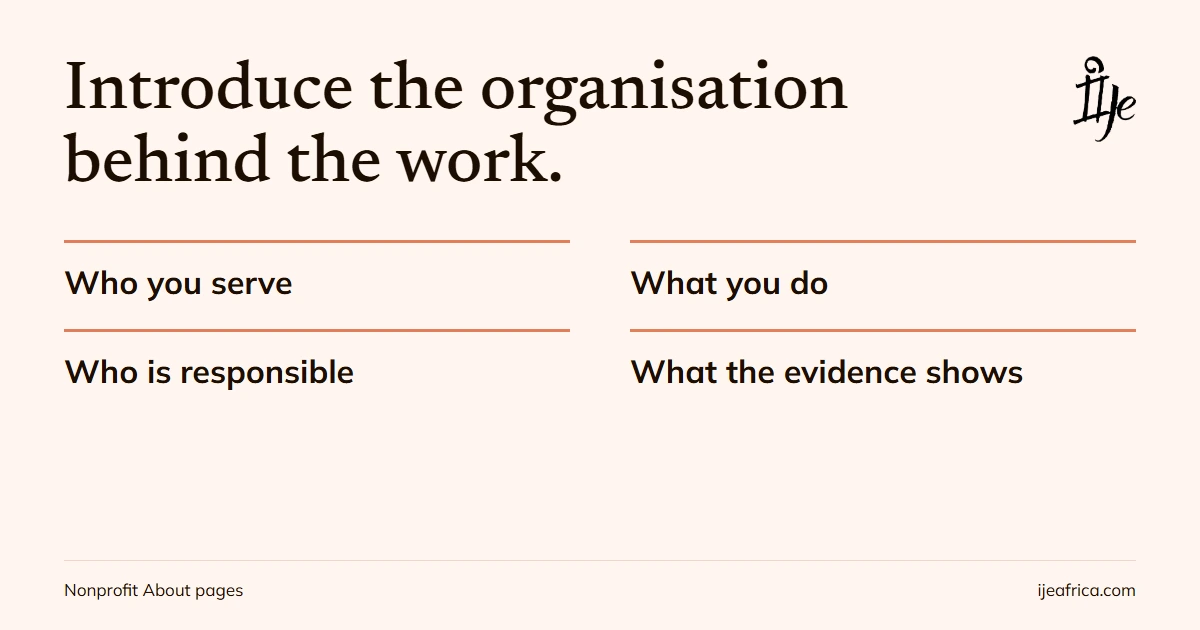
A useful About page explains who you are, why the organisation exists, what it does, who is responsible and what supports its account of the work. From there, visitors should be able to investigate further or take an appropriate next step. You do not need to reproduce the entire website to achieve this. You need to decide which explanation belongs on this page and which details deserve a page of their own.
The following guide works through those decisions using a fictional nonprofit, Bright Path Initiative. Its examples show how to turn a broad mission statement, an organisational history and a collection of programme details into an introduction a new reader can understand. You can apply the same approach to an existing page or use it to plan a new one.
What belongs on a nonprofit About page?
The About page introduces the organisation behind the activities. A programme page might explain how a training course works; the About page explains why your nonprofit provides that training and how it relates to your purpose. A report documents delivery and results in detail; the About page selects enough evidence to substantiate its description of the organisation, with a link to the fuller account.
This distinction helps when deciding what to keep. A paragraph explaining that you work with out-of-school young people belongs on the About page because it identifies whom you serve. The dates, entry requirements and application instructions for the next training cohort belong with that programme. Visitors need both, but at different points in understanding the work.
Your homepage will overlap with the About page to some extent. Both may name your purpose and introduce your activities. The homepage also helps visitors navigate the wider website, while the About page gives a fuller account of the organisation itself. It can explain how your work developed, what your team contributes and how responsibility is organised, without repeating every homepage section.
Begin by reviewing the material you already have. For each paragraph, ask what a newcomer would understand from it. Keep the details that explain the organisation; shorten or relocate those concerned mainly with applying, donating or contacting someone. Once that distinction is clear, the opening becomes easier to write.

Introduce your mission and the work you do
A mission statement expresses the purpose of the organisation, but it may need an accompanying explanation. Phrases such as “creating lasting change” tell readers about an ambition while leaving the work itself unclear. Someone unfamiliar with your nonprofit should be able to identify whom you serve, where you work when that matters, and what you actually contribute.
Consider this opening for the fictional Bright Path Initiative:
We are committed to creating lasting change in underserved communities.
The sentence could describe organisations working in education, health, housing or employment. It gives the reader little basis for interpreting the programmes and results that follow. A more informative introduction would be:
Bright Path Initiative works with out-of-school young people in Kaduna, providing career guidance and practical skills training. We work with local employers to help participants explore routes into safe work.
The revised version names the people, place and activities. It also identifies the employers’ involvement rather than leaving readers to assume that Bright Path provides employment itself. The organisation could retain its formal mission statement below this introduction, where the reader has enough context to understand what pursuing that mission involves.
For your own opening, check whether the language distinguishes your contribution from that of other organisations involved. Running a programme, funding it, referring participants and advocating for a change are different roles. Explain yours accurately. A list of activities becomes more informative when readers understand why your organisation undertakes them and what responsibility it has for delivery.
If your team cannot agree on that explanation, pause the copy edit long enough to resolve the disagreement. Different descriptions of whom you serve or what you exist to do require a shared organisational decision. Ije’s guide to nonprofit branding strategy examines that wider work; the About page should express the resulting decisions consistently.
Explain why the organisation was founded
An origin story can explain a choice that the opening only introduces. Why this problem? Why these communities? Why this particular approach? The useful history is the history that helps a reader understand the organisation’s present work.
For Bright Path, an illustrative origin paragraph might read:
Bright Path began in response to the difficulties out-of-school young people faced in finding safe work. The organisation developed career guidance and practical training alongside relationships with local employers, so participants could explore employment options as they developed relevant skills.
This account connects the reason for establishing the organisation with the activities described above. It does not need the date of every meeting or the name of each early initiative to make that relationship clear. A major change may deserve more explanation: if an organisation began by awarding scholarships and later developed a training programme, readers should understand why its work expanded.
Select milestones on that basis. Keep a date when it explains a meaningful development in the work. A longer organisational timeline can be useful elsewhere, particularly when there is a substantial history to document. On the About page, enough of that history should remain for a visitor to understand how the organisation became what it is today.
An account of the organisation’s beginnings is also different from a participant’s personal story. You do not need to disclose someone’s hardship to explain why a programme exists. Where a personal account genuinely contributes to the explanation, check permission for the specific use and preserve the person’s agency and context. Ije’s nonprofit brand storytelling guide develops those decisions in more detail.
Identify your team, leadership and board
After understanding the purpose and work, a reader should be able to establish who is responsible for it. Names and photographs can introduce people, but their roles need explanation. A prospective partner assessing delivery experience may need different information from someone seeking a programme contact or checking governance arrangements.
In the Bright Path example, a biography could begin:
Ayo Mensah, Programme Director, coordinates the training programme and manages relationships with participating employers.
That sentence explains a responsibility. The biography could then add relevant experience, if verified, rather than relying on broad descriptions such as “passionate leader.” For a board member, describe the person’s governance role accurately; do not imply that they manage daily delivery if they do not.
The level of detail depends on the organisation. A small team may be introduced directly on the About page. An organisation with several programmes may need a short leadership introduction and a separate team page. Governance information can follow the same approach: identify the relevant structure, explain its responsibility and provide further information where needed.
Keep these details current. An outdated leadership list can leave a visitor uncertain about whom to approach, even when the surrounding description remains accurate. Review names, responsibilities and contact destinations together whenever someone changes role. The purpose is to explain the organisation as it operates now.
Support your impact claims with specific evidence
The About page needs enough evidence for readers to assess what you say about the work. Choose evidence that supports the particular statement being made. A photograph of a training session can help explain the activity, but it does not establish how many people completed the programme or what happened afterwards.
Suppose Bright Path’s draft includes “500 young people reached.” Before publishing it, the team needs to establish what “reached” means. Were these individuals attending training, people receiving career guidance or total attendances across repeated sessions? The reporting period matters too. Without those details, readers cannot tell what the figure describes.
If the fictional records established 500 distinct participants in career-guidance sessions during 2025, the statement could be:
In 2025, 500 young people took part in our career-guidance sessions.
The page could link that statement to a public programme summary explaining how participation was recorded. It should describe employment results separately if the organisation has evidence of those results. Participation and employment answer different questions, and the About page should preserve that distinction.

Other claims require other forms of support. If you describe a partnership, explain what the partner contributes and check that the description is current and permitted. If you describe board oversight, identify the actual governance arrangement. Choose a few relevant, supportable statements rather than adding unrelated figures and logos to make the page look established.
Detailed reports can remain on their own pages. Give the reader a clear summary and a descriptive link to the supporting material. Where records contain confidential information, prepare a suitable public account instead of exposing the underlying documents. If the team struggles to locate the sources for its statements, Ije’s guide to organising nonprofit evidence explains how to make those records easier to find and reuse.
Separate programme details from the organisational introduction
Once the main explanation is written, check whether the page has become an application guide. This can happen for a good reason: the team wants visitors to know that support is available. The difficulty arises when several paragraphs of eligibility rules, schedules and instructions interrupt the account of who the organisation is.
For Bright Path, the About page can explain that the organisation provides career guidance and practical training. A nearby link labelled “Programme eligibility and applications” can then direct prospective participants to the details they need. The programme page should explain whom the programme accepts, where and when it runs, how to apply and whom to contact with questions.
The same distinction applies to giving and volunteering. An About page can explain why support matters to the organisation and identify the opportunities available. Payment options, volunteer commitments and application forms need enough space for their own explanation. If the website is small, those details may occupy a clearly labelled section rather than a separate page; what matters is that visitors can find them without having to interpret unrelated organisational history.
Before removing information from the About page, check the destination. Moving application instructions is only useful if the linked page contains the current instructions. Retain a concise explanation and a working link so the edit improves both the introduction and access to the details.
Give different visitors a relevant next step
A donation button may be appropriate, but it does not answer every visitor’s question. A community member seeking support needs the programme information. A potential volunteer needs to understand available roles. A funder or partner may want to examine the organisation’s work before starting a conversation.
Choose links according to what the preceding explanation makes relevant. After describing a programme, offer the programme details. After summarising results, link to the report or public evidence summary. A partnership invitation should identify how to enquire, preferably with enough context for the visitor to understand the kind of collaboration being discussed.
You can give one action greater visual emphasis while retaining other useful links. The decision should reflect the organisation’s current priorities and the readers it expects to serve. Avoid giving every destination equal prominence simply because it exists on the website. Read the page as a prospective participant, then as a prospective supporter: can each find an appropriate next step without being directed towards an action intended for someone else?
Review your About page section by section
Use the following record to turn the guidance into an edit. For each part of your page, identify the question it answers, check the information supporting it and decide what requires further detail elsewhere.
| Page section | What the visitor needs to understand | What to check before publishing | Where further detail belongs |
|---|---|---|---|
| Introduction | Who you serve and what your organisation does | Agreement with the current mission, audience and actual work | Programme pages for individual activities |
| Origin and development | Why the organisation began and how its work developed | Accuracy of events and any permissions needed for personal accounts | A fuller history or story where warranted |
| People and governance | Who manages the work and who provides oversight | Current names, responsibilities and governance arrangements | Team or governance information |
| Selected results | What the organisation has done and what the evidence establishes | Source, reporting period, definitions and permission for public use | Reports and public evidence summaries |
| Next steps | How to access support, participate, give or enquire | Working links and current destination information | Programme, volunteering, donation or contact details |
Scroll sideways to read the full table.
In Bright Path’s case, this review would produce a specific set of changes: replace the vague opening, connect the origin to the current programme, explain the programme director’s responsibility, define the participation figure and relocate the application instructions. Each change answers a question that the earlier page left unresolved.
Your review may also reveal issues that cannot be settled through writing alone. If colleagues describe different purposes, if programme evidence remains unavailable or if the public account omits an important partner’s role, those matters need attention before the page can explain them accurately. Record the missing decision or source and ask the person responsible to resolve it.
These are the connections Ije examines through its Brand-Power Gap perspective: the difference between the impact an organisation creates and its ability to turn that impact into visibility, trust and sustained support. The About page is one place where disconnected identity, story and proof become apparent to an audience. Improving the page starts with those specific problems, rather than assuming that a new design will settle them.
Ije Africa builds brand-power systems for Nigeria’s mission-driven organisations and businesses. If the review exposes wider disagreement about your organisation’s identity or difficulty explaining and substantiating its work, our work with nonprofits and social-impact organisations addresses those questions together. For the page itself, begin with the first explanation a newcomer needs, then make sure every section develops that understanding or helps them act on it.