

Non-profit Messaging Framework: Write Key Messages Your Team Can Use
Resume reading
You probably shouldn’t read this blog post until you’ve done one little task:
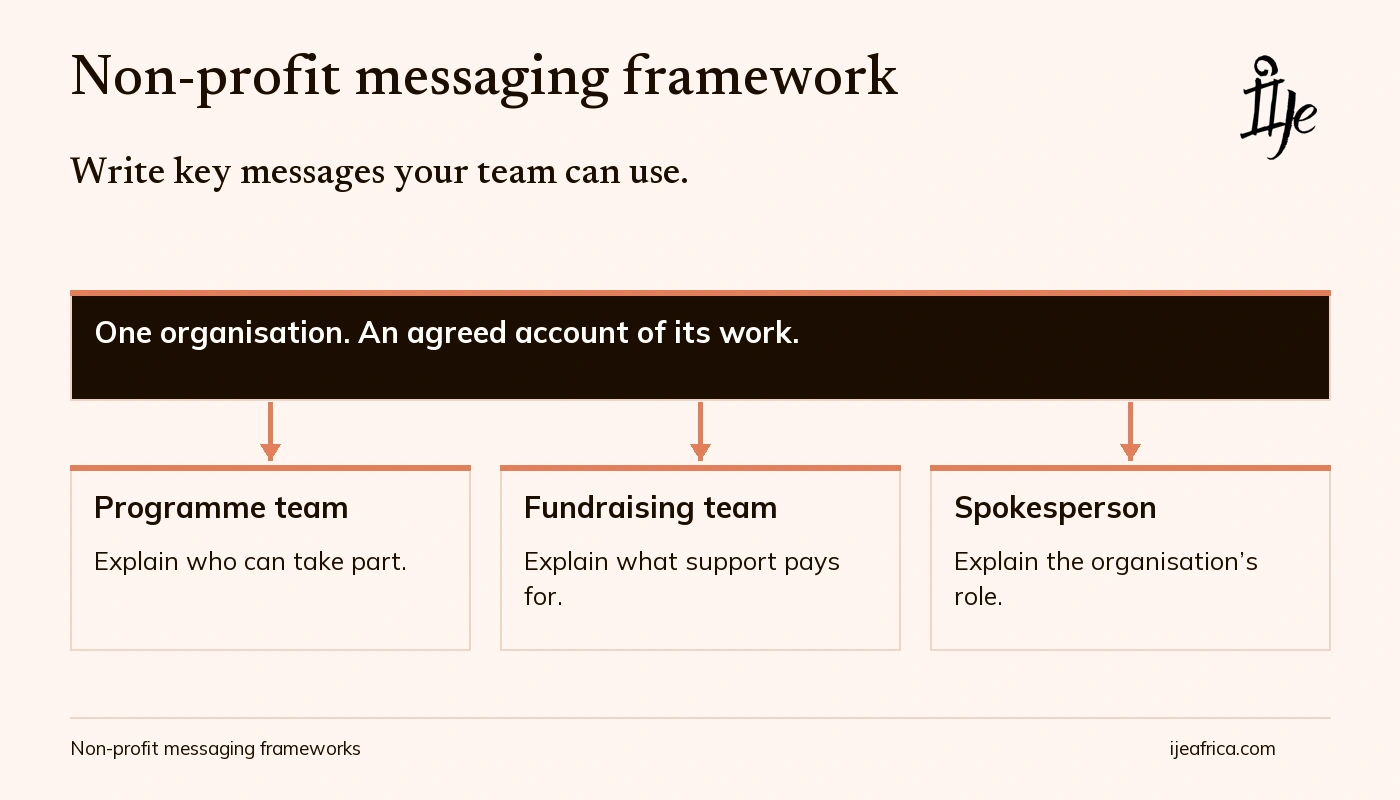
Call two or three members of your team (programme coordinator, social media manager, fundraising outreach coordinator; you decide). Ask them to explain your organisation in one paragraph. Listen to what they say.
If they can’t say as much as a paragraph, if they can’t contain all their explanation within a paragraph, or if there’s no underlying convergence across all their explanations, then, you couldn’t have found this post any sooner.
Your non-profit organisation has a messaging problem. This is not an easily noticeable problem. However, it matters that your organisation ave a coherent messaging framework because every team member is an extension of the work you do and the impact you see. If their understanding of your organisation doesn’t nestle within the broader understanding, then your organisation is likely to suffer problems extending as far as a lack of a clear public idea of what you are, what you stand for, what you do, who you serve, how you serve them, and why your organisation exists. We call this a fragmented public image.
Don’t get me wrong: your team members will likely not have a single explanation of what your organisation is. If they do, that is also a problem (which we will talk about in another blog post). The idea is that even though team members need different messaging assets about your organisation, there should be an overarching framework that governs that each message and connects it back to your mission and organisation’s strategic goals.
So, even when your programme coordinator is helping someone decide whether to enrol in one of your initiatives, or the fundraising lead is explaining what each fundraising target helps you achieve, their explanations should stay true to your broader meaning and reason for existence.
It becomes strenuous to advance your organisation’s mission when the internal understanding and messaging describe the organisation and its work differently. Say, one promises some services the team does not provide, or your explanation alienates a category of people your programme serves. Although these issues may not be easy to tie together or may be infinitesimally placed within day-to-day operations that your team hardly notices them, they readily chip away at the coherence of the immense work you do.
So, when you start to notice instances where a TV interviewer misrepresents the work you do, or the newspaper describes the populations you serve wrongly, it’s good to lash out at how seemingly inept the media guys in the country are. However, it’s also time to start considering the importance of a messaging framework and how it can translate your work into the coherent and sound understanding it deserves.
Why Have a Messaging Framework for Your Non-profit?
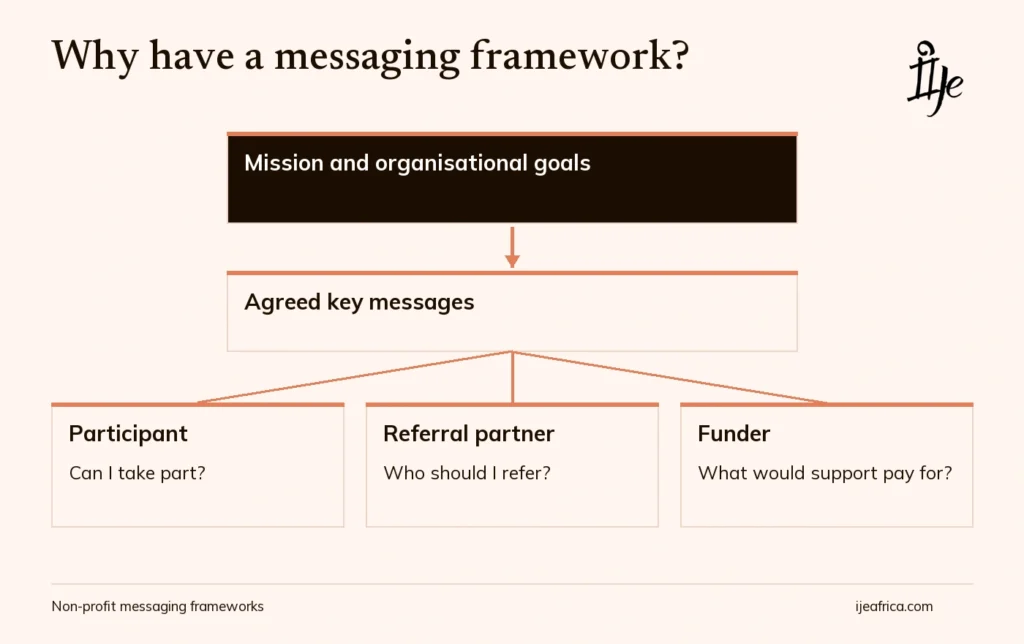
A non-profit messaging framework helps your team agree on the essential messages and adapt them to different conversations you will likely be involved in. The central idea is that at any given time, your organisation needs to communicate with different stakeholders and audience segments, whose questions about the work you do differ, and whose reasons for communicating with you differ, and who might benefit from knowledge about your organisation in different ways.
What is a Non-profit Messaging Framework?
A messaging framework is a shared document that records the main ideas your organisation needs to communicate, the facts supporting those ideas, and the emphasis appropriate to different audiences. Staff use it when writing website pages, preparing presentations, answering enquiries, being the organisation’s spokesperson, or introducing the organisation in person.
While your mission statement explains why your organisation exists, the messaging framework is what develops your organisation’s purpose into messages people can use in specific situations. For instance, a potential participant in your programme needs a more specific answer to their questions about eligibility and the benefits of your programme than a mission statement, impact statement, or similar statements provide.
Your key messages within your messaging framework should be internally understood and broadly defined enough to avoid word-for-word repetition in all use cases, but specific enough to provide the answers needed without abstracting as far as your mission or similar statements. Being able to keep your key messages strategically encompassing allows your staff to explain what you do naturally while preserving the broader idea.
Thus, developing a messaging framework involves regrouping all of your essential messages within a coherent ecoystem. We recommend a process that starts from gathering the consistent facts, identifying what each audience segment needs to understand about each fact, codifying your message reuse process, testing your messages in everyday use, and iterating based on results. Let’s examine each step further.
Gathering Facts before Writing your Non-profit’s Key Messages
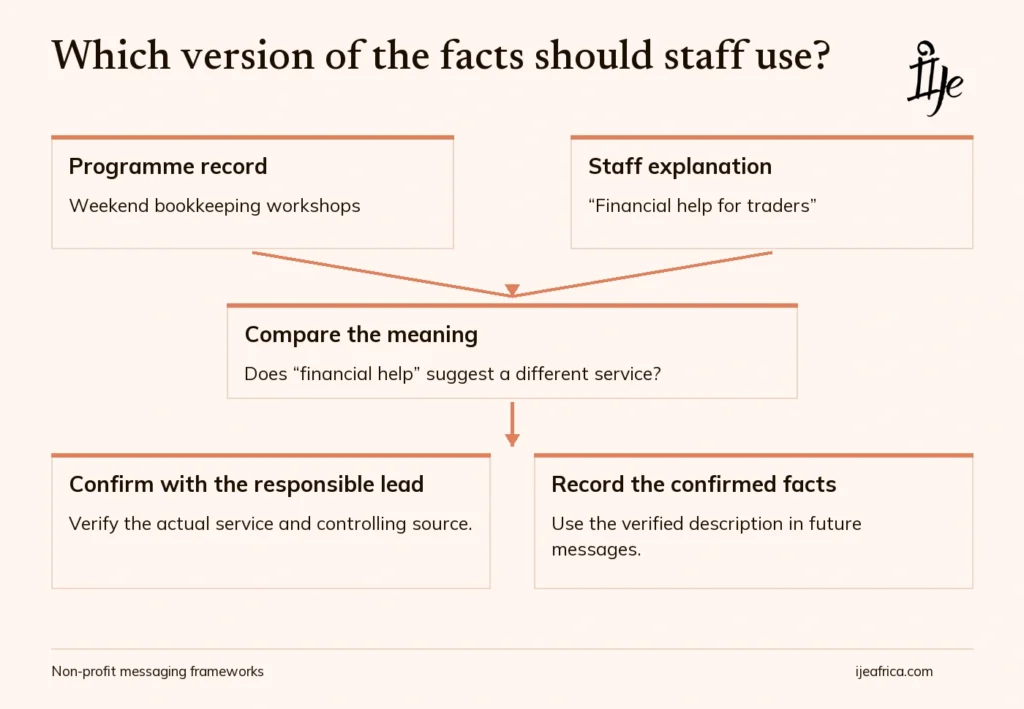
You need to start with fact gathering. At that stage, you will need to identify and codify the facts that are consistent across different understandings and applications of knowledge about your organisation. This can be a susbatntially demanding endeavor, and it is also easy to lose track of what is codified, what is truly a fact that broadly and consistently applies, and what is merely a message item. Therefore, the fact-gathering stage can benefit from a systematic process where you start with one programme or area of work. In gathering facts and creating a message record for each fact, follow this process to validate the consistency of the fact across different knowledge applications:
1) Collect the current programme description, participant information and any results the team is authorised to share.
2) Compare them with what staff say during any enquiries.
For this process, you are looking for differences that would change someone’s understanding of a programme or work area, or possibly change the decision they make about a programme. One thing to note as you go through this process is that some differences are easy to resolve, while others are not. When faced with hard-to-resolve differences, you want to ask if the details being contested qqualify as a fact. If they do qualify, you want to consult with leadership to verify the version that overrrides other versions. In that case, prior decisions about the organisation’s strategy and impact could be helpful in establishing message facts.
Consider a hypothetical non-profit programme in Ibadan that runs weekend bookkeeping workshops for adult market traders. Participants practise recording sales and expenses. They register before attending, and the programme contact provides the dates and venue.
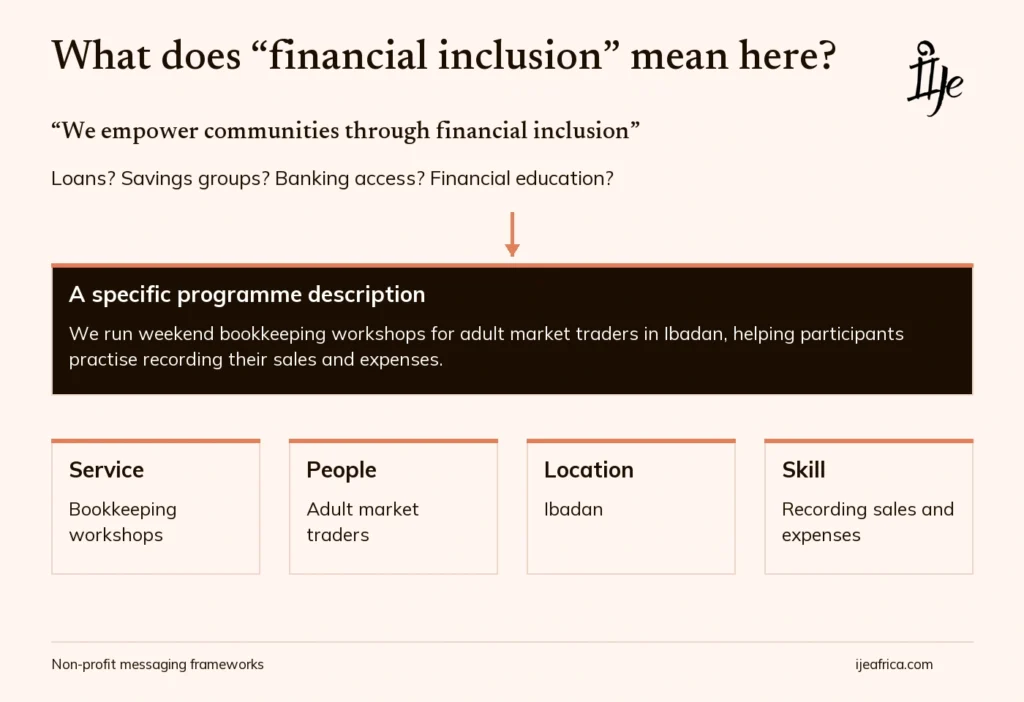
“We empower communities through financial inclusion” tells a prospective participant very little about that service. It could describe loans, savings groups, banking access or financial education. So, for a programme coordinator looking to answer the question, “What is this about?” A closer description is:
We run weekend bookkeeping workshops for adult market traders in Ibadan, helping participants practise recording their sales and expenses.
Notice how the revised version structurally identifies what you do, the people you serve, the programme’s focus location, and the skills taught. Messaging structured in this format meets a strategic intent, as we recommend your messaging structure should be.
Adapt your Messages for Different Audience Segments
Once you have codified your facts, the next step is to document cases where each fact answers the likely questions from each of your audience segments. Some of these questions might be related to the decision the person is considering, what details might help them make an informed decision, the action to take after encountering your message, and what new knowledge they acquire about your organisation based on the fact provided and the way it was provided.
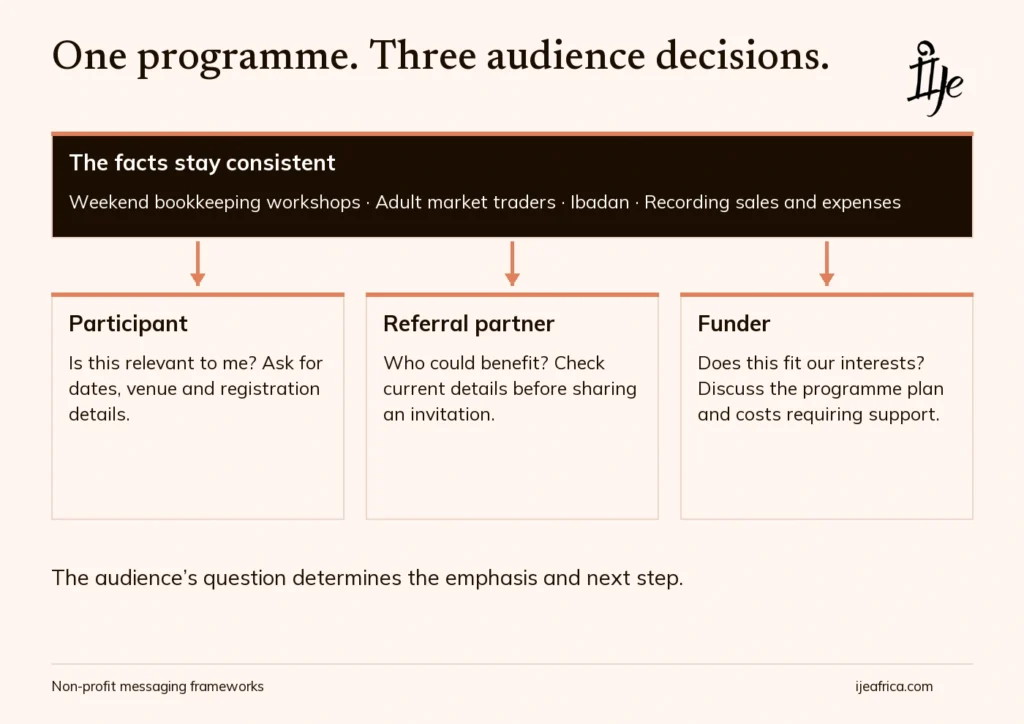
Thus, the messages within your framework will change in relevance and detail, relative to the audience segment. Take these example descriptions of the same workshops, for instance. Notice how the messaging changes in adaptation to the audience segment.
For a prospective participant
Do you trade in an Ibadan market and want to learn how to keep records of your sales and expenses? Our weekend bookkeeping workshops give adult traders the opportunity to practise those tasks. Contact the programme team for dates, venue and registration details before attending.
This version helps someone assess relevance of the programme and find the information needed to attend. It names the skill instead of relying on the broader term, financial inclusion. It also avoids promising a place before registration.
For a referral partner
Our weekend bookkeeping workshops in Ibadan are for adult market traders who want to practise recording sales and expenses. If people you work with may be interested, contact our programme team for the current dates, venue and registration process before sharing an invitation.
Since a referral partner needs to know whom the programme serves and how to make an appropriate introduction, this version of the same message asset directs the partner to current information so they will only share the workshop details with eligible individuals.
For a prospective funder
We run weekend bookkeeping workshops for adult market traders in Ibadan. Participants practise recording sales and expenses, with the aim of helping them maintain records for their businesses. If this work fits your funding interests, we can discuss the programme plan and the costs for which we are seeking support.
Unlike the other two examples, this introduction explains the work and opens a relevant conversation. One thing you to spot is how it highlights concrete next steps and orients towards them. The concept of the elevator pitch is valid case, seeing as the message is captured intwo short paragraphs.
The key details of the programme (such as the location and participant group) stay consistent across all use cases.
Build a Message Record your Team can Reuse
Once you have adapted each fact to the likely needs of your different audiences, the next step in the process is to build a message record that is broadly accessible to your team members so they can easily reuse it. For this mega-record, write the essential messages next to their factual basis. This gives the person adapting a message a way to validate their communications on behalf of the organisation. It also allows access in a way that allows for correcting drifts and updating outdated facts and messages.
The record should reflect the organisation’s chosen role. Let’s build a message record based on our bookkeeping workshop nonprofit. For our example, describing the organisation as a training provider requires distinct supporting information. This task needs to be addressed before you think of conscious language choice to further your intent. Essentially, choosing impressive language to describe your organisation before resolving the role of each key message can produce the wrong explanation of otherwise useful work.
Here is a starter record for the bookkeeping workshop non-profit:
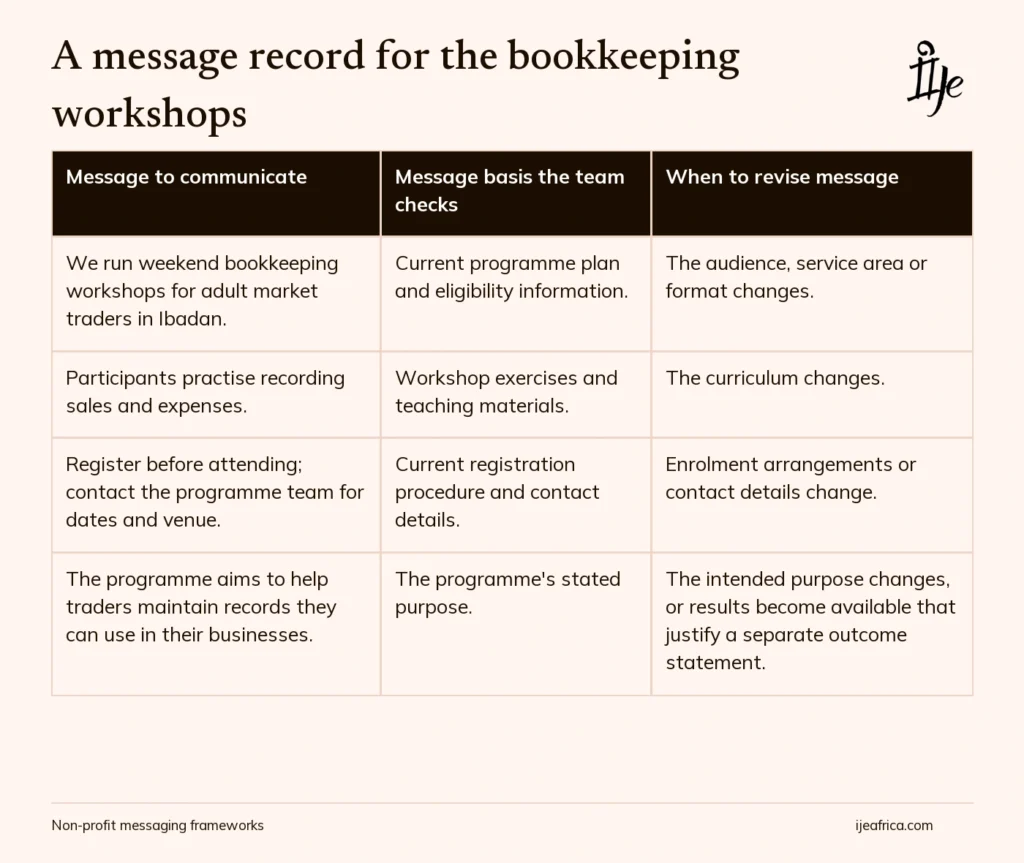
This record should be structured for easy access. Trust me, if this becomes too robust, thereby making it difficult to retrieve information on the go, your team will grow reluctant towards using it. There’s no essence of a message record if it’s not used.
Furthermore, you want to ensure that while the message record stays short enough for easy retrieval on the go, there are links to the source documents (if needed), with details of the person responsible for each source and the date it was last updated. That allows you to keep a proper system that funnels into your message record.
If you’re a large non-profit organisation with several programmes on the go, you will need to repeat this process for all of your programmes. Then, you will need to regroup all these processes within the broader organisational description for each programme.
Test and Update the Messages for Everyday Use
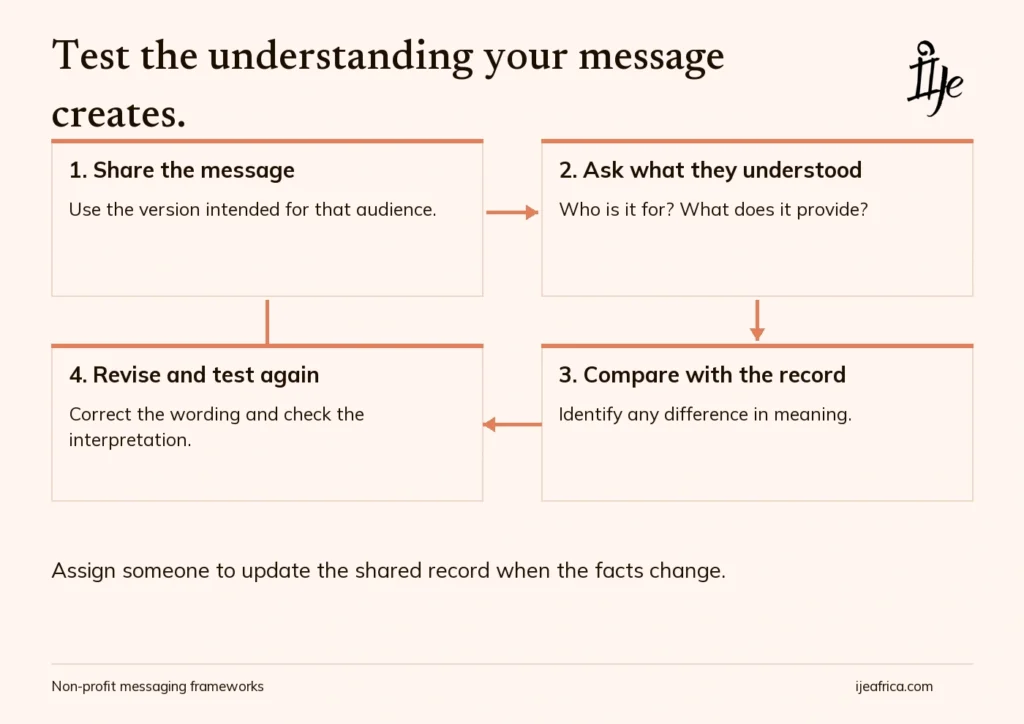
Once your messaging framework is ready, the next step is to put it to the test. You will need to recruit individuals representative of your different audience segments. Then, provide the key message aligned with their audience segment to them. After that, you should ask questions that elicit whether or not they understand what the programme is about, given the messaging about the programme. Then, compare their interpretation with the programme record.
As I said before, the essence of a messaging framework is in its usefulness to your team. Remember the little exercise I gave in this piece’s introuction? You will need to try that at intervals to ensure your team’s messaging framework stays coherent. Anybody’s work also soon becomes nobody’s work. As such, you should assign the responsibility of running these tests and updating the shared document when a source changes. That way, your team ensures that it keeps the testing and updating engine running to make your messaging framework stay fresh and useful.
More often than not, nonprofit organisations commit immense resources towards making impact and increasing the level of impact their organisation makes. However, there are tasks to be done, that if left undone, can strongly mitigate against your ability to make your desired level of impact. In that case, you may find that your organisation is still able to achieve some results. However, your desired results remain elusive and a subject of discussion during your team meeetings.
So, for every discussion the team has had about needing to make people better understand what your programmes are or what your organisation does, a useful path towards addressing the issue is to audit your non-profit’s messaging framework and launch a process towards building a more coherent framework.
It helps to know how deep a problem this is at your organisation, before launching the phases of the messaging framework development discussed in this piece. If you’re unsure how deep a problem this is, our Message Architecture Readiness Diagnostic tool is useful for identifying the depth of the problem, and its results can guide your messaging framework development.