

Should a Nonprofit Programme Have Its Own Brand?
Resume reading
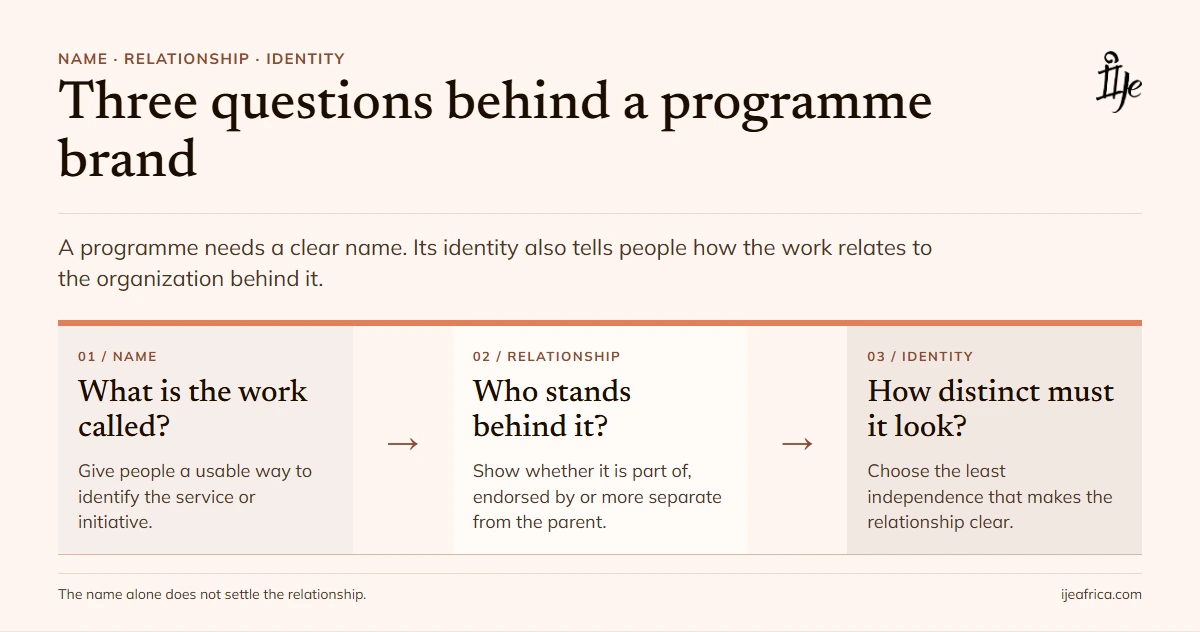
A programme can need a name without needing a separate brand. The distinction matters when a team is deciding whether to add a logo, launch a separate website or social account, or present a funded initiative as independent from its parent organization.
Start with the relationship the audience needs to understand. Is this work one part of the parent organization’s offer? Does it need a clear endorsement from the parent? Or does it have a distinct audience, purpose or partnership that requires more independence? The answer determines more than the artwork. It affects how the programme is named, where the parent appears, who approves materials and who maintains them.
A programme name and a separate brand are different decisions
A programme name identifies work. A brand relationship tells people who is responsible for it and how it connects to the organization behind it. The two decisions often happen together, but one does not settle the other.
For example, a nonprofit may call a service “Community Health Visits” and present it as a programme of the parent organization. The service has a name people can use, yet the parent remains the visible identity. The team may add a short description, contact details or a distinct colour to help people find the service. None of those choices automatically creates an independent brand.
Brand architecture is the way an organization presents the relationship between its parent identity and its programmes, initiatives or other named work. The exact terms vary across organizations. MIT’s brand guide, for instance, distinguishes a parent brand, a sub-brand presented as a direct extension of the parent, and an endorsed identity where the programme is more prominent while the parent remains visibly connected. Those are examples within MIT’s own rules, not a universal nonprofit standard. MIT’s brand-architecture guide is useful here because it shows that a programme can have a distinct name and presentation while still expressing a specific relationship to its parent.
Keep the public identity decision separate from legal registration, governance, contracts and funding terms. Those may require a name, acknowledgement or separate entity for reasons that a design choice cannot answer.
Four ways to show a programme’s relationship to its organization
Think of these as practical options, not a ladder every programme must climb.
| Structure | What people see | When it may fit | What the team must maintain |
|---|---|---|---|
| Programme descriptor | Parent name leads; a plain programme name explains the work | The programme serves the organization’s existing audience and belongs clearly within its mission | A consistent name and description across the parent’s materials |
| Parent-led sub-brand | Programme name is prominent, but it uses the parent’s identity and remains visibly part of it | People need to recognize a specific service or initiative, while the parent relationship should remain clear | Approved name, lock-up and application rules that follow the parent identity |
| Endorsed identity | Programme has more of its own presentation, with a visible “by,” “from” or “a programme of” relationship to the parent | The programme has a distinct audience or partner context, but the parent’s role still matters | Guidance for how the programme and parent names, marks and messages appear together |
| Independent identity | Programme appears as a separate public brand, with a less prominent or no routine parent mark | A real difference in audience, proposition, partnership or operating context calls for greater independence | Separate identity decisions, materials, channels, approvals and a clear reason to keep the distinction |
Scroll sideways to read the full table.
The first two options make the parent the main point of recognition. An endorsed identity gives the programme more room while still showing who stands behind it. An independent identity makes the strongest separation. It is not the same thing as creating a legally separate organization; public identity and legal structure are related decisions, but they are not interchangeable.
The choice should answer a communication need. A programme name can help people identify a service. A distinctive visual identity may help them tell two offers apart. A visible parent endorsement may show who operates or supports the work. When the identity becomes more independent, the team takes on more decisions about where it appears, who speaks for it and how it stays connected to the parent’s work.
Five conditions that can justify more independence
More separation may be appropriate when it helps people understand a genuine difference. Test the conditions below against the programme itself.
1. The audience needs something materially different. If the parent organization and programme serve the same people with related work, the parent identity may already make the connection clear. If the programme is designed for a separate audience that needs different information, language or access, a more distinct presentation may help. Different age groups, locations or activities alone do not automatically require a separate brand; the question is what people need to distinguish.
2. The programme makes a distinct promise. A new name can help when the programme offers a clearly different service or experience. It is less helpful when it labels an activity that is already easy to understand under the parent organization. Before creating a new identity, write what the programme does, whom it serves and what the parent does. If those descriptions remain almost the same, a separate identity may add another name without resolving the underlying position. If the positioning itself is unsettled, the brand-positioning guide addresses that decision before visual work begins.
3. The parent relationship creates a real constraint—or provides important reassurance. A programme may need space from a parent identity when the parent’s public associations make the programme difficult to explain to its intended audience. The reverse can also be true: the parent may be the clearest way to show who is accountable for the work. A partnership can change this calculation. In a 2017 Stanford Social Innovation Review case, a social enterprise’s health-savings identity was visibly tied to one telecom partner; the organization then faced a branding problem as it considered work with other telecom providers. That example shows how one partnership can shape an identity decision. It does not establish that separate programme brands are generally more effective or that the same issue applies to every nonprofit. Anne Miltenburg’s case account describes the specific trade-off.
4. The programme will continue long enough to justify its own rules. A time-limited campaign, funded activity or event may need a recognisable title and an acknowledgement, not a lasting identity system. A long-running service with a distinct audience may warrant more structure. The funding period alone should not decide the matter: a short grant can support ongoing work, and a long grant can still fund one bounded activity. Check the expected life of the programme, the organization’s plans after a grant ends and what should happen to the name if the activity changes.
5. Someone can own the extra work. A more independent identity needs a named person or team to approve the name, answer requests for new materials, keep the parent relationship visible where required and review the system when the programme changes. If no one owns those tasks, the team may create materials it cannot keep aligned. That is a delivery consideration, not a reason to deny a programme a clear identity; it is a reason to choose a structure the organization can actually maintain.
These conditions do not add up to a score. One contractual requirement may matter more than several preferences. The decision rule is simpler: choose more independence when a named audience, proposition or partner requirement makes the parent-led option unclear or unsuitable, and identify who will manage the resulting identity.
Work through a community-health example
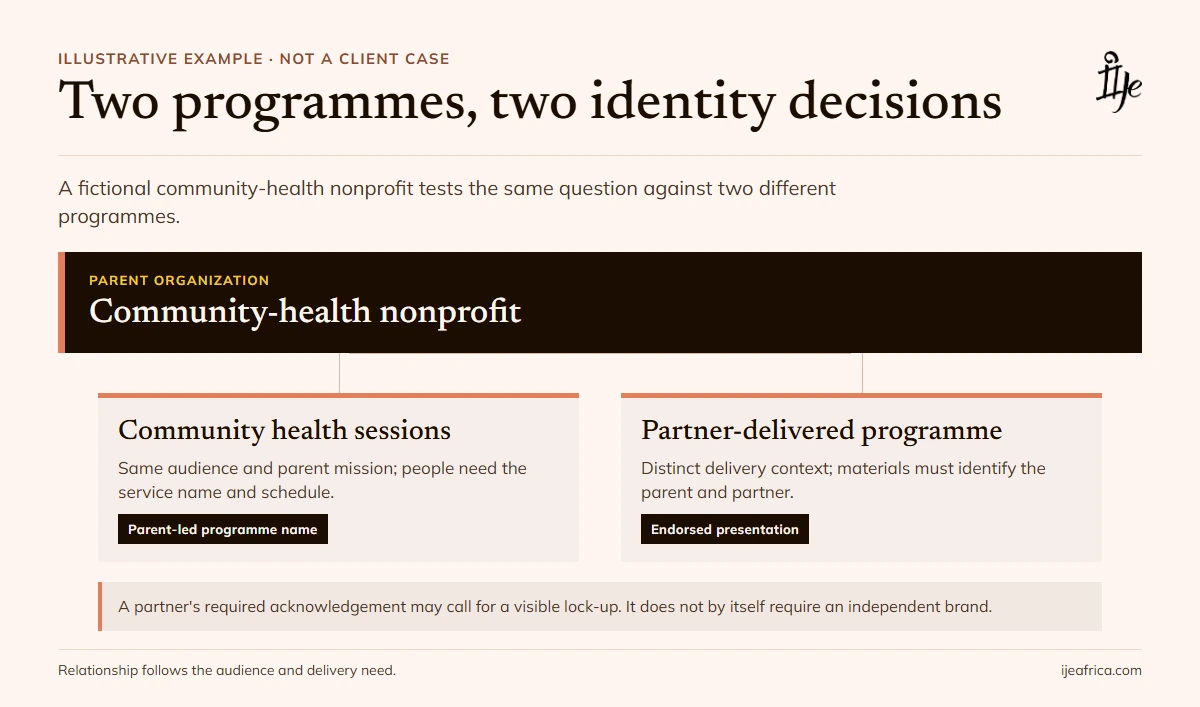
Consider a fictional Nigerian nonprofit running two community-health programmes. The example is illustrative; it does not describe an Ije client or a documented Nigerian organization.
The first programme offers regular health-information sessions through the nonprofit’s existing community work. It serves the same local audience, shares the parent organization’s purpose and uses the same staff and response route. People need to know what the sessions cover and when they take place. A clear programme name under the parent identity may be enough. The team can describe it as a programme of the nonprofit and publish the session information through the parent’s existing channels.
The second programme has a different audience and a delivery partnership that requires its own materials to identify both the programme and the organizations involved. That need may justify an endorsed presentation: the programme name can lead, while the parent and partner relationship remain visible in the places required. The team should confirm the exact wording and placement with the partner before production. The partnership requirement may justify a specific lock-up; by itself, it does not establish a need for a fully independent brand, new website or separate social channels.
For both programmes, the team can ask the same question: what must a person understand when they encounter this name? In the first case, the answer is the service and its parent. In the second, the answer includes the programme’s distinct role and the organizations responsible for delivery. The difference in that answer—not the number of activities—guides the identity choice.
Write the programme identity rule before design starts
Once the team has chosen a relationship, record it in a short rule that can guide real materials. For the fictional partnership programme, it might read:
Name: [Programme name]. Relationship: A programme of [parent organization], delivered with [partner name]. Presentation: The programme name may lead; the parent and partner are identified in the agreed materials. Owner: [Named role] approves the wording, mark and public uses. Review: Revisit the arrangement if the partner, audience, programme purpose or delivery model changes.
The final wording and placement must follow the actual agreement. The rule’s job is to help the team apply an approved relationship consistently; it cannot override a contract or determine legal status.
For a parent-led programme, the rule can be shorter: “Use [programme name] as a descriptor under [parent organization]. The parent identity leads. [Named role] approves changes to the name and description. Review the rule if the programme begins serving a different audience or offering a materially different service.”
In either case, the team has made several decisions before asking for a logo: who the programme serves, what the name identifies, how the parent appears, who approves changes and what would trigger a review. If the team has already made those decisions and needs to define the visual identity deliverables, the identity-design briefing guide can help scope that next task.
When a programme question points to wider brand work
A single programme may need one naming or application decision. That can remain a focused task. The question points to wider brand work when the programme name, parent website, partnership materials, evidence and public description give people conflicting accounts of who is responsible or what the organization offers.
For example, a programme page may present the initiative as independent while its proposal describes it as a core service and the partnership material names a different lead organization. Changing the logo alone would not settle those relationships. The team would need to agree what the organization is offering, which evidence supports the description and how each asset should show the parent, programme and partner.
That is the kind of connected decision addressed by Ije’s Brand-Power System. If the position is already clear and the need is limited to a visual identity, use the identity-design guide. If the question remains what the parent organization should be known for, return to brand positioning.
Before commissioning anything, complete this sentence: “People should understand that [programme] is [relationship to parent], because [audience or partner need]; [role] owns the rule, and we will review it if [named condition] changes.” If the team can fill those blanks, it has a decision to brief. If it cannot, more design options will not supply the missing organizational choice.