

Social Enterprise Examples: Three Ways Purpose Meets Trade
Resume reading
If you are looking for social enterprise examples, start with the relationship between what an organisation offers and the purpose it intends to serve. A mission alone does not explain the enterprise. You also need to see who pays, what they receive, and how the activity is meant to contribute to a social or environmental goal.
Three Nigeria-connected models make those differences easier to see: Babban Gona’s farmer services, RecyclePoints’ recycling incentives, and SoSo Care’s documented exchange of recyclable waste for health-cover premiums. Each connects trading activity to purpose in a different way.
What makes an enterprise social?
There is no single definition used everywhere. In its 2022 study of social enterprise in Nigeria, the British Council and its research partners used three criteria for one part of their estimate: a social or environmental mission, sales of a product or service that generate trading income, and reinvestment of most profit towards the social purpose. Those were the study’s working criteria; they are not a Nigerian legal definition or a rule that every organisation uses.
That distinction matters because a label does not tell you how a model works. Some nonprofits earn income from products or services. Some businesses state a social purpose. To understand a particular organisation, look at the offer, the source of income, the intended contribution and the relationship between them. The legal form alone does not answer all four questions.
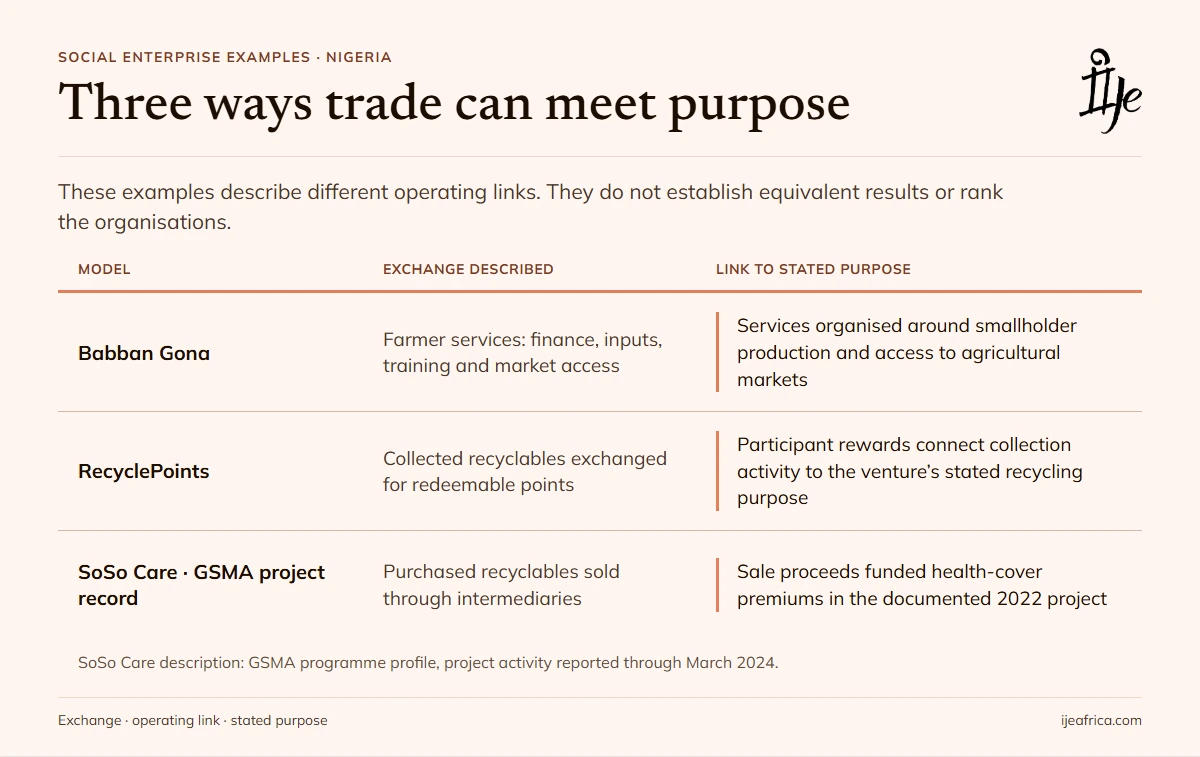
The examples make the range of these connections easier to see.
Three Nigerian models connect trade and purpose in different ways
Babban Gona: farmer services linked to production and market access
Babban Gona describes itself as an agricultural enterprise working to make farming more profitable for smallholder farmers. A World Bank account of its model explains the service bundle: financing, agricultural inputs, training through farmer groups, and support with market access. Those pieces respond to practical constraints that can affect a farming season: a member needs finance and inputs before production, useful guidance while crops grow, and a route to market after harvest. Babban Gona’s current public description sets out its stated purpose and model.
The model therefore connects a commercial agricultural service with a stated purpose around smallholder farming and rural opportunity. The useful lesson is the sequence: organise farmers, make services available at the point they are needed, then connect production to market access. Babban Gona’s public materials also describe farmer and harvest relationships; the World Bank account is the stronger source here for the service structure.
This description does not establish what every farmer earns or what the current result is for every member. Those claims would need current records and a clear comparison. The example shows how the service package is designed to relate to the purpose; it does not substitute for outcome evidence.
RecyclePoints: recyclables exchanged for participant rewards
RecyclePoints describes itself as a waste-recycling and social-benefit venture. Its published model collects materials such as plastic bottles, sachets, cans, glass and paper from registered participants. The quantity collected determines points, which participants can redeem for household items or cash. The company also names a partnership with the Lagos State Waste Management Authority for recycling and sanitation advocacy.
Here, the user-facing exchange is visible: a participant separates and presents recyclable material, then receives points with a stated redemption value. The environmental purpose is connected to participation in collection. That arrangement is different from selling a farmer-service bundle or providing health cover.
The public model description explains the collection and reward mechanism. It does not provide enough information to assess the venture’s full revenue mix, cost recovery or total environmental effect. Those are separate questions from how the participant exchange works.
SoSo Care: waste sales connected to health-cover premiums
SoSo Care offers another connection between recycling and a social service. In a profile of its 2022 digital-services project, GSMA describes a model in which the company purchased recyclable waste from low-income participants and sold the materials through intermediaries and recycling companies. Proceeds were used to fund health-insurance premiums for participating households.
That sequence is more specific than “recycling helps health.” Waste changes hands, the material is sold, and the proceeds support an insurance payment. GSMA’s profile reports project activity through March 2024, including service and participation measures. Those figures belong to that dated programme record; they should not be presented as current totals or as proof that recycling alone caused a health outcome.
Compared with RecyclePoints, the documented SoSo Care project makes the link from material sale to insurance premium explicit. The two examples share a material, but their user offer and stated social purpose differ.
Compare what each model makes visible
| Example | What the participant or customer receives | How the activity connects to purpose | What still needs its own evidence |
|---|---|---|---|
| Babban Gona | A bundle of farmer services, including finance, inputs, training and market access | The services are organised around smallholder production and access to agricultural markets | Current member-level results, costs and the experience of different farmer groups |
| RecyclePoints | Points that can be redeemed for goods or cash in exchange for collected recyclables | The incentive links participant collection with the venture’s stated recycling and social-benefit purpose | The full revenue model, cost recovery and measured environmental outcomes |
| SoSo Care | In the GSMA-documented project, a route to health-cover premiums through recyclable material | Sale proceeds from recyclable material were used to fund premiums in the described programme | Current service status and outcomes beyond the dated programme evidence |
Scroll sideways to read the full table.
“We solve a social problem” is not a complete explanation of an enterprise. A reader also needs to understand the offer and the activity that connects it to the stated purpose.
Use the examples to explain your own enterprise
Try answering four questions in plain language:
- Who pays, and who uses the offer? They may be the same person, or they may be different.
- What does the customer or participant receive? Name the service, product, access or exchange.
- What activity connects the offer to the purpose? Describe what the enterprise does, not only what it hopes will change.
- What evidence supports each part? A sales record can show a sale; it does not by itself prove a social outcome.

If a purpose-linked activity is still planned, describe it as intended. If it is underway, name the period and the records you can show. Keep outcome claims tied to evidence that measures the outcome itself.
SoSo Care’s GSMA-documented project can be described in four separate statements: the project bought recyclable material from participants; the material was sold through intermediaries; proceeds funded health-cover premiums; and GSMA reported programme activity through March 2024. The first three explain the model’s operating link. The dated programme record supports the fourth. It does not, by itself, establish current service status or prove that the arrangement caused a health outcome.
An enterprise’s public explanation is clearer when a founder names what is available, who it is for and how the activity relates to its purpose. Whether customers want the offer and whether it can cover its costs require separate evidence.
If you want to examine how the offer, intended contribution and evidence fit together for your own organisation, continue to Ije’s guide to a social-enterprise value proposition. It focuses on articulating one enterprise’s offer; this article has focused on understanding different models.