

Social Enterprise vs NGO: What Actually Differs?
Resume reading
People often use “NGO” and “social enterprise” as if they describe two opposing kinds of organisation. The split usually sounds straightforward: an NGO gets grants, while a social enterprise sells something. For a Nigerian organisation explaining its work to a funder, customer or partner, that shortcut can obscure more than it clarifies.
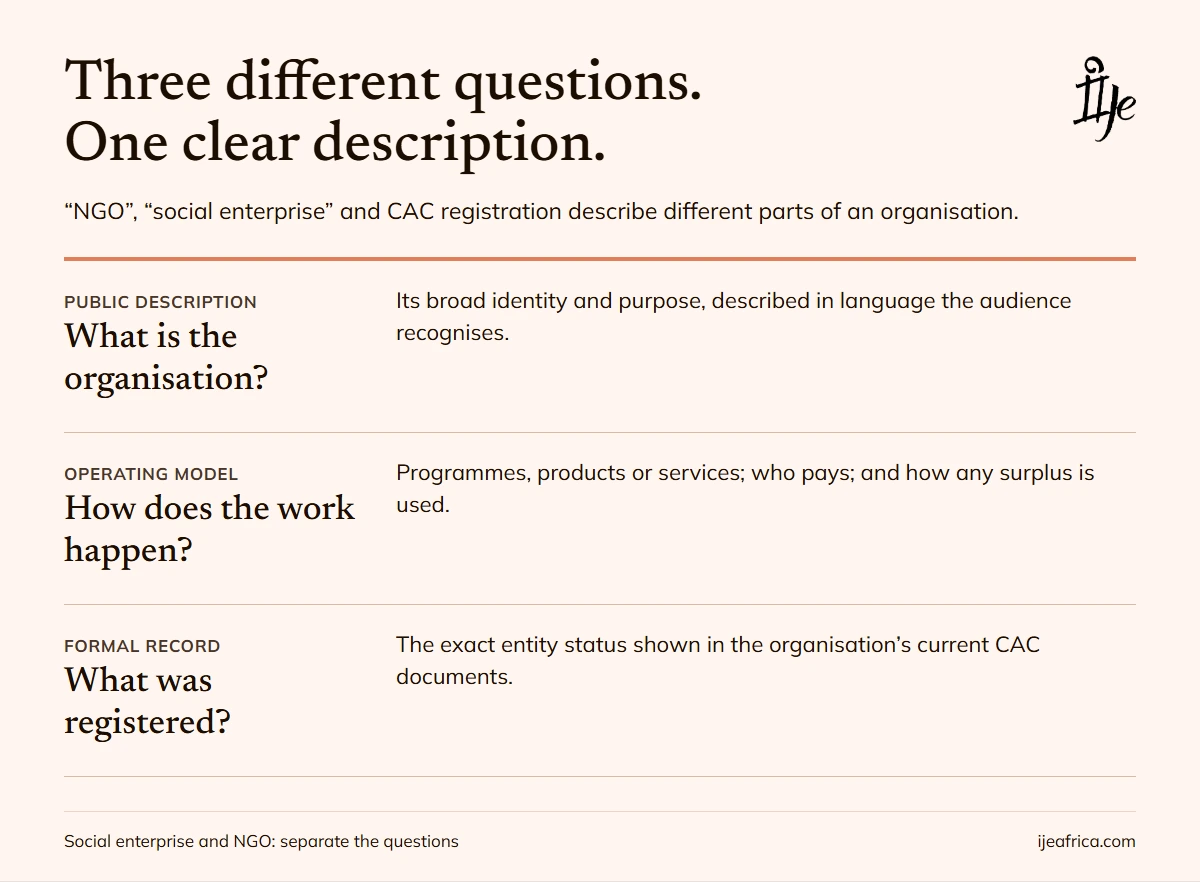
The British Council’s 2022 State of Social Enterprise in Nigeria used a study-specific screen that considered social or environmental mission, trading income, and the use of surplus for impact. The report is explicit that its criteria were not a universal definition. Its sample also included organisations that reported grant finance. That combination matters: earning income and seeking grants do not automatically cancel each other out. The useful comparison is about three separate questions—what the organisation is called, how it operates, and how it is registered.
What does “NGO” tell a reader?
In ordinary public language, “non-governmental organisation” tells a reader that the organisation sits outside government. It is a broad description of organisational identity and purpose. By itself, the label does not tell a supporter whether the organisation sells products, charges for training, earns service income, receives grants, or combines several sources.
It also does not show the organisation’s precise registration. The words used in a website biography may be shorter than the formal name and status on its Corporate Affairs Commission records. A partner checking an organisation should look at the certificate, registration details and governing documents rather than treating a public label as a substitute for them.
That distinction keeps a useful word from doing too much work. “NGO” can help a reader understand the organisation’s broad role. It cannot, on its own, answer every question about money, activity or legal form.
What makes an organisation a social enterprise?
“Social enterprise” is commonly used for an organisation that pursues a social or environmental purpose through an enterprise model. In practice, definitions vary. The British Council report notes the lack of a globally agreed definition. For its own Nigerian estimate, the research team looked for organisations with a social or environmental mission, sales of products or services that generated trading income, and a commitment to reinvest most profit toward social impact. Those criteria helped the researchers classify respondents; they were not presented as a statutory test or a definition everyone must adopt.
The useful question is how the activity and the purpose relate. Does the organisation earn income by selling something connected to its work? What happens to any surplus? Which people or communities benefit, and how? Those questions reveal more than the label alone.
The phrase does not settle legal form. The report’s sample included organisations across different registration forms, and its researchers recorded legal form separately from their social-enterprise screening. That is a practical clue for readers: purpose, trading activity and registration should be checked as distinct facts.
Can a social enterprise receive grants?
Yes, grant support can be part of a social enterprise’s funding mix. The Nigerian study’s survey criteria excluded organisations that received 75–100 per cent of their income from grants for its classification exercise; they did not exclude every organisation that received a grant. In its discussion of study respondents, the report also lists grants among the finance sources and identifies access to grants as a difficulty.
Those findings describe the study samples collected across 2019–2021, not every Nigerian organisation today. They do, however, challenge the simple claim that an organisation must choose between trading and grant support. An enterprise might sell a product or service, receive a time-limited grant for a related activity, and reinvest any surplus in its stated purpose. The mix depends on the organisation and the terms attached to each source.
For a specific grant, the funder’s eligibility rules still decide who may apply and what costs are allowed. A general description such as “social enterprise” does not guarantee eligibility. The organisation should check the call, its registration documents and any restrictions on income or surplus use before it applies.
Where does CAC registration fit?
Registration is a separate question from whether an organisation uses the term “NGO” or “social enterprise.” The CAC currently describes an Incorporated Trustees registration process that includes a constitution and trustee details. Its official registration portal also provides routes and materials for Nigerian entity registration. These records establish what was registered through the relevant route; the public label does not replace them.
This article is not legal advice. A team deciding whether to incorporate trustees, register a company or use another arrangement should consider its purpose, governance, planned activities, income, funding conditions and compliance responsibilities with a qualified Nigerian adviser. The answer can affect more than what the organisation calls itself.
For a public profile or proposal, keep the statements precise. Name the organisation as it appears in its records. Then explain its purpose and how its activities work. Avoid implying that a particular label automatically creates a particular tax treatment, funding entitlement or permission to trade.
Describe the three facts separately
Consider two constructed examples. They illustrate the distinctions and do not describe actual Nigerian organisations or prescribe a legal structure.
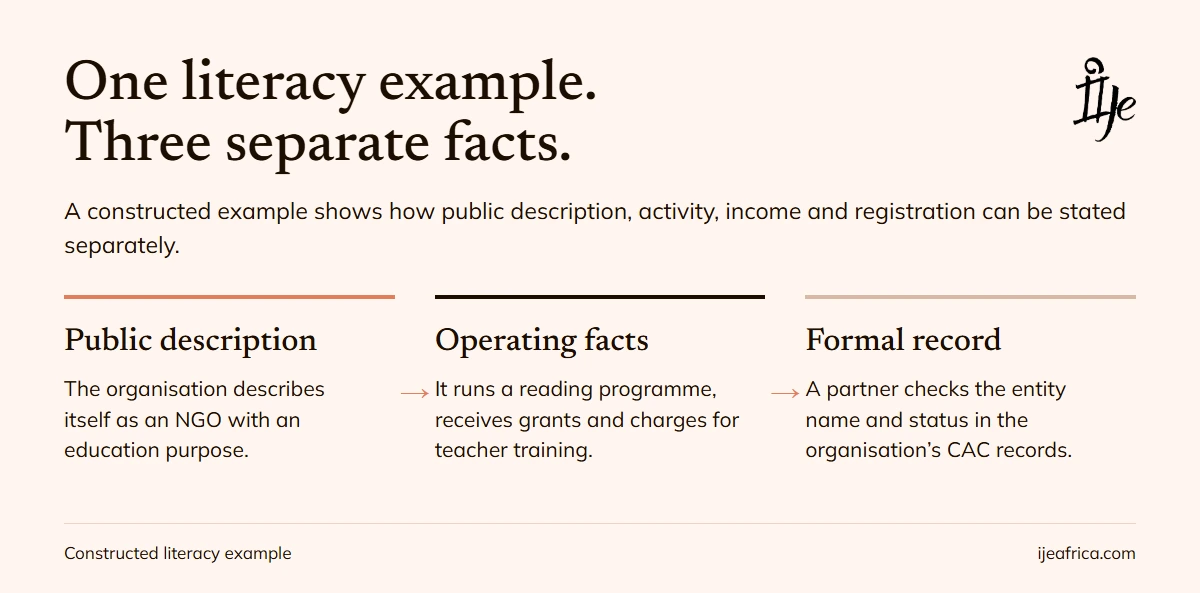
One literacy organisation might describe itself publicly as an NGO. It could fund a community reading programme through donations and grants, while also charging schools for teacher training. The label describes its broad identity; the funding statement describes its income; the paid training describes one activity. Its registration would need to be checked in its own CAC records.
A second organisation might sell low-cost learning materials as part of a social-enterprise model and use any surplus to support its education purpose. It might also receive a grant for a pilot. Again, those facts do not tell a reader which CAC route the founders selected or whether the project meets a particular funder’s requirements.
The descriptions become clearer when an organisation can answer these prompts separately:
The British Council’s study criteria above frame the operating question; the current CAC process shows why the formal record remains a separate check.
| Question | What to state | What it helps a reader understand |
|---|---|---|
| How do you describe the organisation? | Its public identity and purpose, in terms the audience recognises. | Who is speaking and what the work is for. |
| How does the work operate? | The products, services or programmes; who pays; and how any surplus is used. | How purpose connects to day-to-day activity and income. |
| What is the formal registration? | The exact status and name shown in the organisation’s current CAC record. | Which entity and governing documents a partner should verify. |
Scroll sideways to read the full table.
This separation is useful wherever the organisation introduces itself: a website, grant application, partnership note or customer page. A reader should not have to infer the purpose from the income source or guess the legal form from the mission statement.
The order can change with the audience. A prospective customer may first need to know what is sold, who it serves and what the purchase supports. A grant-maker may need the programme purpose, delivery plan, applicant entity and eligible costs. A community partner may care most about who makes decisions and who benefits. The facts stay the same; the introduction brings forward the details that answer that reader’s question. That makes the description clearer without changing the organisation’s identity to suit each conversation.
Once those facts are clear, the organisation can explain the offer in language that links the need it addresses, what it provides and the change it intends to support. Ije’s guide to a social enterprise value proposition works through that next question. The two pieces have different jobs: this one separates the labels and operating facts; the guide helps describe the value of the offer.