

NGO Marketing Agency in Nigeria: What Should You Hire For?
Resume reading
When you search for an NGO marketing agency in Nigeria, you may find firms offering social media, search marketing, public relations, content, branding, fundraising campaigns or all of them together. Those labels can make a shortlist look straightforward. They do not yet tell you which kind of help your organisation needs.
Start with the work you need done. Is the organisation hard to explain? Are the right people not finding your work? Does the public understand your role but lack a clear next step? Are campaign materials inconsistent? Each problem points to a different brief.
The distinction matters because an agency can deliver exactly what you requested and still leave the underlying problem untouched. A content calendar cannot settle what the organisation should say. A new identity cannot, on its own, make a campaign reach the people it needs. A fundraising appeal cannot replace the evidence and follow-up the organisation needs to earn confidence.
What does “marketing” mean for an NGO?
In an NGO, “marketing” may refer to several kinds of work: helping people understand the organisation, reaching a defined audience, building media attention, recruiting supporters or generating donations. Those purposes can overlap, but they are not the same assignment.
The Nigeria Network of NGOs’ communications policy offers a useful local example of the range involved. Its stated audiences include civil organisations, donor organisations, implementing partners, regulators, academics, the public and the media. It also distinguishes internal from external communication and names choices such as English, local-language translation when needed, websites, email, phone, social media and media briefings. The lesson for a buyer is practical: audience and purpose should shape the work and channel, rather than one generic “marketing” request being sent to every provider.
Before contacting an NGO marketing agency, write one sentence that completes this thought:
We need [specific audience] to understand or do [specific next step] because [organisational priority].
If the sentence is hard to complete, that is useful information. You may need to settle the audience, message or proof before commissioning more promotion.
Four kinds of support an NGO might mean by “marketing”
The work below solves different problems. Some providers offer more than one kind; the important question is what they will actually do, what decisions they need from you and what evidence will show that the work was delivered.

Brand strategy and identity work
Brand work clarifies the organisation’s role, audiences, position, messages, evidence and expression. It can include verbal identity, visual identity, narrative, guidelines and the tools teams need to apply those decisions consistently.
This may be the right starting point when staff, proposals and public pages describe the organisation in conflicting ways; when a new programme has changed the organisation’s role; when useful evidence is not being used; or when teams keep requesting new assets because no shared direction exists.
Ask a prospective partner what decisions the work will settle, how staff will use the resulting assets, and what is outside the scope. If the proposal lists only a logo, templates or a website, ask who will decide the audience, message and proof those materials should express.
Digital marketing and audience acquisition
Digital marketing uses online channels and tools to reach people with a defined message or offer. Depending on the brief, the work may involve search visibility, paid advertising, social media, email, landing pages, analytics or campaign optimisation.
It may fit when the organisation can explain what it offers, whom it needs to reach and what action those people can take, but needs specialist help with a digital channel or campaign. Before approving activity, agree which audience and action matter, which destination will receive that audience, who will respond, and what will be measured.
Do not treat impressions, views, followers or clicks as proof that people understood the organisation or took a suitable next step. Choose measures that match the assignment: delivery and reach for a visibility task, completed registrations for an event pathway, or qualified enquiries for a partnership campaign. The agency can report channel activity; your organisation remains responsible for what happens after an enquiry arrives.
Strategic communications and public relations
Communications and PR help an organisation explain work to particular audiences and navigate public, media or stakeholder attention. The scope can include message development, editorial planning, media relations, public information, issues communication or internal communications.
This may fit when the organisation already knows what it needs to communicate but lacks the relationships, expertise or capacity to deliver it well. A sound brief identifies the audience, the information they need, the spokesperson or approval route, and how the team will handle questions or corrections.
For an organisation sharing stories about people or communities, agree consent, dignity, safety and accuracy requirements before production. The story should represent the person and work truthfully; it should not ask a participant’s experience to stand in for evidence about an entire programme.
Fundraising and campaign support
Fundraising support focuses on a funding objective and the steps that invite, receive and steward contributions. A campaign partner may help with a case for support, donor communications, campaign creative, donation pathways, events or fundraising operations.
It may fit when the organisation has a defined funding need, an accountable owner for donations and a credible way to explain what the funding will support. Before launching, check the amount or resource sought, the evidence behind the case, the donation or response route, the fulfilment plan and the follow-up responsibility.
Campaign communication can help people understand an invitation; it cannot guarantee that they will give. Make the ask clear and make the post-response process work before increasing campaign reach.
How do you choose the right kind of NGO marketing agency?
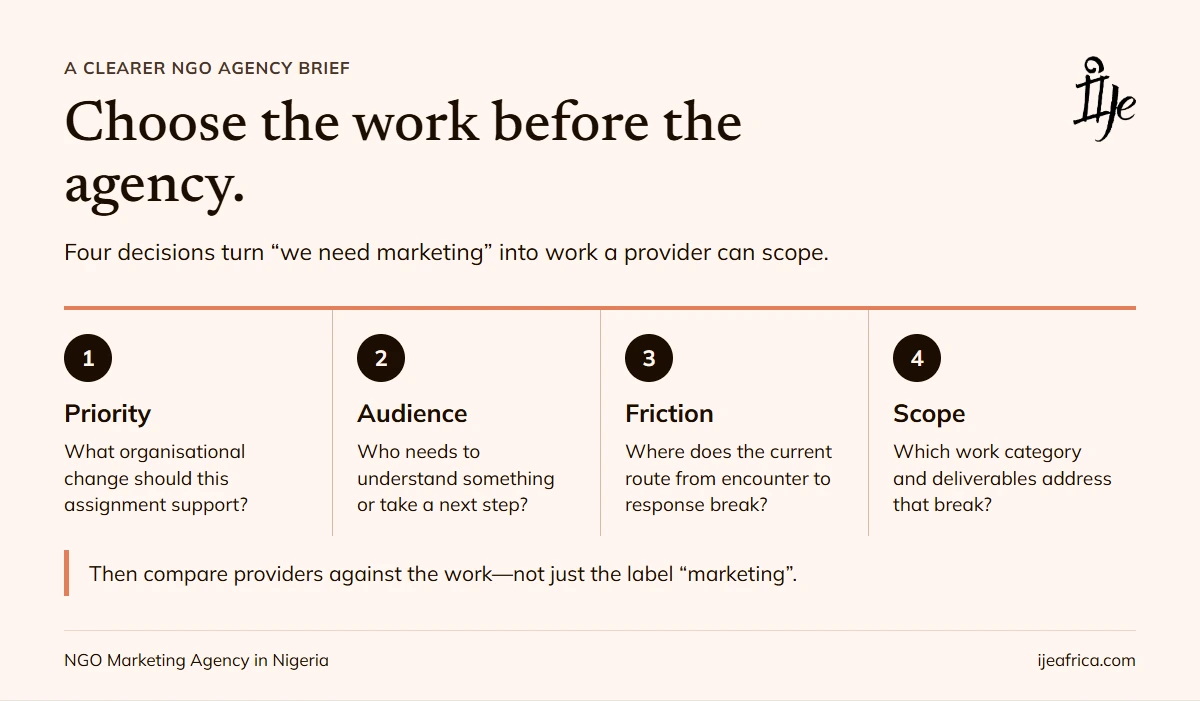
Use the sequence below before comparing names or requesting proposals.
1. Name the organisational priority
Choose the change the assignment should support: for example, make a service easier to understand, recruit participants for a defined programme, reach institutional partners, inform the public about an issue, or invite contributions to a specific campaign.
Keep the priority within the organisation’s authority. “Raise awareness” is a starting point; it needs a more concrete audience and purpose. “Secure funding” is an organisational ambition; an agency can prepare and distribute campaign materials, but the funding decision belongs to prospective supporters.
2. Identify the audience and the question they have
An NGO may speak with participants, donors, foundations, government bodies, journalists, peer organisations, volunteers and community members. A single campaign may involve several of them, but each material should make clear whom it addresses and what that person needs to know.
Write down the audience’s likely question. A participant may need to know eligibility and safety. A foundation may need to assess programme logic and evidence. A journalist may need a reliable contact and current facts. The questions determine the message, format and response route.
3. Find the point where the current pathway breaks
Follow one real example from the first encounter to the response. A person sees a post, opens a page, reads a claim, looks for evidence and decides whether to act. Which step fails?
- If people cannot explain what the organisation does, address identity and messaging.
- If the offer is clear but the intended audience cannot find it, assess distribution and channel work.
- If a media contact cannot verify a claim or reach a spokesperson, repair the communications process and evidence access.
- If a donor understands the request but cannot complete it or receive follow-up, repair the fundraising pathway.
The break may involve more than one provider. Decide who owns each part and how the handoff will work before the assignment begins.
4. Match the brief to the work, then compare providers
Once the work category is clear, compare providers on relevant evidence: fit with mission-driven work, scope from strategy into execution, named project evidence, and a visible working approach. Ask what the public examples show and what you still need to verify for your own assignment.
For a closer look at that provider-comparison decision, see NGO Branding Agencies in Nigeria: 9 Providers to Explore. It considers branding providers; this guide helps you decide whether branding is the right category in the first place.
What should an NGO put in its agency brief?
A useful brief does not need to be long. It does need enough detail for a provider to propose work that fits the organisation.
Include:
- The organisational priority: What are you trying to make possible?
- The audience: Who needs to understand, find, trust or respond to the work?
- The current situation: What is happening now, and where does the pathway break?
- The evidence: Which records, stories, results, permissions or existing materials can the agency use?
- The requested work: What decisions, assets, channels or implementation are in scope?
- The boundaries: What is not included, what claims should not be made, and what data or stories cannot be shared?
- The people and timing: Who provides input, who decides, who approves and what dates matter?
- The follow-through: Who receives enquiries, maintains assets, updates information and learns from the response?
- The measures: What can the team verify as delivered, and what audience or organisational signal will it observe without treating correlation as proof of cause?
For example, “We need a new social media strategy” describes an output. “We need programme partners in two states to understand our teacher-training model and ask about a partnership; our current materials describe the programme differently, and the team has no approved partnership page” identifies a decision and a visible gap. The second brief gives providers something concrete to diagnose and scope.
When should brand work come before more promotion?
Before commissioning a larger marketing campaign, check whether the organisation can answer these questions consistently:
- What role does the organisation play, and what change does it contribute to?
- Which audience matters for this particular effort?
- What should that audience understand about the work?
- Which evidence supports the public claims?
- What next step can the organisation actually support?
If different departments give incompatible answers, or if the evidence and response route are missing, a promotion partner may be forced to invent the strategy as it goes. That creates avoidable revisions and can produce more materials without resolving the original decision.
Brand work is not automatically the answer. A team may have a clear identity and simply need help with a time-bound digital campaign. Another may need a functioning donation form, a media contact process, better programme data or more delivery capacity. Diagnose the actual break; commission only the work that addresses it.
Ije’s nonprofit branding strategy guide explains the decisions and connected assets that brand strategy should address. The brand visibility guide focuses on the public pathway from audience and message through channel, response and learning.
Where the Brand-Power System fits
The provider category is one question. The organisation’s underlying brand-power assets are another. If your team needs to clarify its identity, organise its proof and story, connect the public materials and decide what should be activated first, explore Ije’s Brand-Power System.
The system does not replace every specialist. It helps an organisation understand which brand-power assets are latent, missing or disconnected, then build or activate the parts that fit the diagnosis. A digital marketer, communications partner or fundraising specialist may still be right for a defined execution need.
Before you contact any provider, write the one-sentence priority, the audience’s question and the point where the current pathway breaks. You will have a better starting brief—and a better basis for deciding what kind of help to hire.
Common questions about NGO marketing agencies
What does an NGO marketing agency do?
The term can cover brand strategy, digital marketing, communications and PR, fundraising campaigns, or a combination. Ask which decisions and deliverables are included, who will carry them out, and how the work connects to your organisation’s priority.
Should an NGO hire a branding agency or a digital marketing agency?
Choose based on the problem. If the organisation’s role, audience, message or proof is unclear, resolve those decisions before scaling promotion. If those foundations are clear and the team needs help reaching a defined audience through digital channels, a digital marketing partner may fit. Some assignments need both, sequenced clearly.
How can an NGO assess an agency proposal?
Check whether the proposal responds to your audience and organisational priority, names the work and exclusions, shows relevant project evidence, explains its approach, identifies your team’s responsibilities and measures delivery separately from audience outcomes.
Can an agency guarantee donations or visibility?
An agency can commit to agreed work and report what it delivers. Donations, public attention, media coverage and audience response depend on people and conditions outside the agency’s control. Ask how the provider will measure its contribution without presenting an influenced outcome as guaranteed.