

Brand Naming: Give the Name a Clear Job
Resume reading
Before a team starts collecting brand-name ideas, it needs to answer one question: what exactly are we naming?
It might be the organisation, a service, an offer or a programme. Those names appear in different places and serve different decisions. A service name may need to distinguish the offer. An organisation’s name may need to remain useful as its work changes. A programme name must make its relationship to the parent organisation clear enough for its audience.
When those choices are still open, a shortlist becomes a preference contest. One person wants a name that says exactly what the organisation does. Another wants something broader. A third is already asking for a logo. The team can spend hours comparing words without agreeing what any of them need to accomplish.
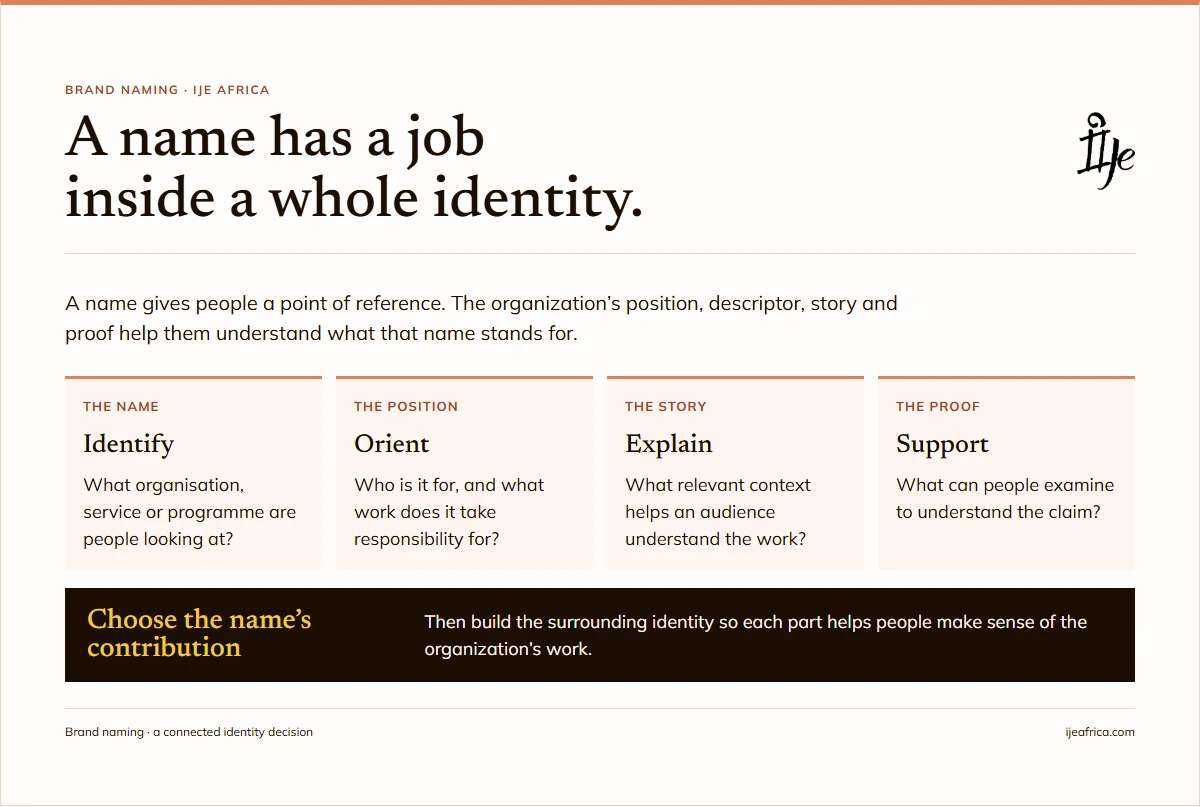
Good brand naming begins with the job the name must do. The name then has a place in the organisation’s wider identity, alongside its position, proof, story and public presence.

Decide what the name belongs to
“We need a new name” can describe several different decisions: the organisation’s public name; a service or offer it provides; a programme or initiative connected to it; or a campaign with a particular time, audience or purpose.
Write down which object is in scope, then name who will approve, use and maintain it when the organisation or offer changes. A service may need a clear label without becoming a separate brand. A programme may need its own name while remaining visibly connected to its parent. If the relationship is the main question, Ije’s guide to whether a nonprofit programme should have its own brand explores that decision. Here, the focus is the name and the work it should support.
Complete this sentence before comparing candidates: “We are naming ___ for ___, so that ___ can ___.” If the team cannot complete it, the object or audience is still unclear. That uncertainty will make every name feel like it solves a different problem.
Give the name a job the rest of the brand can support
A name can help people identify an organisation or offer, distinguish it from alternatives, or give its work a distinctive point of reference. It does not have to explain every service, audience, method and result. Descriptions, messages, evidence and visual identity do other parts of that work.
This is why naming should follow the strategic choice the name needs to express. If the organisation has not decided who it serves, what it does for them or how its work differs, those questions will keep returning to the naming discussion. Ije’s brand-positioning guide covers that earlier decision.
For the name itself, agree on a few requirements. Some are necessary: it must refer to the right object, fit the chosen direction and work in the settings that matter. Others are preferences, such as a particular sound, spelling pattern or style. Keeping these separate gives disagreement a useful subject. The team can ask whether a candidate fails a requirement or simply differs from someone’s taste.
A name that clearly describes one service may become restrictive if the service expands. A broader, more associative name may leave room, but its descriptor may need to do more work. Neither is automatically better. The direction should match the role agreed in the brief.
Compare naming directions before debating individual words
Teams often need to choose how directly a name should describe the work. These are practical directions to compare, not a formula for producing a successful name.
| Direction | What it helps the team examine | Question to resolve |
|---|---|---|
| Descriptive | Whether the subject or function is recognisable on first contact. | Could the wording become too narrow, generic or hard to distinguish? |
| Associative | Whether an idea connected to the work can create a distinctive point of reference. | What explanation or descriptor will make the intended connection clear? |
| Coined or newly combined | Whether a new verbal form leaves room beyond a literal description. | How will people learn what the name refers to, and how will it be written and said? |
| Founder-, place- or history-linked | Whether a real origin or relationship belongs in the public name. | Will the reference remain accurate as the work, ownership or reach changes? |
Scroll sideways to read the full table.
A direction can combine more than one of these. Compare options against the same agreed role so the discussion is about what each asks the organisation to explain, maintain and leave open—not which word sounds most impressive in isolation.
Work a name brief through a real use case
Imagine an Ibadan social enterprise that provides a service helping community clinics coordinate referrals. Its team is preparing to name the service while the parent organisation may add other services later.
The first brief says, “We want a memorable name that sounds modern.” That records a preference; it does not say what is being named or where people will encounter it. A more useful brief identifies the decision:

With that brief, a descriptive direction could help clinic managers recognise the referral task sooner. It may feel restrictive if the service expands. An associative direction could leave more room, but its descriptor would need to identify the service clearly in a proposal and on a web page. The team can compare those trade-offs without inventing a winning name before it understands the job.
The decision question is concrete: does the name, together with its descriptor, help a clinic manager recognise this service in both settings? If not, identify what is unclear—the word, the descriptor or the parent relationship. That tells the team what to revise. It does not establish what a wider market will understand or prefer.
Check the name where people will meet it
Put each shortlisted candidate in the places where it will actually appear: a website heading, one-line service description, proposal, email introduction or application form. Keep the surrounding copy the same so the name is what changes.
Then review the role from the brief. Can a reader tell whether the name identifies the organisation or one service? Does the descriptor make the offer clearer? Does the name still fit beside the parent organisation? If it uses a word from a language or community context, involve people with relevant fluency and context; one person or one language check cannot stand in for all the audiences an organisation may serve.
Ask people what they think the name refers to and what information they still need. “Do you like it?” can start a conversation, but it does not reveal what someone understood. A small review can surface questions to investigate; it cannot establish broad audience response by itself.
Record which requirements each candidate meets, what remains unclear and which preference the team is choosing. A candidate that fails a necessary requirement leaves the shortlist. If two candidates meet them all, the team can make a deliberate choice between their remaining trade-offs.
Keep creative selection separate from formal clearance
Strategic fit and legal availability are different checks. The Corporate Affairs Commission’s published business-name registration process begins with an availability check and continues through pre-registration steps and a filing fee. That administrative process does not decide whether a name expresses the right position or fits an organisation’s public identity.
Trademark protection is a separate matter. The World Intellectual Property Organization explains that trademarks are generally protected through national or regional registration and that distinctiveness matters. This is general guidance, not a Nigerian clearance result. Before relying on a name, complete the relevant searches and get appropriate local advice. WIPO’s trademark guidance explains the general distinction.
A creative shortlist can be ready while formal checks are still under way. Keep each candidate’s status clear so a preferred option is not mistaken for an available or cleared name.
A name works as part of a larger identity
Once the team knows what is being named and what the name must contribute, it can brief the right work. If the request is one name, keep the commission focused. If naming reveals unresolved questions about position, offer structure, proof, story or public presence, the organisation may need to connect those decisions too.
Ije’s Brand-Power System connects those parts of an organisation’s identity and public presence. Start with a one-line name brief, test the candidates where they will be used, and route availability or trademark questions to the appropriate source.