

NGO Mission Statement Examples: Five Nigerian Organisations
Resume reading
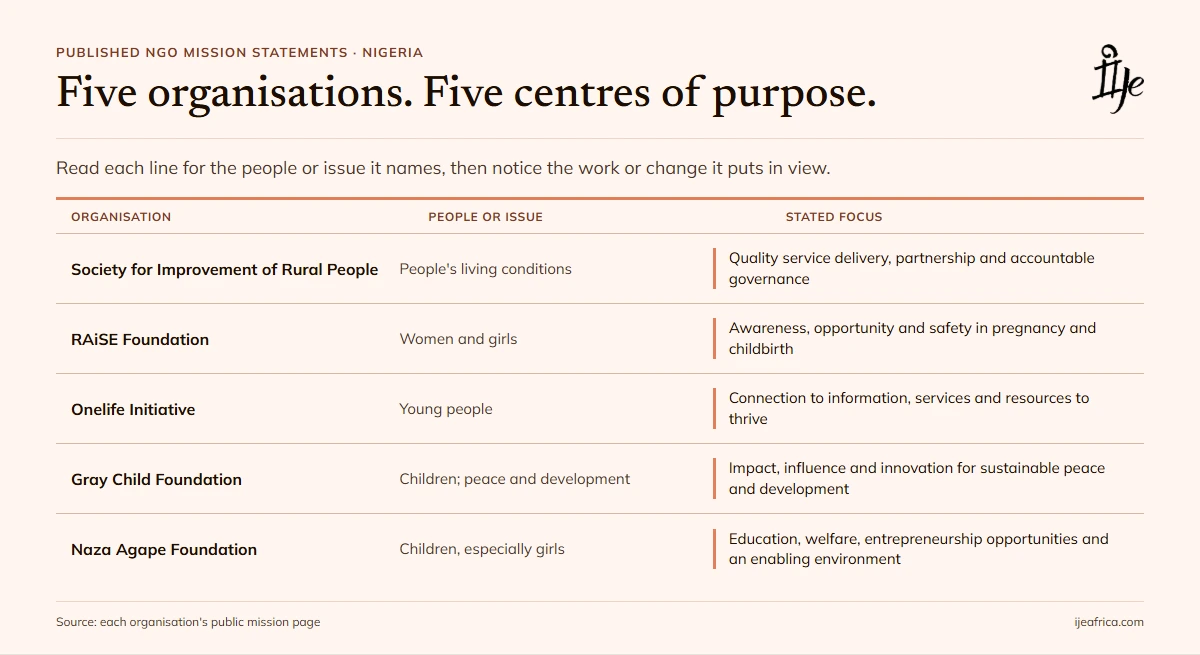
If you are looking for NGO mission statement examples, these five Nigerian organisations show how a single line can point to very different work. One names service delivery and governance. Another centres women’s safety in pregnancy. Others focus on young people’s access to resources, sustainable peace, or children’s education and opportunity.
Read the wording closely and each statement gives you a different starting point: the people an organisation names, the issue it addresses, and the change it describes. The examples are drawn from the organisations’ own public pages.
Five Nigerian NGO mission statement examples
Society for Improvement of Rural People: service, partnership and governance
The Society for Improvement of Rural People (SIRP) states its mission as promoting “quality service delivery” to improve living conditions while ensuring “true partnership, accountability and good governance.” The mission page carries the full statement and describes the organisation’s approach.
The line brings together an intended improvement in people’s living conditions and the principles that should shape the work. “Service delivery” names an activity; partnership, accountability and governance say something about how SIRP presents the relationships and public conduct around that activity. It is a broader formulation than a sentence focused on one population or one issue.
RAiSE Foundation: women’s safety in pregnancy and childbirth
RAiSE Foundation’s About Us page describes its mission around creating awareness and opportunity so women and girls can realise their potential in an environment “safe for pregnancy and childbirth.” Its vision is stated more narrowly: “Nigeria where no woman dies from pregnancy-related causes.”
The two statements make different parts of the organisation’s purpose visible. The mission names a population, the conditions it wants to support, and the area of concern. The vision names a future condition and gives it a clear place: Nigeria. RAiSE’s page also lists objectives, which add more detail than either sentence can carry on its own.
Onelife Initiative: young people’s access to resources
Onelife Initiative says its mission connects young people with information, services and resources that can help them thrive. Its official site also describes a vision of young people who are valued, informed and resourced, driving sustainable change.
Access is the key idea in the mission. The sentence does not name one programme or issue; it names the resources young people need and the organisation’s connecting role. The vision then describes the position young people could occupy when informed and resourced. The organisation’s site gives readers more context about its work and locations, including Ibadan.
Gray Child Foundation: peace and development for children
Gray Child Foundation describes its mission with the verbs “impact, influence and innovate” and names “sustainable peace and development in Nigeria and beyond.” Its official home page places the African child at the centre of its vision.
This statement foregrounds a broad field of change rather than a single service. Its three verbs signal ways the organisation says it approaches the work; the phrase about peace and development names the intended direction. The surrounding site context is important for readers who want to understand which programmes or activities give those broad terms their practical meaning.
Naza Agape Foundation: children’s education, welfare and opportunity
Naza Agape Foundation’s Our Mission page says the organisation is dedicated to ensuring that every child—especially the “girl child”—can access education, welfare, entrepreneurship opportunities and an enabling environment. The statement also names poverty reduction and sustainable positive change in communities.
The sentence gives readers several dimensions of the organisation’s stated scope: a population, access to services and opportunity, and a wider community aspiration. That breadth makes the rest of the public explanation useful. Readers can look for how the organisation describes each area and how the work is organised around children and communities.
Mission and vision sit beside each other, but do different jobs
Some organisations publish both. RAiSE Foundation’s mission describes the work and conditions it seeks to support; its vision names a future Nigeria where no woman dies from pregnancy-related causes. Onelife Initiative’s mission names its connecting role and the resources young people need; its vision describes young people who are valued, informed and resourced.
These paired examples show why it helps to read the labels on the organisation’s own page. A mission statement may explain the purpose or role the organisation says it serves. A vision statement may describe the future it wants to see. Neither one, by itself, tells the reader which current programmes are active or what results have been achieved.

Read a mission statement with the rest of the organisation’s story
The five examples do not follow one formula. SIRP puts a service and principles in the same sentence. RAiSE and Onelife describe conditions or resources that support particular groups. Gray Child and Naza Agape name a wider field of change, while identifying the children at its centre. Those differences reflect different ways each organisation chooses to describe its purpose; they are not a scale from better to worse.
The examples are easier to understand when you look beyond the mission line. As you compare them, notice three things:
- Who is named? SIRP refers to people whose living conditions it seeks to improve; RAiSE names women and girls; Onelife names young people; Gray Child centres children; Naza Agape gives particular attention to girls.
- What work or change is described? The statements range from service delivery and resource access to safety in pregnancy, peace and development, education and opportunity.
- What does the organisation explain elsewhere? Objectives, programmes, locations and examples of work give readers context that a short statement cannot contain.
The wording is part of an organisation’s public identity. It helps people recognise what the organisation says it exists to do. The broader public account connects that purpose to the organisation’s programmes, people, evidence and other communications. Ije’s guide to what a nonprofit About page should explain looks at that next layer of public explanation.
If you are reviewing your own organisation’s purpose, compare the statement with what your website, programme descriptions and evidence already make visible. The question is whether those parts give readers a coherent understanding of the work. Ije’s Brand-Power System explains how purpose, messaging and other brand assets can work together to build visibility and trust.